Compare commits
75 Commits
v2.14.4
...
release1.6
| Author | SHA1 | Date | |
|---|---|---|---|
| 907c98ed7b | |||
| 9e44f7b7ba | |||
| 62a1295a3e | |||
| 69d85c22c7 | |||
| 3761bc1132 | |||
| d36195a355 | |||
| cb4b196288 | |||
| 8ed484c544 | |||
| cc4129f6a1 | |||
| c35bbdaa21 | |||
| 84c40fc111 | |||
| 2c6c1b99c7 | |||
| 2aa7ce006f | |||
| b8b96b2109 | |||
| dffea7f877 | |||
| 7059528059 | |||
| fadf02d0c6 | |||
| 3ebecdd1ed | |||
| 58a0bcbe51 | |||
| 10074d3622 | |||
| 2625196f5d | |||
| e85a9abe75 | |||
| b99ea2723a | |||
| 7cb7fdc2a7 | |||
| 936e1de18b | |||
| c4b6c0ab84 | |||
| 4dd5eeb1c4 | |||
| d8c8c0823a | |||
| 3801be693b | |||
| 75adb3978b | |||
| 4e4ffa669a | |||
| ce80c0b8af | |||
| b50a64b0a1 | |||
| adfbcb8760 | |||
| 5128bced6b | |||
| 549f67c0d8 | |||
| d98b6ae8ab | |||
| ce4883bcc5 | |||
| a75a84b44a | |||
| f132e99b2a | |||
| 4d0ce5bd41 | |||
| b01da1b780 | |||
| 1248d2ce8a | |||
| d72cd70cc8 | |||
| 362626d07c | |||
| a54b8764fa | |||
| 6b4584d004 | |||
| cb0842ab49 | |||
| 2432b45eb1 | |||
| d6214c5d56 | |||
| c5b6d23c63 | |||
| e83f14200c | |||
| 7c0431b1e4 | |||
| 1c5055a401 | |||
| 24d885e368 | |||
| 8851ceaa9e | |||
| 854bf14222 | |||
| d8526a6c80 | |||
| e0fe6ca5d8 | |||
| ca2a12aa5b | |||
| 29018cf2a7 | |||
| 9d8eee633d | |||
| 8cc71a6eec | |||
| 3565249471 | |||
| 595813a1fe | |||
| 0de306574e | |||
| d33486d52a | |||
| 0dabb37337 | |||
| 9a930fb481 | |||
| d4e11c5c69 | |||
| 08f4984d92 | |||
| 7daaabdedb | |||
| 9943c50863 | |||
| ce15813e70 | |||
| f05d457560 |

@ -1,235 +0,0 @@
|
||||
trigger:
|
||||
batch: true
|
||||
branches:
|
||||
include:
|
||||
- devel
|
||||
- stable-*
|
||||
|
||||
pr:
|
||||
autoCancel: true
|
||||
branches:
|
||||
include:
|
||||
- devel
|
||||
- stable-*
|
||||
|
||||
schedules:
|
||||
- cron: 0 7 * * *
|
||||
displayName: Nightly
|
||||
always: true
|
||||
branches:
|
||||
include:
|
||||
- devel
|
||||
- stable-*
|
||||
|
||||
variables:
|
||||
- name: checkoutPath
|
||||
value: ansible
|
||||
- name: coverageBranches
|
||||
value: devel
|
||||
- name: entryPoint
|
||||
value: .azure-pipelines/commands/entry-point.sh
|
||||
- name: fetchDepth
|
||||
value: 500
|
||||
|
||||
resources:
|
||||
containers:
|
||||
- container: default
|
||||
image: quay.io/ansible/azure-pipelines-test-container:3.0.0
|
||||
|
||||
pool: Standard
|
||||
|
||||
stages:
|
||||
- stage: Sanity
|
||||
dependsOn: []
|
||||
jobs:
|
||||
- template: templates/matrix.yml
|
||||
parameters:
|
||||
nameFormat: Test {0}
|
||||
testFormat: sanity/{0}
|
||||
targets:
|
||||
- test: 1
|
||||
- test: 2
|
||||
- test: 3
|
||||
- test: 4
|
||||
- test: 5
|
||||
- stage: Units
|
||||
dependsOn: []
|
||||
jobs:
|
||||
- template: templates/matrix.yml
|
||||
parameters:
|
||||
nameFormat: Python {0}
|
||||
testFormat: units/{0}
|
||||
targets:
|
||||
- test: 2.7
|
||||
- test: 3.5
|
||||
- test: 3.6
|
||||
- test: 3.7
|
||||
- test: 3.8
|
||||
- test: 3.9
|
||||
- test: '3.10'
|
||||
- test: 3.11
|
||||
- stage: Windows
|
||||
dependsOn: []
|
||||
jobs:
|
||||
- template: templates/matrix.yml
|
||||
parameters:
|
||||
nameFormat: Server {0}
|
||||
testFormat: windows/{0}/1
|
||||
targets:
|
||||
- test: 2012
|
||||
- test: 2012-R2
|
||||
- test: 2016
|
||||
- test: 2019
|
||||
- test: 2022
|
||||
- stage: Remote
|
||||
dependsOn: []
|
||||
jobs:
|
||||
- template: templates/matrix.yml # context/target
|
||||
parameters:
|
||||
targets:
|
||||
- name: macOS 12.0
|
||||
test: macos/12.0
|
||||
- name: RHEL 7.9
|
||||
test: rhel/7.9
|
||||
- name: RHEL 8.6 py36
|
||||
test: rhel/8.6@3.6
|
||||
- name: RHEL 8.6 py39
|
||||
test: rhel/8.6@3.9
|
||||
- name: RHEL 9.0
|
||||
test: rhel/9.0
|
||||
- name: FreeBSD 12.3
|
||||
test: freebsd/12.3
|
||||
- name: FreeBSD 13.1
|
||||
test: freebsd/13.1
|
||||
groups:
|
||||
- 1
|
||||
- 2
|
||||
- template: templates/matrix.yml # context/controller
|
||||
parameters:
|
||||
targets:
|
||||
- name: macOS 12.0
|
||||
test: macos/12.0
|
||||
- name: RHEL 8.6
|
||||
test: rhel/8.6
|
||||
- name: RHEL 9.0
|
||||
test: rhel/9.0
|
||||
- name: FreeBSD 13.1
|
||||
test: freebsd/13.1
|
||||
groups:
|
||||
- 3
|
||||
- 4
|
||||
- 5
|
||||
- template: templates/matrix.yml # context/controller (ansible-test container management)
|
||||
parameters:
|
||||
targets:
|
||||
- name: Alpine 3.16
|
||||
test: alpine/3.16
|
||||
- name: Fedora 36
|
||||
test: fedora/36
|
||||
- name: RHEL 8.6
|
||||
test: rhel/8.6
|
||||
- name: RHEL 9.0
|
||||
test: rhel/9.0
|
||||
- name: Ubuntu 20.04
|
||||
test: ubuntu/20.04
|
||||
- name: Ubuntu 22.04
|
||||
test: ubuntu/22.04
|
||||
groups:
|
||||
- 6
|
||||
- stage: Docker
|
||||
dependsOn: []
|
||||
jobs:
|
||||
- template: templates/matrix.yml
|
||||
parameters:
|
||||
testFormat: linux/{0}
|
||||
targets:
|
||||
- name: Alpine 3
|
||||
test: alpine3
|
||||
- name: CentOS 7
|
||||
test: centos7
|
||||
- name: Fedora 36
|
||||
test: fedora36
|
||||
- name: openSUSE 15
|
||||
test: opensuse15
|
||||
- name: Ubuntu 20.04
|
||||
test: ubuntu2004
|
||||
- name: Ubuntu 22.04
|
||||
test: ubuntu2204
|
||||
groups:
|
||||
- 1
|
||||
- 2
|
||||
- template: templates/matrix.yml
|
||||
parameters:
|
||||
testFormat: linux/{0}
|
||||
targets:
|
||||
- name: Alpine 3
|
||||
test: alpine3
|
||||
- name: Fedora 36
|
||||
test: fedora36
|
||||
- name: Ubuntu 22.04
|
||||
test: ubuntu2204
|
||||
groups:
|
||||
- 3
|
||||
- 4
|
||||
- 5
|
||||
- stage: Galaxy
|
||||
dependsOn: []
|
||||
jobs:
|
||||
- template: templates/matrix.yml
|
||||
parameters:
|
||||
nameFormat: Python {0}
|
||||
testFormat: galaxy/{0}/1
|
||||
targets:
|
||||
- test: 3.9
|
||||
- test: '3.10'
|
||||
- test: 3.11
|
||||
- stage: Generic
|
||||
dependsOn: []
|
||||
jobs:
|
||||
- template: templates/matrix.yml
|
||||
parameters:
|
||||
nameFormat: Python {0}
|
||||
testFormat: generic/{0}/1
|
||||
targets:
|
||||
- test: 3.9
|
||||
- test: '3.10'
|
||||
- test: 3.11
|
||||
- stage: Incidental_Windows
|
||||
displayName: Incidental Windows
|
||||
dependsOn: []
|
||||
jobs:
|
||||
- template: templates/matrix.yml
|
||||
parameters:
|
||||
nameFormat: Server {0}
|
||||
testFormat: i/windows/{0}
|
||||
targets:
|
||||
- test: 2012
|
||||
- test: 2012-R2
|
||||
- test: 2016
|
||||
- test: 2019
|
||||
- test: 2022
|
||||
- stage: Incidental
|
||||
dependsOn: []
|
||||
jobs:
|
||||
- template: templates/matrix.yml
|
||||
parameters:
|
||||
testFormat: i/{0}/1
|
||||
targets:
|
||||
- name: IOS Python
|
||||
test: ios/csr1000v/
|
||||
- name: VyOS Python
|
||||
test: vyos/1.1.8/
|
||||
- stage: Summary
|
||||
condition: succeededOrFailed()
|
||||
dependsOn:
|
||||
- Sanity
|
||||
- Units
|
||||
- Windows
|
||||
- Remote
|
||||
- Docker
|
||||
- Galaxy
|
||||
- Generic
|
||||
- Incidental_Windows
|
||||
- Incidental
|
||||
jobs:
|
||||
- template: templates/coverage.yml
|
||||
@ -1 +0,0 @@
|
||||
remote.sh
|
||||
@ -1,34 +0,0 @@
|
||||
#!/usr/bin/env bash
|
||||
|
||||
set -o pipefail -eux
|
||||
|
||||
declare -a args
|
||||
IFS='/:' read -ra args <<< "$1"
|
||||
|
||||
cloud="${args[0]}"
|
||||
python="${args[1]}"
|
||||
group="${args[2]}"
|
||||
|
||||
target="shippable/${cloud}/group${group}/"
|
||||
|
||||
stage="${S:-prod}"
|
||||
|
||||
changed_all_target="shippable/${cloud}/smoketest/"
|
||||
|
||||
if ! ansible-test integration "${changed_all_target}" --list-targets > /dev/null 2>&1; then
|
||||
# no smoketest tests are available for this cloud
|
||||
changed_all_target="none"
|
||||
fi
|
||||
|
||||
if [ "${group}" == "1" ]; then
|
||||
# only run smoketest tests for group1
|
||||
changed_all_mode="include"
|
||||
else
|
||||
# smoketest tests already covered by group1
|
||||
changed_all_mode="exclude"
|
||||
fi
|
||||
|
||||
# shellcheck disable=SC2086
|
||||
ansible-test integration --color -v --retry-on-error "${target}" ${COVERAGE:+"$COVERAGE"} ${CHANGED:+"$CHANGED"} ${UNSTABLE:+"$UNSTABLE"} \
|
||||
--remote-terminate always --remote-stage "${stage}" \
|
||||
--docker --python "${python}" --changed-all-target "${changed_all_target}" --changed-all-mode "${changed_all_mode}"
|
||||
@ -1,62 +0,0 @@
|
||||
#!/usr/bin/env bash
|
||||
|
||||
set -o pipefail -eux
|
||||
|
||||
declare -a args
|
||||
IFS='/:' read -ra args <<< "$1"
|
||||
|
||||
script="${args[0]}"
|
||||
|
||||
test="$1"
|
||||
|
||||
docker images
|
||||
docker ps
|
||||
|
||||
for container in $(docker ps --format '{{.Image}} {{.ID}}' | grep -v -e '^quay.io/ansible/azure-pipelines-test-container:' | sed 's/^.* //'); do
|
||||
docker rm -f "${container}" || true # ignore errors
|
||||
done
|
||||
|
||||
docker ps
|
||||
|
||||
export PATH="${PWD}/bin:${PATH}"
|
||||
export PYTHONIOENCODING='utf-8'
|
||||
|
||||
if [ -n "${COVERAGE:-}" ]; then
|
||||
# on-demand coverage reporting triggered by setting the COVERAGE environment variable to a non-empty value
|
||||
export COVERAGE="--coverage"
|
||||
elif [[ "${COMMIT_MESSAGE}" =~ ci_coverage ]]; then
|
||||
# on-demand coverage reporting triggered by having 'ci_coverage' in the latest commit message
|
||||
export COVERAGE="--coverage"
|
||||
else
|
||||
# on-demand coverage reporting disabled (default behavior, always-on coverage reporting remains enabled)
|
||||
export COVERAGE="--coverage-check"
|
||||
fi
|
||||
|
||||
if [ -n "${COMPLETE:-}" ]; then
|
||||
# disable change detection triggered by setting the COMPLETE environment variable to a non-empty value
|
||||
export CHANGED=""
|
||||
elif [[ "${COMMIT_MESSAGE}" =~ ci_complete ]]; then
|
||||
# disable change detection triggered by having 'ci_complete' in the latest commit message
|
||||
export CHANGED=""
|
||||
else
|
||||
# enable change detection (default behavior)
|
||||
export CHANGED="--changed"
|
||||
fi
|
||||
|
||||
if [ "${IS_PULL_REQUEST:-}" == "true" ]; then
|
||||
# run unstable tests which are targeted by focused changes on PRs
|
||||
export UNSTABLE="--allow-unstable-changed"
|
||||
else
|
||||
# do not run unstable tests outside PRs
|
||||
export UNSTABLE=""
|
||||
fi
|
||||
|
||||
if [[ "${COVERAGE:-}" == "--coverage" ]]; then
|
||||
timeout=60
|
||||
else
|
||||
timeout=50
|
||||
fi
|
||||
|
||||
ansible-test env --dump --show --timeout "${timeout}" --color -v
|
||||
|
||||
".azure-pipelines/commands/${script}.sh" "${test}"
|
||||
@ -1 +0,0 @@
|
||||
remote.sh
|
||||
@ -1 +0,0 @@
|
||||
remote.sh
|
||||
@ -1 +0,0 @@
|
||||
cloud.sh
|
||||
@ -1,18 +0,0 @@
|
||||
#!/usr/bin/env bash
|
||||
|
||||
set -o pipefail -eux
|
||||
|
||||
declare -a args
|
||||
IFS='/:' read -ra args <<< "$1"
|
||||
|
||||
python="${args[1]}"
|
||||
|
||||
if [ "${#args[@]}" -gt 2 ]; then
|
||||
target="shippable/generic/group${args[2]}/"
|
||||
else
|
||||
target="shippable/generic/"
|
||||
fi
|
||||
|
||||
# shellcheck disable=SC2086
|
||||
ansible-test integration --color -v --retry-on-error "${target}" ${COVERAGE:+"$COVERAGE"} ${CHANGED:+"$CHANGED"} ${UNSTABLE:+"$UNSTABLE"} \
|
||||
--docker default --python "${python}"
|
||||
@ -1,14 +0,0 @@
|
||||
#!/usr/bin/env bash
|
||||
# Temporary script to support side-by-side testing for incidental code coverage.
|
||||
# Once collection migration has been completed the incidental tests can be combined with the regular tests.
|
||||
|
||||
set -o pipefail -eux
|
||||
|
||||
declare -a args
|
||||
IFS='/:' read -ra args <<< "$1"
|
||||
|
||||
script="${args[1]}"
|
||||
|
||||
IFS='/' test="${args[*]:1}"
|
||||
|
||||
".azure-pipelines/commands/incidental/${script}.sh" "${test}"
|
||||
@ -1 +0,0 @@
|
||||
network.sh
|
||||
@ -1,40 +0,0 @@
|
||||
#!/usr/bin/env bash
|
||||
|
||||
set -o pipefail -eux
|
||||
|
||||
declare -a args
|
||||
IFS='/:' read -ra args <<< "$1"
|
||||
|
||||
platform="${args[0]}"
|
||||
version="${args[1]}"
|
||||
python_version="${args[2]}"
|
||||
|
||||
target="shippable/${platform}/incidental/"
|
||||
|
||||
stage="${S:-prod}"
|
||||
provider="${P:-default}"
|
||||
|
||||
# python versions to test in order
|
||||
# all versions run full tests
|
||||
IFS=' ' read -r -a python_versions <<< \
|
||||
"$(PYTHONPATH="${PWD}/test/lib" python -c 'from ansible_test._internal import constants; print(" ".join(constants.CONTROLLER_PYTHON_VERSIONS))')"
|
||||
|
||||
if [ "${python_version}" ]; then
|
||||
# limit tests to a single python version
|
||||
python_versions=("${python_version}")
|
||||
fi
|
||||
|
||||
for python_version in "${python_versions[@]}"; do
|
||||
# terminate remote instances on the final python version tested
|
||||
if [ "${python_version}" = "${python_versions[-1]}" ]; then
|
||||
terminate="always"
|
||||
else
|
||||
terminate="never"
|
||||
fi
|
||||
|
||||
# shellcheck disable=SC2086
|
||||
ansible-test network-integration --color -v --retry-on-error "${target}" ${COVERAGE:+"$COVERAGE"} ${CHANGED:+"$CHANGED"} ${UNSTABLE:+"$UNSTABLE"} \
|
||||
--platform "${platform}/${version}" \
|
||||
--docker default --python "${python_version}" \
|
||||
--remote-terminate "${terminate}" --remote-stage "${stage}" --remote-provider "${provider}"
|
||||
done
|
||||
@ -1 +0,0 @@
|
||||
network.sh
|
||||
@ -1,52 +0,0 @@
|
||||
#!/usr/bin/env bash
|
||||
|
||||
set -o pipefail -eux
|
||||
|
||||
declare -a args
|
||||
IFS='/:' read -ra args <<< "$1"
|
||||
|
||||
version="${args[1]}"
|
||||
|
||||
target="shippable/windows/incidental/"
|
||||
|
||||
stage="${S:-prod}"
|
||||
provider="${P:-default}"
|
||||
|
||||
# python version to run full tests on while other versions run minimal tests
|
||||
python_default="$(PYTHONPATH="${PWD}/test/lib" python -c 'from ansible_test._internal import constants; print(constants.CONTROLLER_MIN_PYTHON_VERSION)')"
|
||||
|
||||
# version to test when only testing a single version
|
||||
single_version=2012-R2
|
||||
|
||||
# shellcheck disable=SC2086
|
||||
ansible-test windows-integration --list-targets -v ${CHANGED:+"$CHANGED"} ${UNSTABLE:+"$UNSTABLE"} > /tmp/explain.txt 2>&1 || { cat /tmp/explain.txt && false; }
|
||||
{ grep ' windows-integration: .* (targeted)$' /tmp/explain.txt || true; } > /tmp/windows.txt
|
||||
|
||||
if [ -s /tmp/windows.txt ] || [ "${CHANGED:+$CHANGED}" == "" ]; then
|
||||
echo "Detected changes requiring integration tests specific to Windows:"
|
||||
cat /tmp/windows.txt
|
||||
|
||||
echo "Running Windows integration tests for multiple versions concurrently."
|
||||
|
||||
platforms=(
|
||||
--windows "${version}"
|
||||
)
|
||||
else
|
||||
echo "No changes requiring integration tests specific to Windows were detected."
|
||||
echo "Running Windows integration tests for a single version only: ${single_version}"
|
||||
|
||||
if [ "${version}" != "${single_version}" ]; then
|
||||
echo "Skipping this job since it is for: ${version}"
|
||||
exit 0
|
||||
fi
|
||||
|
||||
platforms=(
|
||||
--windows "${version}"
|
||||
)
|
||||
fi
|
||||
|
||||
# shellcheck disable=SC2086
|
||||
ansible-test windows-integration --color -v --retry-on-error "${target}" ${COVERAGE:+"$COVERAGE"} ${CHANGED:+"$CHANGED"} ${UNSTABLE:+"$UNSTABLE"} \
|
||||
"${platforms[@]}" \
|
||||
--docker default --python "${python_default}" \
|
||||
--remote-terminate always --remote-stage "${stage}" --remote-provider "${provider}"
|
||||
@ -1,18 +0,0 @@
|
||||
#!/usr/bin/env bash
|
||||
|
||||
set -o pipefail -eux
|
||||
|
||||
declare -a args
|
||||
IFS='/:' read -ra args <<< "$1"
|
||||
|
||||
image="${args[1]}"
|
||||
|
||||
if [ "${#args[@]}" -gt 2 ]; then
|
||||
target="shippable/posix/group${args[2]}/"
|
||||
else
|
||||
target="shippable/posix/"
|
||||
fi
|
||||
|
||||
# shellcheck disable=SC2086
|
||||
ansible-test integration --color -v --retry-on-error "${target}" ${COVERAGE:+"$COVERAGE"} ${CHANGED:+"$CHANGED"} ${UNSTABLE:+"$UNSTABLE"} \
|
||||
--docker "${image}"
|
||||
@ -1 +0,0 @@
|
||||
remote.sh
|
||||
@ -1,32 +0,0 @@
|
||||
#!/usr/bin/env bash
|
||||
|
||||
set -o pipefail -eux
|
||||
|
||||
declare -a args
|
||||
IFS='/:' read -ra args <<< "$1"
|
||||
|
||||
platform="${args[0]}"
|
||||
version="${args[1]}"
|
||||
pyver=default
|
||||
|
||||
# check for explicit python version like 8.3@3.8
|
||||
declare -a splitversion
|
||||
IFS='@' read -ra splitversion <<< "$version"
|
||||
|
||||
if [ "${#splitversion[@]}" -gt 1 ]; then
|
||||
version="${splitversion[0]}"
|
||||
pyver="${splitversion[1]}"
|
||||
fi
|
||||
|
||||
if [ "${#args[@]}" -gt 2 ]; then
|
||||
target="shippable/posix/group${args[2]}/"
|
||||
else
|
||||
target="shippable/posix/"
|
||||
fi
|
||||
|
||||
stage="${S:-prod}"
|
||||
provider="${P:-default}"
|
||||
|
||||
# shellcheck disable=SC2086
|
||||
ansible-test integration --color -v --retry-on-error "${target}" ${COVERAGE:+"$COVERAGE"} ${CHANGED:+"$CHANGED"} ${UNSTABLE:+"$UNSTABLE"} \
|
||||
--python "${pyver}" --remote "${platform}/${version}" --remote-terminate always --remote-stage "${stage}" --remote-provider "${provider}" \
|
||||
@ -1 +0,0 @@
|
||||
remote.sh
|
||||
@ -1,21 +0,0 @@
|
||||
#!/usr/bin/env bash
|
||||
|
||||
set -o pipefail -eux
|
||||
|
||||
declare -a args
|
||||
IFS='/:' read -ra args <<< "$1"
|
||||
|
||||
group="${args[1]}"
|
||||
|
||||
case "${group}" in
|
||||
1) options=(--skip-test pylint --skip-test ansible-doc --skip-test docs-build --skip-test package-data --skip-test changelog --skip-test validate-modules) ;;
|
||||
2) options=( --test ansible-doc --test docs-build --test package-data --test changelog) ;;
|
||||
3) options=(--test pylint --exclude test/units/ --exclude lib/ansible/module_utils/) ;;
|
||||
4) options=(--test pylint test/units/ lib/ansible/module_utils/) ;;
|
||||
5) options=( --test validate-modules) ;;
|
||||
esac
|
||||
|
||||
# shellcheck disable=SC2086
|
||||
ansible-test sanity --color -v --junit ${COVERAGE:+"$COVERAGE"} ${CHANGED:+"$CHANGED"} \
|
||||
--docker \
|
||||
"${options[@]}" --allow-disabled
|
||||
@ -1 +0,0 @@
|
||||
remote.sh
|
||||
@ -1,11 +0,0 @@
|
||||
#!/usr/bin/env bash
|
||||
|
||||
set -o pipefail -eux
|
||||
|
||||
declare -a args
|
||||
IFS='/:' read -ra args <<< "$1"
|
||||
|
||||
version="${args[1]}"
|
||||
|
||||
# shellcheck disable=SC2086
|
||||
ansible-test units --color -v --docker default --python "${version}" ${COVERAGE:+"$COVERAGE"} ${CHANGED:+"$CHANGED"} \
|
||||
@ -1,94 +0,0 @@
|
||||
#!/usr/bin/env bash
|
||||
|
||||
set -o pipefail -eux
|
||||
|
||||
declare -a args
|
||||
IFS='/:' read -ra args <<< "$1"
|
||||
|
||||
version="${args[1]}"
|
||||
group="${args[2]}"
|
||||
|
||||
target="shippable/windows/group${group}/"
|
||||
|
||||
stage="${S:-prod}"
|
||||
provider="${P:-default}"
|
||||
|
||||
# python versions to test in order
|
||||
IFS=' ' read -r -a python_versions <<< \
|
||||
"$(PYTHONPATH="${PWD}/test/lib" python -c 'from ansible_test._internal import constants; print(" ".join(constants.CONTROLLER_PYTHON_VERSIONS))')"
|
||||
|
||||
# python version to run full tests on while other versions run minimal tests
|
||||
python_default="$(PYTHONPATH="${PWD}/test/lib" python -c 'from ansible_test._internal import constants; print(constants.CONTROLLER_MIN_PYTHON_VERSION)')"
|
||||
|
||||
# version to test when only testing a single version
|
||||
single_version=2012-R2
|
||||
|
||||
# shellcheck disable=SC2086
|
||||
ansible-test windows-integration --list-targets -v ${CHANGED:+"$CHANGED"} ${UNSTABLE:+"$UNSTABLE"} > /tmp/explain.txt 2>&1 || { cat /tmp/explain.txt && false; }
|
||||
{ grep ' windows-integration: .* (targeted)$' /tmp/explain.txt || true; } > /tmp/windows.txt
|
||||
|
||||
if [ -s /tmp/windows.txt ] || [ "${CHANGED:+$CHANGED}" == "" ]; then
|
||||
echo "Detected changes requiring integration tests specific to Windows:"
|
||||
cat /tmp/windows.txt
|
||||
|
||||
echo "Running Windows integration tests for multiple versions concurrently."
|
||||
|
||||
platforms=(
|
||||
--windows "${version}"
|
||||
)
|
||||
else
|
||||
echo "No changes requiring integration tests specific to Windows were detected."
|
||||
echo "Running Windows integration tests for a single version only: ${single_version}"
|
||||
|
||||
if [ "${version}" != "${single_version}" ]; then
|
||||
echo "Skipping this job since it is for: ${version}"
|
||||
exit 0
|
||||
fi
|
||||
|
||||
platforms=(
|
||||
--windows "${version}"
|
||||
)
|
||||
fi
|
||||
|
||||
for version in "${python_versions[@]}"; do
|
||||
changed_all_target="all"
|
||||
changed_all_mode="default"
|
||||
|
||||
if [ "${version}" == "${python_default}" ]; then
|
||||
# smoketest tests
|
||||
if [ "${CHANGED}" ]; then
|
||||
# with change detection enabled run tests for anything changed
|
||||
# use the smoketest tests for any change that triggers all tests
|
||||
ci="${target}"
|
||||
changed_all_target="shippable/windows/smoketest/"
|
||||
if [ "${target}" == "shippable/windows/group1/" ]; then
|
||||
# only run smoketest tests for group1
|
||||
changed_all_mode="include"
|
||||
else
|
||||
# smoketest tests already covered by group1
|
||||
changed_all_mode="exclude"
|
||||
fi
|
||||
else
|
||||
# without change detection enabled run entire test group
|
||||
ci="${target}"
|
||||
fi
|
||||
else
|
||||
# only run minimal tests for group1
|
||||
if [ "${target}" != "shippable/windows/group1/" ]; then continue; fi
|
||||
# minimal tests for other python versions
|
||||
ci="shippable/windows/minimal/"
|
||||
fi
|
||||
|
||||
# terminate remote instances on the final python version tested
|
||||
if [ "${version}" = "${python_versions[-1]}" ]; then
|
||||
terminate="always"
|
||||
else
|
||||
terminate="never"
|
||||
fi
|
||||
|
||||
# shellcheck disable=SC2086
|
||||
ansible-test windows-integration --color -v --retry-on-error "${ci}" ${COVERAGE:+"$COVERAGE"} ${CHANGED:+"$CHANGED"} ${UNSTABLE:+"$UNSTABLE"} \
|
||||
"${platforms[@]}" --changed-all-target "${changed_all_target}" --changed-all-mode "${changed_all_mode}" \
|
||||
--docker default --python "${version}" \
|
||||
--remote-terminate "${terminate}" --remote-stage "${stage}" --remote-provider "${provider}"
|
||||
done
|
||||
@ -1,20 +0,0 @@
|
||||
#!/usr/bin/env bash
|
||||
# Aggregate code coverage results for later processing.
|
||||
|
||||
set -o pipefail -eu
|
||||
|
||||
agent_temp_directory="$1"
|
||||
|
||||
PATH="${PWD}/bin:${PATH}"
|
||||
|
||||
mkdir "${agent_temp_directory}/coverage/"
|
||||
|
||||
options=(--venv --color -v)
|
||||
|
||||
ansible-test coverage combine --group-by command --export "${agent_temp_directory}/coverage/" "${options[@]}"
|
||||
|
||||
if ansible-test coverage analyze targets generate --help >/dev/null 2>&1; then
|
||||
# Only analyze coverage if the installed version of ansible-test supports it.
|
||||
# Doing so allows this script to work unmodified for multiple Ansible versions.
|
||||
ansible-test coverage analyze targets generate "${agent_temp_directory}/coverage/coverage-analyze-targets.json" "${options[@]}"
|
||||
fi
|
||||
@ -1,60 +0,0 @@
|
||||
#!/usr/bin/env python
|
||||
"""
|
||||
Combine coverage data from multiple jobs, keeping the data only from the most recent attempt from each job.
|
||||
Coverage artifacts must be named using the format: "Coverage $(System.JobAttempt) {StableUniqueNameForEachJob}"
|
||||
The recommended coverage artifact name format is: Coverage $(System.JobAttempt) $(System.StageDisplayName) $(System.JobDisplayName)
|
||||
Keep in mind that Azure Pipelines does not enforce unique job display names (only names).
|
||||
It is up to pipeline authors to avoid name collisions when deviating from the recommended format.
|
||||
"""
|
||||
|
||||
from __future__ import (absolute_import, division, print_function)
|
||||
__metaclass__ = type
|
||||
|
||||
import os
|
||||
import re
|
||||
import shutil
|
||||
import sys
|
||||
|
||||
|
||||
def main():
|
||||
"""Main program entry point."""
|
||||
source_directory = sys.argv[1]
|
||||
|
||||
if '/ansible_collections/' in os.getcwd():
|
||||
output_path = "tests/output"
|
||||
else:
|
||||
output_path = "test/results"
|
||||
|
||||
destination_directory = os.path.join(output_path, 'coverage')
|
||||
|
||||
if not os.path.exists(destination_directory):
|
||||
os.makedirs(destination_directory)
|
||||
|
||||
jobs = {}
|
||||
count = 0
|
||||
|
||||
for name in os.listdir(source_directory):
|
||||
match = re.search('^Coverage (?P<attempt>[0-9]+) (?P<label>.+)$', name)
|
||||
label = match.group('label')
|
||||
attempt = int(match.group('attempt'))
|
||||
jobs[label] = max(attempt, jobs.get(label, 0))
|
||||
|
||||
for label, attempt in jobs.items():
|
||||
name = 'Coverage {attempt} {label}'.format(label=label, attempt=attempt)
|
||||
source = os.path.join(source_directory, name)
|
||||
source_files = os.listdir(source)
|
||||
|
||||
for source_file in source_files:
|
||||
source_path = os.path.join(source, source_file)
|
||||
destination_path = os.path.join(destination_directory, source_file + '.' + label)
|
||||
print('"%s" -> "%s"' % (source_path, destination_path))
|
||||
shutil.copyfile(source_path, destination_path)
|
||||
count += 1
|
||||
|
||||
print('Coverage file count: %d' % count)
|
||||
print('##vso[task.setVariable variable=coverageFileCount]%d' % count)
|
||||
print('##vso[task.setVariable variable=outputPath]%s' % output_path)
|
||||
|
||||
|
||||
if __name__ == '__main__':
|
||||
main()
|
||||
@ -1,24 +0,0 @@
|
||||
#!/usr/bin/env bash
|
||||
# Check the test results and set variables for use in later steps.
|
||||
|
||||
set -o pipefail -eu
|
||||
|
||||
if [[ "$PWD" =~ /ansible_collections/ ]]; then
|
||||
output_path="tests/output"
|
||||
else
|
||||
output_path="test/results"
|
||||
fi
|
||||
|
||||
echo "##vso[task.setVariable variable=outputPath]${output_path}"
|
||||
|
||||
if compgen -G "${output_path}"'/junit/*.xml' > /dev/null; then
|
||||
echo "##vso[task.setVariable variable=haveTestResults]true"
|
||||
fi
|
||||
|
||||
if compgen -G "${output_path}"'/bot/ansible-test-*' > /dev/null; then
|
||||
echo "##vso[task.setVariable variable=haveBotResults]true"
|
||||
fi
|
||||
|
||||
if compgen -G "${output_path}"'/coverage/*' > /dev/null; then
|
||||
echo "##vso[task.setVariable variable=haveCoverageData]true"
|
||||
fi
|
||||
@ -1,101 +0,0 @@
|
||||
#!/usr/bin/env python
|
||||
"""
|
||||
Upload code coverage reports to codecov.io.
|
||||
Multiple coverage files from multiple languages are accepted and aggregated after upload.
|
||||
Python coverage, as well as PowerShell and Python stubs can all be uploaded.
|
||||
"""
|
||||
|
||||
import argparse
|
||||
import dataclasses
|
||||
import pathlib
|
||||
import shutil
|
||||
import subprocess
|
||||
import tempfile
|
||||
import typing as t
|
||||
import urllib.request
|
||||
|
||||
|
||||
@dataclasses.dataclass(frozen=True)
|
||||
class CoverageFile:
|
||||
name: str
|
||||
path: pathlib.Path
|
||||
flags: t.List[str]
|
||||
|
||||
|
||||
@dataclasses.dataclass(frozen=True)
|
||||
class Args:
|
||||
dry_run: bool
|
||||
path: pathlib.Path
|
||||
|
||||
|
||||
def parse_args() -> Args:
|
||||
parser = argparse.ArgumentParser()
|
||||
parser.add_argument('-n', '--dry-run', action='store_true')
|
||||
parser.add_argument('path', type=pathlib.Path)
|
||||
|
||||
args = parser.parse_args()
|
||||
|
||||
# Store arguments in a typed dataclass
|
||||
fields = dataclasses.fields(Args)
|
||||
kwargs = {field.name: getattr(args, field.name) for field in fields}
|
||||
|
||||
return Args(**kwargs)
|
||||
|
||||
|
||||
def process_files(directory: pathlib.Path) -> t.Tuple[CoverageFile, ...]:
|
||||
processed = []
|
||||
for file in directory.joinpath('reports').glob('coverage*.xml'):
|
||||
name = file.stem.replace('coverage=', '')
|
||||
|
||||
# Get flags from name
|
||||
flags = name.replace('-powershell', '').split('=') # Drop '-powershell' suffix
|
||||
flags = [flag if not flag.startswith('stub') else flag.split('-')[0] for flag in flags] # Remove "-01" from stub files
|
||||
|
||||
processed.append(CoverageFile(name, file, flags))
|
||||
|
||||
return tuple(processed)
|
||||
|
||||
|
||||
def upload_files(codecov_bin: pathlib.Path, files: t.Tuple[CoverageFile, ...], dry_run: bool = False) -> None:
|
||||
for file in files:
|
||||
cmd = [
|
||||
str(codecov_bin),
|
||||
'--name', file.name,
|
||||
'--file', str(file.path),
|
||||
]
|
||||
for flag in file.flags:
|
||||
cmd.extend(['--flags', flag])
|
||||
|
||||
if dry_run:
|
||||
print(f'DRY-RUN: Would run command: {cmd}')
|
||||
continue
|
||||
|
||||
subprocess.run(cmd, check=True)
|
||||
|
||||
|
||||
def download_file(url: str, dest: pathlib.Path, flags: int, dry_run: bool = False) -> None:
|
||||
if dry_run:
|
||||
print(f'DRY-RUN: Would download {url} to {dest} and set mode to {flags:o}')
|
||||
return
|
||||
|
||||
with urllib.request.urlopen(url) as resp:
|
||||
with dest.open('w+b') as f:
|
||||
# Read data in chunks rather than all at once
|
||||
shutil.copyfileobj(resp, f, 64 * 1024)
|
||||
|
||||
dest.chmod(flags)
|
||||
|
||||
|
||||
def main():
|
||||
args = parse_args()
|
||||
url = 'https://ci-files.testing.ansible.com/codecov/linux/codecov'
|
||||
with tempfile.TemporaryDirectory(prefix='codecov-') as tmpdir:
|
||||
codecov_bin = pathlib.Path(tmpdir) / 'codecov'
|
||||
download_file(url, codecov_bin, 0o755, args.dry_run)
|
||||
|
||||
files = process_files(args.path)
|
||||
upload_files(codecov_bin, files, args.dry_run)
|
||||
|
||||
|
||||
if __name__ == '__main__':
|
||||
main()
|
||||
@ -1,17 +0,0 @@
|
||||
#!/usr/bin/env bash
|
||||
# Generate code coverage reports for uploading to Azure Pipelines and codecov.io.
|
||||
|
||||
set -o pipefail -eu
|
||||
|
||||
PATH="${PWD}/bin:${PATH}"
|
||||
|
||||
if ! ansible-test --help >/dev/null 2>&1; then
|
||||
# Install the devel version of ansible-test for generating code coverage reports.
|
||||
# This is only used by Ansible Collections, which are typically tested against multiple Ansible versions (in separate jobs).
|
||||
# Since a version of ansible-test is required that can work the output from multiple older releases, the devel version is used.
|
||||
pip install https://github.com/ansible/ansible/archive/devel.tar.gz --disable-pip-version-check
|
||||
fi
|
||||
|
||||
# Generate stubs using docker (if supported) otherwise fall back to using a virtual environment instead.
|
||||
# The use of docker is required when Powershell code is present, but Ansible 2.12 was the first version to support --docker with coverage.
|
||||
ansible-test coverage xml --group-by command --stub --docker --color -v || ansible-test coverage xml --group-by command --stub --venv --color -v
|
||||
@ -1,34 +0,0 @@
|
||||
#!/usr/bin/env bash
|
||||
# Configure the test environment and run the tests.
|
||||
|
||||
set -o pipefail -eu
|
||||
|
||||
entry_point="$1"
|
||||
test="$2"
|
||||
read -r -a coverage_branches <<< "$3" # space separated list of branches to run code coverage on for scheduled builds
|
||||
|
||||
export COMMIT_MESSAGE
|
||||
export COMPLETE
|
||||
export COVERAGE
|
||||
export IS_PULL_REQUEST
|
||||
|
||||
if [ "${SYSTEM_PULLREQUEST_TARGETBRANCH:-}" ]; then
|
||||
IS_PULL_REQUEST=true
|
||||
COMMIT_MESSAGE=$(git log --format=%B -n 1 HEAD^2)
|
||||
else
|
||||
IS_PULL_REQUEST=
|
||||
COMMIT_MESSAGE=$(git log --format=%B -n 1 HEAD)
|
||||
fi
|
||||
|
||||
COMPLETE=
|
||||
COVERAGE=
|
||||
|
||||
if [ "${BUILD_REASON}" = "Schedule" ]; then
|
||||
COMPLETE=yes
|
||||
|
||||
if printf '%s\n' "${coverage_branches[@]}" | grep -q "^${BUILD_SOURCEBRANCHNAME}$"; then
|
||||
COVERAGE=yes
|
||||
fi
|
||||
fi
|
||||
|
||||
"${entry_point}" "${test}" 2>&1 | "$(dirname "$0")/time-command.py"
|
||||
@ -1,25 +0,0 @@
|
||||
#!/usr/bin/env python
|
||||
"""Prepends a relative timestamp to each input line from stdin and writes it to stdout."""
|
||||
|
||||
from __future__ import (absolute_import, division, print_function)
|
||||
__metaclass__ = type
|
||||
|
||||
import sys
|
||||
import time
|
||||
|
||||
|
||||
def main():
|
||||
"""Main program entry point."""
|
||||
start = time.time()
|
||||
|
||||
sys.stdin.reconfigure(errors='surrogateescape')
|
||||
sys.stdout.reconfigure(errors='surrogateescape')
|
||||
|
||||
for line in sys.stdin:
|
||||
seconds = time.time() - start
|
||||
sys.stdout.write('%02d:%02d %s' % (seconds // 60, seconds % 60, line))
|
||||
sys.stdout.flush()
|
||||
|
||||
|
||||
if __name__ == '__main__':
|
||||
main()
|
||||
@ -1,29 +0,0 @@
|
||||
# This template adds a job for processing code coverage data.
|
||||
# It will upload results to Azure Pipelines and codecov.io.
|
||||
# Use it from a job stage that completes after all other jobs have completed.
|
||||
# This can be done by placing it in a separate summary stage that runs after the test stage(s) have completed.
|
||||
|
||||
jobs:
|
||||
- job: Coverage
|
||||
displayName: Code Coverage
|
||||
container: default
|
||||
workspace:
|
||||
clean: all
|
||||
steps:
|
||||
- checkout: self
|
||||
fetchDepth: $(fetchDepth)
|
||||
path: $(checkoutPath)
|
||||
- task: DownloadPipelineArtifact@2
|
||||
displayName: Download Coverage Data
|
||||
inputs:
|
||||
path: coverage/
|
||||
patterns: "Coverage */*=coverage.combined"
|
||||
- bash: .azure-pipelines/scripts/combine-coverage.py coverage/
|
||||
displayName: Combine Coverage Data
|
||||
- bash: .azure-pipelines/scripts/report-coverage.sh
|
||||
displayName: Generate Coverage Report
|
||||
condition: gt(variables.coverageFileCount, 0)
|
||||
- bash: .azure-pipelines/scripts/publish-codecov.py "$(outputPath)"
|
||||
displayName: Publish to codecov.io
|
||||
condition: gt(variables.coverageFileCount, 0)
|
||||
continueOnError: true
|
||||
@ -1,55 +0,0 @@
|
||||
# This template uses the provided targets and optional groups to generate a matrix which is then passed to the test template.
|
||||
# If this matrix template does not provide the required functionality, consider using the test template directly instead.
|
||||
|
||||
parameters:
|
||||
# A required list of dictionaries, one per test target.
|
||||
# Each item in the list must contain a "test" or "name" key.
|
||||
# Both may be provided. If one is omitted, the other will be used.
|
||||
- name: targets
|
||||
type: object
|
||||
|
||||
# An optional list of values which will be used to multiply the targets list into a matrix.
|
||||
# Values can be strings or numbers.
|
||||
- name: groups
|
||||
type: object
|
||||
default: []
|
||||
|
||||
# An optional format string used to generate the job name.
|
||||
# - {0} is the name of an item in the targets list.
|
||||
- name: nameFormat
|
||||
type: string
|
||||
default: "{0}"
|
||||
|
||||
# An optional format string used to generate the test name.
|
||||
# - {0} is the name of an item in the targets list.
|
||||
- name: testFormat
|
||||
type: string
|
||||
default: "{0}"
|
||||
|
||||
# An optional format string used to add the group to the job name.
|
||||
# {0} is the formatted name of an item in the targets list.
|
||||
# {{1}} is the group -- be sure to include the double "{{" and "}}".
|
||||
- name: nameGroupFormat
|
||||
type: string
|
||||
default: "{0} - {{1}}"
|
||||
|
||||
# An optional format string used to add the group to the test name.
|
||||
# {0} is the formatted test of an item in the targets list.
|
||||
# {{1}} is the group -- be sure to include the double "{{" and "}}".
|
||||
- name: testGroupFormat
|
||||
type: string
|
||||
default: "{0}/{{1}}"
|
||||
|
||||
jobs:
|
||||
- template: test.yml
|
||||
parameters:
|
||||
jobs:
|
||||
- ${{ if eq(length(parameters.groups), 0) }}:
|
||||
- ${{ each target in parameters.targets }}:
|
||||
- name: ${{ format(parameters.nameFormat, coalesce(target.name, target.test)) }}
|
||||
test: ${{ format(parameters.testFormat, coalesce(target.test, target.name)) }}
|
||||
- ${{ if not(eq(length(parameters.groups), 0)) }}:
|
||||
- ${{ each group in parameters.groups }}:
|
||||
- ${{ each target in parameters.targets }}:
|
||||
- name: ${{ format(format(parameters.nameGroupFormat, parameters.nameFormat), coalesce(target.name, target.test), group) }}
|
||||
test: ${{ format(format(parameters.testGroupFormat, parameters.testFormat), coalesce(target.test, target.name), group) }}
|
||||
@ -1,45 +0,0 @@
|
||||
# This template uses the provided list of jobs to create test one or more test jobs.
|
||||
# It can be used directly if needed, or through the matrix template.
|
||||
|
||||
parameters:
|
||||
# A required list of dictionaries, one per test job.
|
||||
# Each item in the list must contain a "job" and "name" key.
|
||||
- name: jobs
|
||||
type: object
|
||||
|
||||
jobs:
|
||||
- ${{ each job in parameters.jobs }}:
|
||||
- job: test_${{ replace(replace(replace(replace(job.test, '/', '_'), '.', '_'), '-', '_'), '@', '_') }}
|
||||
displayName: ${{ job.name }}
|
||||
container: default
|
||||
workspace:
|
||||
clean: all
|
||||
steps:
|
||||
- checkout: self
|
||||
fetchDepth: $(fetchDepth)
|
||||
path: $(checkoutPath)
|
||||
- bash: .azure-pipelines/scripts/run-tests.sh "$(entryPoint)" "${{ job.test }}" "$(coverageBranches)"
|
||||
displayName: Run Tests
|
||||
- bash: .azure-pipelines/scripts/process-results.sh
|
||||
condition: succeededOrFailed()
|
||||
displayName: Process Results
|
||||
- bash: .azure-pipelines/scripts/aggregate-coverage.sh "$(Agent.TempDirectory)"
|
||||
condition: eq(variables.haveCoverageData, 'true')
|
||||
displayName: Aggregate Coverage Data
|
||||
- task: PublishTestResults@2
|
||||
condition: eq(variables.haveTestResults, 'true')
|
||||
inputs:
|
||||
testResultsFiles: "$(outputPath)/junit/*.xml"
|
||||
displayName: Publish Test Results
|
||||
- task: PublishPipelineArtifact@1
|
||||
condition: eq(variables.haveBotResults, 'true')
|
||||
displayName: Publish Bot Results
|
||||
inputs:
|
||||
targetPath: "$(outputPath)/bot/"
|
||||
artifactName: "Bot $(System.JobAttempt) $(System.StageDisplayName) $(System.JobDisplayName)"
|
||||
- task: PublishPipelineArtifact@1
|
||||
condition: eq(variables.haveCoverageData, 'true')
|
||||
displayName: Publish Coverage Data
|
||||
inputs:
|
||||
targetPath: "$(Agent.TempDirectory)/coverage/"
|
||||
artifactName: "Coverage $(System.JobAttempt) $(System.StageDisplayName) $(System.JobDisplayName)"
|
||||
@ -1,5 +0,0 @@
|
||||
team = "ansible"
|
||||
repo = "ansible"
|
||||
check_sha = "f31421576b00f0b167cdbe61217c31c21a41ac02" # the very first commit in repo
|
||||
fix_commit_msg = false # Don't replace "#" with "GH-"
|
||||
default_branch = "devel"
|
||||
1
.gitattributes
vendored
1
.gitattributes
vendored
@ -1 +0,0 @@
|
||||
.github/ export-ignore
|
||||
151
.github/BOTMETA.yml
vendored
151
.github/BOTMETA.yml
vendored
@ -1,151 +0,0 @@
|
||||
automerge: false
|
||||
collection_redirect: true
|
||||
notifications: false
|
||||
files:
|
||||
$module_utils/csharp: &id001
|
||||
labels: windows
|
||||
maintainers: $team_windows_core
|
||||
support: core
|
||||
$module_utils/network:
|
||||
labels: networking
|
||||
$module_utils/network/common:
|
||||
maintainers: $team_networking
|
||||
support: network
|
||||
$module_utils/powershell: *id001
|
||||
$modules:
|
||||
ignored: ryansb tomaszkiewicz
|
||||
$modules/lineinfile.py: $team_ansible samdoran
|
||||
$modules/stat.py:
|
||||
ignored: bpennypacker
|
||||
$modules/unarchive.py:
|
||||
ignored: dagwieers
|
||||
labels: m:unarchive
|
||||
maintainers: pileofrogs
|
||||
$modules/add_host.py:
|
||||
ignored: skvidal
|
||||
maintainers: $team_ansible
|
||||
$modules/get_url.py: ptux
|
||||
$modules/uri.py:
|
||||
ignored: romeotheriault
|
||||
maintainers: $team_ansible
|
||||
$modules/pip.py: Lujeni webknjaz
|
||||
$modules//yum.py:
|
||||
ignored: skvidal
|
||||
maintainers: $team_ansible kustodian
|
||||
$modules/user.py: $team_ansible samdoran
|
||||
$modules/pause.py: samdoran
|
||||
$modules/wait_for.py: gregswift
|
||||
$plugins/cliconf/:
|
||||
labels: networking
|
||||
$plugins/connection/psrp.py: *id001
|
||||
$plugins/connection/winrm.py: *id001
|
||||
$plugins/doc_fragments/url_windows.py:
|
||||
labels: windows
|
||||
maintainers: $team_windows_core
|
||||
support: core
|
||||
$plugins/httpapi:
|
||||
labels: networking
|
||||
maintainers: $team_networking
|
||||
support: network
|
||||
$plugins/netconf/:
|
||||
labels: networking
|
||||
maintainers: $team_networking
|
||||
support: network
|
||||
$plugins/shell/powershell.py: *id001
|
||||
$plugins/terminal/:
|
||||
labels: networking
|
||||
$plugins/terminal/__init__.py:
|
||||
support: network
|
||||
.github/BOTMETA.yml:
|
||||
labels: botmeta
|
||||
support: core
|
||||
docs/:
|
||||
maintainers:
|
||||
- acozine
|
||||
docs/docsite/rst/community/:
|
||||
maintainers:
|
||||
- gundalow
|
||||
docs/docsite/rst/dev_guide/:
|
||||
maintainers:
|
||||
- gundalow
|
||||
docs/docsite/rst/network/:
|
||||
labels: networking
|
||||
maintainers:
|
||||
- samccann
|
||||
docs/docsite/rst/user_guide/windows: *id001
|
||||
hacking/report.py:
|
||||
notified: mattclay
|
||||
hacking/shippable/:
|
||||
notified: mattclay
|
||||
lib/ansible/cli/scripts/ansible_connection_cli_stub.py:
|
||||
keywords:
|
||||
- persistent connection
|
||||
labels: networking
|
||||
lib/ansible/config/ansible_builtin_runtime.yml:
|
||||
labels: runtime
|
||||
maintainers: gundalow
|
||||
lib/ansible/executor/powershell: *id001
|
||||
lib/ansible/inventory:
|
||||
keywords:
|
||||
- core inventory
|
||||
- inventory
|
||||
- inventory parsing
|
||||
lib/ansible/playbook/handler.py:
|
||||
keywords:
|
||||
- handlers
|
||||
lib/ansible/playbook/role:
|
||||
keywords:
|
||||
- roles path
|
||||
- roles_path
|
||||
- role
|
||||
- role path
|
||||
lib/ansible/playbook/role/include.py:
|
||||
keywords:
|
||||
- include role
|
||||
- include_role
|
||||
- role include
|
||||
lib/ansible/playbook/role/requirement.py:
|
||||
keywords:
|
||||
- role dependencies
|
||||
- role dep
|
||||
- role dependency
|
||||
lib/ansible/release.py:
|
||||
notified: mattclay nitzmahone
|
||||
lib/ansible/template:
|
||||
keywords:
|
||||
- jinja
|
||||
- jinja2
|
||||
lib/ansible/utils/collection_loader.py:
|
||||
notified: mattclay nitzmahone
|
||||
test/integration/targets/incidental_:
|
||||
notified: mattclay
|
||||
test/lib/:
|
||||
notified: mattclay
|
||||
test/lib/ansible_test/_util/controller/sanity/validate-modules:
|
||||
keywords:
|
||||
- validate-modules
|
||||
notified:
|
||||
- mattclay
|
||||
test/lib/ansible_test/_util/controller/sanity/validate-modules/validate_modules/main.py:
|
||||
notified:
|
||||
- gundalow
|
||||
- sivel
|
||||
test/lib/ansible_test/_util/controller/sanity/validate-modules/validate_modules/schema.py:
|
||||
notified:
|
||||
- gundalow
|
||||
- sivel
|
||||
test/sanity/:
|
||||
notified: mattclay
|
||||
test/sanity/ignore.txt:
|
||||
notified: tremble
|
||||
test/support/:
|
||||
notified: mattclay
|
||||
test/utils/shippable/:
|
||||
notified: mattclay
|
||||
macros:
|
||||
module_utils: lib/ansible/module_utils
|
||||
modules: lib/ansible/modules
|
||||
plugins: lib/ansible/plugins
|
||||
team_ansible: []
|
||||
team_networking: Qalthos ganeshrn trishnaguha justjais NilashishC danielmellado rohitthakur2590 GomathiselviS
|
||||
team_windows_core: nitzmahone jborean93
|
||||
3
.github/CODE_OF_CONDUCT.md
vendored
3
.github/CODE_OF_CONDUCT.md
vendored
@ -1,3 +0,0 @@
|
||||
# Community Code of Conduct
|
||||
|
||||
Please see the official [Ansible Community Code of Conduct](https://docs.ansible.com/ansible/latest/community/code_of_conduct.html).
|
||||
25
.github/CONTRIBUTING.md
vendored
25
.github/CONTRIBUTING.md
vendored
@ -1,25 +0,0 @@
|
||||
# WELCOME TO ANSIBLE GITHUB
|
||||
|
||||
Hi! Nice to see you here!
|
||||
|
||||
## QUESTIONS ?
|
||||
|
||||
Please see the [Community Guide](https://docs.ansible.com/ansible/latest/community/index.html) for information on how to ask questions on the [mailing lists](https://docs.ansible.com/ansible/latest/community/communication.html#mailing-list-information) and IRC.
|
||||
|
||||
The GitHub issue tracker is not the best place for questions for various reasons, but both IRC and the mailing list are very helpful places for those things, as the community page explains best.
|
||||
|
||||
## CONTRIBUTING ?
|
||||
|
||||
By contributing you agree that these contributions are your own (or approved by your employer) and you grant a full, complete, irrevocable copyright license to all users and developers of the project, present and future, pursuant to the license of the project. You can also read the same [CLA](https://docs.ansible.com/ansible/latest/community/contributor_license_agreement.html) on the Ansible docsite.
|
||||
|
||||
Please review the [Community Guide](https://docs.ansible.com/ansible/latest/community/index.html) for more information on contributing to Ansible.
|
||||
|
||||
## BUG TO REPORT ?
|
||||
|
||||
First and foremost, also check the [Community Guide](https://docs.ansible.com/ansible/latest/community/index.html).
|
||||
|
||||
You can report bugs or make enhancement requests at the [Ansible GitHub issue page](http://github.com/ansible/ansible/issues/new/choose) by filling out the issue template that will be presented.
|
||||
|
||||
Also please make sure you are testing on the latest released version of Ansible or the development branch; see the [Installation Guide](https://docs.ansible.com/ansible/latest/installation_guide/intro_installation.html) for details.
|
||||
|
||||
Thanks!
|
||||
1
.github/ISSUE_TEMPLATE.md
vendored
1
.github/ISSUE_TEMPLATE.md
vendored
@ -1 +0,0 @@
|
||||
Please raise issues via the [new interface](https://github.com/ansible/ansible/issues/new/choose)
|
||||
265
.github/ISSUE_TEMPLATE/bug_report.yml
vendored
265
.github/ISSUE_TEMPLATE/bug_report.yml
vendored
@ -1,265 +0,0 @@
|
||||
---
|
||||
name: 🐛 Bug report
|
||||
description: Create a report to help us improve
|
||||
|
||||
body:
|
||||
- type: markdown
|
||||
attributes:
|
||||
value: >
|
||||
**Thank you for wanting to report a bug in ansible-core!**
|
||||
|
||||
|
||||
⚠
|
||||
Verify first that your issue is not [already reported on
|
||||
GitHub][issue search] and keep in mind that we may have to keep
|
||||
the current behavior because [every change breaks someone's
|
||||
workflow][XKCD 1172].
|
||||
We try to be mindful about this.
|
||||
|
||||
Also test if the latest release and devel branch are affected too.
|
||||
|
||||
|
||||
**Tip:** If you are seeking community support, please consider
|
||||
[starting a mailing list thread or chatting in IRC][ML||IRC].
|
||||
|
||||
|
||||
|
||||
[ML||IRC]:
|
||||
https://docs.ansible.com/ansible-core/devel/community/communication.html?utm_medium=github&utm_source=issue_form--bug_report.yml#mailing-list-information
|
||||
|
||||
[issue search]: ../search?q=is%3Aissue&type=issues
|
||||
|
||||
[XKCD 1172]: https://xkcd.com/1172/
|
||||
|
||||
|
||||
- type: textarea
|
||||
attributes:
|
||||
label: Summary
|
||||
description: Explain the problem briefly below.
|
||||
placeholder: >-
|
||||
When I try to do X with ansible-core from the devel branch on GitHub, Y
|
||||
breaks in a way Z under the env E. Here are all the details I know
|
||||
about this problem...
|
||||
validations:
|
||||
required: true
|
||||
|
||||
- type: dropdown
|
||||
attributes:
|
||||
label: Issue Type
|
||||
description: >
|
||||
Please select the single available option in the drop-down.
|
||||
|
||||
<details>
|
||||
<summary>
|
||||
<em>Why?</em>
|
||||
</summary>
|
||||
|
||||
We would do it by ourselves but unfortunatelly, the curent
|
||||
edition of GitHub Issue Forms Alpha does not support this yet 🤷
|
||||
|
||||
|
||||
_We will make it easier in the future, once GitHub
|
||||
supports dropdown defaults. Promise!_
|
||||
|
||||
</details>
|
||||
# FIXME: Once GitHub allows defining the default choice, update this
|
||||
options:
|
||||
- Bug Report
|
||||
validations:
|
||||
required: true
|
||||
|
||||
- type: input
|
||||
attributes:
|
||||
label: Component Name
|
||||
description: >
|
||||
Write the short name of the rst file, module, plugin, task or
|
||||
feature below, *use your best guess if unsure*.
|
||||
|
||||
|
||||
**Tip:** Cannot find it in this repository? Please be advised that
|
||||
the source for some parts of the documentation are hosted outside
|
||||
of this repository. If the page you are reporting describes
|
||||
modules/plugins/etc that are not officially supported by the
|
||||
Ansible Core Engineering team, there is a good chance that it is
|
||||
coming from one of the [Ansible Collections maintained by the
|
||||
community][collections org]. If this is the case, please make sure
|
||||
to file an issue under the appropriate project there instead.
|
||||
|
||||
|
||||
[collections org]: /ansible-collections
|
||||
placeholder: dnf, apt, yum, pip, user etc.
|
||||
validations:
|
||||
required: true
|
||||
|
||||
- type: textarea
|
||||
attributes:
|
||||
label: Ansible Version
|
||||
description: >-
|
||||
Paste verbatim output from `ansible --version` below, under
|
||||
the prompt line. Please don't wrap it with tripple backticks — your
|
||||
whole input will be turned into a code snippet automatically.
|
||||
render: console
|
||||
value: |
|
||||
$ ansible --version
|
||||
placeholder: |
|
||||
$ ansible --version
|
||||
ansible [core 2.11.0b4.post0] (detached HEAD ref: refs/) last updated 2021/04/02 00:33:35 (GMT +200)
|
||||
config file = None
|
||||
configured module search path = ['~/.ansible/plugins/modules', '/usr/share/ansible/plugins/modules']
|
||||
ansible python module location = ~/src/github/ansible/ansible/lib/ansible
|
||||
ansible collection location = ~/.ansible/collections:/usr/share/ansible/collections
|
||||
executable location = bin/ansible
|
||||
python version = 3.9.0 (default, Oct 26 2020, 13:08:59) [GCC 10.2.0]
|
||||
jinja version = 2.11.3
|
||||
libyaml = True
|
||||
validations:
|
||||
required: true
|
||||
|
||||
- type: textarea
|
||||
attributes:
|
||||
label: Configuration
|
||||
description: >-
|
||||
Paste verbatim output from `ansible-config dump --only-changed -t all` below, under the prompt line.
|
||||
(if using a version older than ansible-core 2.12 you should omit the '-t all')
|
||||
Please don't wrap it with tripple backticks — your
|
||||
whole input will be turned into a code snippet automatically.
|
||||
render: console
|
||||
value: |
|
||||
# if using a version older than ansible-core 2.12 you should omit the '-t all'
|
||||
$ ansible-config dump --only-changed -t all
|
||||
placeholder: |
|
||||
# if using a version older than ansible-core 2.12 you should omit the '-t all'
|
||||
$ ansible-config dump --only-changed -t all
|
||||
DEFAULT_GATHERING(~/src/github/ansible/ansible/ansible.cfg) = smart
|
||||
DEFAULT_HOST_LIST(~/src/github/ansible/ansible/ansible.cfg) = ['~/src/github/ansible/ansible/hosts']
|
||||
DEFAULT_VAULT_PASSWORD_FILE(~/src/github/ansible/ansible/ansible.cfg) = ~/src/github/ansible/ansible/vault/print-password.sh
|
||||
validations:
|
||||
required: true
|
||||
|
||||
- type: textarea
|
||||
attributes:
|
||||
label: OS / Environment
|
||||
description: >-
|
||||
Provide all relevant information below, e.g. target OS versions,
|
||||
network device firmware, etc.
|
||||
placeholder: RHEL 8, CentOS Stream etc.
|
||||
validations:
|
||||
required: true
|
||||
|
||||
|
||||
- type: textarea
|
||||
attributes:
|
||||
label: Steps to Reproduce
|
||||
description: |
|
||||
Describe exactly how to reproduce the problem, using a minimal test-case. It would *really* help us understand your problem if you could also pased any playbooks, configs and commands you used.
|
||||
|
||||
**HINT:** You can paste https://gist.github.com links for larger files.
|
||||
value: |
|
||||
<!--- Paste example playbooks or commands between quotes below -->
|
||||
```yaml (paste below)
|
||||
|
||||
```
|
||||
placeholder: |
|
||||
1. Implement the following playbook:
|
||||
|
||||
```yaml
|
||||
---
|
||||
# ping.yml
|
||||
- hosts: all
|
||||
gather_facts: false
|
||||
tasks:
|
||||
- ping:
|
||||
...
|
||||
```
|
||||
2. Then run `ANSIBLE_DEBUG=1 ansible-playbook ping.yml -vvvvv`
|
||||
3. An error occurs.
|
||||
validations:
|
||||
required: true
|
||||
|
||||
- type: textarea
|
||||
attributes:
|
||||
label: Expected Results
|
||||
description: >-
|
||||
Describe what you expected to happen when running the steps above.
|
||||
placeholder: >-
|
||||
I expected X to happen because I assumed Y and was shocked
|
||||
that it did not.
|
||||
validations:
|
||||
required: true
|
||||
|
||||
- type: textarea
|
||||
attributes:
|
||||
label: Actual Results
|
||||
description: |
|
||||
Describe what actually happened. If possible run with extra verbosity (`-vvvv`).
|
||||
|
||||
Paste verbatim command output and don't wrap it with tripple backticks — your
|
||||
whole input will be turned into a code snippet automatically.
|
||||
render: console
|
||||
placeholder: >-
|
||||
Certificate did not match expected hostname: files.pythonhosted.org. Certificate: {'notAfter': 'Apr 28 19:20:25 2021 GMT', 'subjectAltName': ((u'DNS', 'r.ssl.fastly.net'), (u'DNS', '*.catchpoint.com'), (u'DNS', '*.cnn.io'), (u'DNS', '*.dollarshaveclub.com'), (u'DNS', '*.eater.com'), (u'DNS', '*.fastly.picmonkey.com'), (u'DNS', '*.files.saymedia-content.com'), (u'DNS', '*.ft.com'), (u'DNS', '*.meetupstatic.com'), (u'DNS', '*.nfl.com'), (u'DNS', '*.pagar.me'), (u'DNS', '*.picmonkey.com'), (u'DNS', '*.realself.com'), (u'DNS', '*.sbnation.com'), (u'DNS', '*.shakr.com'), (u'DNS', '*.streamable.com'), (u'DNS', '*.surfly.com'), (u'DNS', '*.theverge.com'), (u'DNS', '*.thrillist.com'), (u'DNS', '*.vox-cdn.com'), (u'DNS', '*.vox.com'), (u'DNS', '*.voxmedia.com'), (u'DNS', 'eater.com'), (u'DNS', 'ft.com'), (u'DNS', 'i.gse.io'), (u'DNS', 'picmonkey.com'), (u'DNS', 'realself.com'), (u'DNS', 'static.wixstatic.com'), (u'DNS', 'streamable.com'), (u'DNS', 'surfly.com'), (u'DNS', 'theverge.com'), (u'DNS', 'vox-cdn.com'), (u'DNS', 'vox.com'), (u'DNS', 'www.joyent.com')), 'subject': ((('countryName', u'US'),), (('stateOrProvinceName', u'California'),), (('localityName', u'San Francisco'),), (('organizationName', u'Fastly, Inc'),), (('commonName', u'r.ssl.fastly.net'),))}
|
||||
Exception:
|
||||
Traceback (most recent call last):
|
||||
File "/usr/local/lib/python2.6/dist-packages/pip/basecommand.py", line 215, in main
|
||||
status = self.run(options, args)
|
||||
File "/usr/local/lib/python2.6/dist-packages/pip/commands/install.py", line 335, in run
|
||||
wb.build(autobuilding=True)
|
||||
File "/usr/local/lib/python2.6/dist-packages/pip/wheel.py", line 749, in build
|
||||
self.requirement_set.prepare_files(self.finder)
|
||||
File "/usr/local/lib/python2.6/dist-packages/pip/req/req_set.py", line 380, in prepare_files
|
||||
ignore_dependencies=self.ignore_dependencies))
|
||||
File "/usr/local/lib/python2.6/dist-packages/pip/req/req_set.py", line 620, in _prepare_file
|
||||
session=self.session, hashes=hashes)
|
||||
File "/usr/local/lib/python2.6/dist-packages/pip/download.py", line 821, in unpack_url
|
||||
hashes=hashes
|
||||
File "/usr/local/lib/python2.6/dist-packages/pip/download.py", line 659, in unpack_http_url
|
||||
hashes)
|
||||
File "/usr/local/lib/python2.6/dist-packages/pip/download.py", line 853, in _download_http_url
|
||||
stream=True,
|
||||
File "/usr/local/lib/python2.6/dist-packages/pip/_vendor/requests/sessions.py", line 521, in get
|
||||
return self.request('GET', url, **kwargs)
|
||||
File "/usr/local/lib/python2.6/dist-packages/pip/download.py", line 386, in request
|
||||
return super(PipSession, self).request(method, url, *args, **kwargs)
|
||||
File "/usr/local/lib/python2.6/dist-packages/pip/_vendor/requests/sessions.py", line 508, in request
|
||||
resp = self.send(prep, **send_kwargs)
|
||||
File "/usr/local/lib/python2.6/dist-packages/pip/_vendor/requests/sessions.py", line 618, in send
|
||||
r = adapter.send(request, **kwargs)
|
||||
File "/usr/local/lib/python2.6/dist-packages/pip/_vendor/cachecontrol/adapter.py", line 47, in send
|
||||
resp = super(CacheControlAdapter, self).send(request, **kw)
|
||||
File "/usr/local/lib/python2.6/dist-packages/pip/_vendor/requests/adapters.py", line 506, in send
|
||||
raise SSLError(e, request=request)
|
||||
SSLError: HTTPSConnectionPool(host='files.pythonhosted.org', port=443): Max retries exceeded with url: /packages/ef/ab/aa12712415809bf698e719b307419f953e25344e8f42d557533d7a02b276/netapp_lib-2020.7.16-py2-none-any.whl (Caused by SSLError(CertificateError("hostname 'files.pythonhosted.org' doesn't match either of 'r.ssl.fastly.net', '*.catchpoint.com', '*.cnn.io', '*.dollarshaveclub.com', '*.eater.com', '*.fastly.picmonkey.com', '*.files.saymedia-content.com', '*.ft.com', '*.meetupstatic.com', '*.nfl.com', '*.pagar.me', '*.picmonkey.com', '*.realself.com', '*.sbnation.com', '*.shakr.com', '*.streamable.com', '*.surfly.com', '*.theverge.com', '*.thrillist.com', '*.vox-cdn.com', '*.vox.com', '*.voxmedia.com', 'eater.com', 'ft.com', 'i.gse.io', 'picmonkey.com', 'realself.com', 'static.wixstatic.com', 'streamable.com', 'surfly.com', 'theverge.com', 'vox-cdn.com', 'vox.com', 'www.joyent.com'",),))
|
||||
ERROR: Command "/usr/bin/python2.6 /root/ansible/test/lib/ansible_test/_data/quiet_pip.py install --disable-pip-version-check -r /root/ansible/test/lib/ansible_test/_data/requirements/units.txt -r tests/unit/requirements.txt -c /root/ansible/test/lib/ansible_test/_data/requirements/constraints.txt" returned exit status 2.
|
||||
ERROR: Command "docker exec d47eb360db4ce779c1f690db964655b76e68895c4360ff252c46fe7fe6f5c75a /usr/bin/env ANSIBLE_TEST_CONTENT_ROOT=/root/ansible_collections/netapp/ontap LC_ALL=en_US.UTF-8 /usr/bin/python3.6 /root/ansible/bin/ansible-test units --metadata tests/output/.tmp/metadata-9i2qfrcl.json --truncate 200 --redact --color yes --requirements --python default --requirements-mode only" returned exit status 1.
|
||||
validations:
|
||||
required: true
|
||||
|
||||
|
||||
- type: markdown
|
||||
attributes:
|
||||
value: >
|
||||
*One last thing...*
|
||||
|
||||
|
||||
*Please, complete **all** sections as described, this form
|
||||
is [processed automatically by a robot][ansibot help].*
|
||||
|
||||
|
||||
Thank you for your collaboration!
|
||||
|
||||
|
||||
[ansibot help]:
|
||||
/ansible/ansibullbot/blob/master/ISSUE_HELP.md#for-issue-submitters
|
||||
|
||||
|
||||
- type: checkboxes
|
||||
attributes:
|
||||
label: Code of Conduct
|
||||
description: |
|
||||
Read the [Ansible Code of Conduct][CoC] first.
|
||||
|
||||
[CoC]: https://docs.ansible.com/ansible/latest/community/code_of_conduct.html?utm_medium=github&utm_source=issue_form--bug_report.yml
|
||||
options:
|
||||
- label: I agree to follow the Ansible Code of Conduct
|
||||
required: true
|
||||
...
|
||||
26
.github/ISSUE_TEMPLATE/config.yml
vendored
26
.github/ISSUE_TEMPLATE/config.yml
vendored
@ -1,26 +0,0 @@
|
||||
# Ref: https://help.github.com/en/github/building-a-strong-community/configuring-issue-templates-for-your-repository#configuring-the-template-chooser
|
||||
blank_issues_enabled: false # default: true
|
||||
contact_links:
|
||||
- name: 🔐 Security bug report 🔥
|
||||
url: https://docs.ansible.com/ansible/latest/community/reporting_bugs_and_features.html?utm_medium=github&utm_source=issue_template_chooser
|
||||
about: |
|
||||
Please learn how to report security vulnerabilities here.
|
||||
|
||||
For all security related bugs, email security@ansible.com
|
||||
instead of using this issue tracker and you will receive
|
||||
a prompt response.
|
||||
|
||||
For more information, see
|
||||
https://docs.ansible.com/ansible/latest/community/reporting_bugs_and_features.html
|
||||
- name: 📝 Ansible Code of Conduct
|
||||
url: https://docs.ansible.com/ansible/latest/community/code_of_conduct.html?utm_medium=github&utm_source=issue_template_chooser
|
||||
about: ❤ Be nice to other members of the community. ☮ Behave.
|
||||
- name: 💬 Talks to the community
|
||||
url: https://docs.ansible.com/ansible/latest/community/communication.html?utm_medium=github&utm_source=issue_template_chooser#mailing-list-information
|
||||
about: Please ask and answer usage questions here
|
||||
- name: ⚡ Working groups
|
||||
url: https://github.com/ansible/community/wiki
|
||||
about: Interested in improving a specific area? Become a part of a working group!
|
||||
- name: 💼 For Enterprise
|
||||
url: https://www.ansible.com/products/engine?utm_medium=github&utm_source=issue_template_chooser
|
||||
about: Red Hat offers support for the Ansible Automation Platform
|
||||
201
.github/ISSUE_TEMPLATE/documentation_report.yml
vendored
201
.github/ISSUE_TEMPLATE/documentation_report.yml
vendored
@ -1,201 +0,0 @@
|
||||
---
|
||||
name: 📝 Documentation Report
|
||||
description: Ask us about docs
|
||||
|
||||
body:
|
||||
- type: markdown
|
||||
attributes:
|
||||
value: >
|
||||
**Thank you for wanting to report a problem with ansible-core
|
||||
documentation!**
|
||||
|
||||
|
||||
Please fill out your suggestions below. If the problem seems
|
||||
straightforward, feel free to go ahead and
|
||||
[submit a pull request] instead!
|
||||
|
||||
|
||||
⚠
|
||||
Verify first that your issue is not [already reported on
|
||||
GitHub][issue search].
|
||||
|
||||
Also test if the latest release and devel branch are affected too.
|
||||
|
||||
|
||||
**Tip:** If you are seeking community support, please consider
|
||||
[starting a mailing list thread or chatting in IRC][ML||IRC].
|
||||
|
||||
|
||||
[ML||IRC]:
|
||||
https://docs.ansible.com/ansible-core/devel/community/communication.html?utm_medium=github&utm_source=issue_form--documentation_report.yml#mailing-list-information
|
||||
|
||||
[issue search]: ../search?q=is%3Aissue&type=issues
|
||||
|
||||
[submit a pull request]:
|
||||
https://docs.ansible.com/ansible-core/devel/community/documentation_contributions.html
|
||||
|
||||
|
||||
- type: textarea
|
||||
attributes:
|
||||
label: Summary
|
||||
description: >
|
||||
Explain the problem briefly below, add suggestions to wording
|
||||
or structure.
|
||||
|
||||
|
||||
**HINT:** Did you know the documentation has a `View on GitHub`
|
||||
link on some pages? Feel free to use it to start a pull request
|
||||
right from the GitHub UI!
|
||||
placeholder: >-
|
||||
I was reading the ansible-core documentation of version X and I'm having
|
||||
problems understanding Y. It would be very helpful if that got
|
||||
rephrased as Z.
|
||||
validations:
|
||||
required: true
|
||||
|
||||
- type: dropdown
|
||||
attributes:
|
||||
label: Issue Type
|
||||
description: >
|
||||
Please select the single available option in the drop-down.
|
||||
|
||||
<details>
|
||||
<summary>
|
||||
<em>Why?</em>
|
||||
</summary>
|
||||
|
||||
We would do it by ourselves but unfortunatelly, the curent
|
||||
edition of GitHub Issue Forms Alpha does not support this yet 🤷
|
||||
|
||||
|
||||
_We will make it easier in the future, once GitHub
|
||||
supports dropdown defaults. Promise!_
|
||||
|
||||
</details>
|
||||
# FIXME: Once GitHub allows defining the default choice, update this
|
||||
options:
|
||||
- Documentation Report
|
||||
validations:
|
||||
required: true
|
||||
|
||||
- type: input
|
||||
attributes:
|
||||
label: Component Name
|
||||
description: >
|
||||
Write the short name of the rst file, module, plugin, task or
|
||||
feature below, *use your best guess if unsure*.
|
||||
|
||||
|
||||
**Tip:** Be advised that the source for some parts of the
|
||||
documentation are hosted outside of this repository. If the page
|
||||
you are reporting describes modules/plugins/etc that are not
|
||||
officially supported by the Ansible Core Engineering team, there
|
||||
is a good chance that it is coming from one of the [Ansible
|
||||
Collections maintained by the community][collections org]. If this
|
||||
is the case, please make sure to file an issue under the
|
||||
appropriate project there instead.
|
||||
|
||||
|
||||
[collections org]: /ansible-collections
|
||||
placeholder: docs/docsite/rst/dev_guide/debugging.rst
|
||||
validations:
|
||||
required: true
|
||||
|
||||
- type: textarea
|
||||
attributes:
|
||||
label: Ansible Version
|
||||
description: >-
|
||||
Paste verbatim output from `ansible --version` below, under
|
||||
the prompt line. Please don't wrap it with tripple backticks — your
|
||||
whole input will be turned into a code snippet automatically.
|
||||
render: console
|
||||
value: |
|
||||
$ ansible --version
|
||||
placeholder: |
|
||||
$ ansible --version
|
||||
ansible [core 2.11.0b4.post0] (detached HEAD ref: refs/) last updated 2021/04/02 00:33:35 (GMT +200)
|
||||
config file = None
|
||||
configured module search path = ['~/.ansible/plugins/modules', '/usr/share/ansible/plugins/modules']
|
||||
ansible python module location = ~/src/github/ansible/ansible/lib/ansible
|
||||
ansible collection location = ~/.ansible/collections:/usr/share/ansible/collections
|
||||
executable location = bin/ansible
|
||||
python version = 3.9.0 (default, Oct 26 2020, 13:08:59) [GCC 10.2.0]
|
||||
jinja version = 2.11.3
|
||||
libyaml = True
|
||||
validations:
|
||||
required: true
|
||||
|
||||
- type: textarea
|
||||
attributes:
|
||||
label: Configuration
|
||||
description: >-
|
||||
Paste verbatim output from `ansible-config dump --only-changed -t all` below, under the prompt line.
|
||||
(if using a version older than ansible-core 2.12 you should omit the '-t all')
|
||||
Please don't wrap it with tripple backticks — your
|
||||
whole input will be turned into a code snippet automatically.
|
||||
render: console
|
||||
value: |
|
||||
# if using a version older than ansible-core 2.12 you should omit the '-t all'
|
||||
$ ansible-config dump --only-changed -t all
|
||||
placeholder: |
|
||||
# if using a version older than ansible-core 2.12 you should omit the '-t all'
|
||||
$ ansible-config dump --only-changed -t all
|
||||
DEFAULT_GATHERING(~/src/github/ansible/ansible/ansible.cfg) = smart
|
||||
DEFAULT_HOST_LIST(~/src/github/ansible/ansible/ansible.cfg) = ['~/src/github/ansible/ansible/hosts']
|
||||
DEFAULT_VAULT_PASSWORD_FILE(~/src/github/ansible/ansible/ansible.cfg) = ~/src/github/ansible/ansible/vault/print-password.sh
|
||||
validations:
|
||||
required: true
|
||||
|
||||
- type: textarea
|
||||
attributes:
|
||||
label: OS / Environment
|
||||
description: >-
|
||||
Provide all relevant information below, e.g. OS version,
|
||||
browser, etc.
|
||||
placeholder: Fedora 33, Firefox etc.
|
||||
validations:
|
||||
required: true
|
||||
|
||||
|
||||
- type: textarea
|
||||
attributes:
|
||||
label: Additional Information
|
||||
description: |
|
||||
Describe how this improves the documentation, e.g. before/after situation or screenshots.
|
||||
|
||||
**HINT:** You can paste https://gist.github.com links for larger files.
|
||||
placeholder: >-
|
||||
When the improvement is applied, it makes it more straightforward
|
||||
to understand X.
|
||||
validations:
|
||||
required: true
|
||||
|
||||
|
||||
- type: markdown
|
||||
attributes:
|
||||
value: >
|
||||
*One last thing...*
|
||||
|
||||
|
||||
*Please, complete **all** sections as described, this form
|
||||
is [processed automatically by a robot][ansibot help].*
|
||||
|
||||
|
||||
Thank you for your collaboration!
|
||||
|
||||
|
||||
[ansibot help]:
|
||||
/ansible/ansibullbot/blob/master/ISSUE_HELP.md#for-issue-submitters
|
||||
|
||||
|
||||
- type: checkboxes
|
||||
attributes:
|
||||
label: Code of Conduct
|
||||
description: |
|
||||
Read the [Ansible Code of Conduct][CoC] first.
|
||||
|
||||
[CoC]: https://docs.ansible.com/ansible/latest/community/code_of_conduct.html?utm_medium=github&utm_source=issue_form--documentation_report.yml
|
||||
options:
|
||||
- label: I agree to follow the Ansible Code of Conduct
|
||||
required: true
|
||||
...
|
||||
192
.github/ISSUE_TEMPLATE/feature_request.yml
vendored
192
.github/ISSUE_TEMPLATE/feature_request.yml
vendored
@ -1,192 +0,0 @@
|
||||
---
|
||||
name: ✨ Feature request
|
||||
description: Suggest an idea for this project
|
||||
|
||||
body:
|
||||
- type: markdown
|
||||
attributes:
|
||||
value: >
|
||||
**Thank you for wanting to suggest a feature for ansible-core!**
|
||||
|
||||
|
||||
|
||||
💡
|
||||
Before you go ahead with your request, please first consider if it
|
||||
would be useful for majority of the ansible-core users. As a
|
||||
general rule of thumb, any feature that is only of interest to a
|
||||
small sub group should be [implemented in a third-party Ansible
|
||||
Collection][contribute to collections] or maybe even just your
|
||||
project alone. Be mindful of the fact that the essential
|
||||
ansible-core features have a broad impact.
|
||||
|
||||
If unsure, consider filing a [new proposal] instead outlining your
|
||||
use-cases, the research and implementation considerations. Then,
|
||||
start a discussion on one of the public [IRC meetings] we have just
|
||||
for this.
|
||||
|
||||
|
||||
<details>
|
||||
<summary>
|
||||
❗ Every change breaks someone's workflow.
|
||||
</summary>
|
||||
|
||||
|
||||
[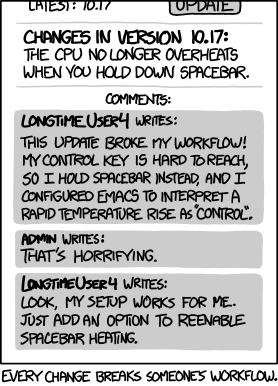
|
||||
](https://xkcd.com/1172/)
|
||||
</details>
|
||||
|
||||
|
||||
⚠
|
||||
Verify first that your idea is not [already requested on
|
||||
GitHub][issue search].
|
||||
|
||||
Also test if the devel branch does not already implement this.
|
||||
|
||||
|
||||
**Tip:** If you are seeking community support, please consider
|
||||
[starting a mailing list thread or chatting in IRC][ML||IRC].
|
||||
|
||||
|
||||
|
||||
[contribute to collections]:
|
||||
https://docs.ansible.com/ansible-core/devel/community/contributing_maintained_collections.html?utm_medium=github&utm_source=issue_form--feature_request.yml
|
||||
|
||||
[IRC meetings]:
|
||||
https://docs.ansible.com/ansible-core/devel/community/communication.html?utm_medium=github&utm_source=issue_form--feature_request.yml#irc-meetings
|
||||
|
||||
[issue search]: ../search?q=is%3Aissue&type=issues
|
||||
|
||||
[ML||IRC]:
|
||||
https://docs.ansible.com/ansible-core/devel/community/communication.html?utm_medium=github&utm_source=issue_form--feature_request.yml#mailing-list-information
|
||||
|
||||
[new proposal]: ../../proposals/issues/new
|
||||
|
||||
|
||||
- type: textarea
|
||||
attributes:
|
||||
label: Summary
|
||||
description: >
|
||||
Describe the new feature/improvement you would like briefly below.
|
||||
|
||||
|
||||
What's the problem this feature will solve?
|
||||
|
||||
What are you trying to do, that you are unable to achieve
|
||||
with ansible-core as it currently stands?
|
||||
|
||||
|
||||
* Provide examples of real-world use cases that this would enable
|
||||
and how it solves the problem you described.
|
||||
|
||||
* How do you solve this now?
|
||||
|
||||
* Have you tried to work around the problem using other tools?
|
||||
|
||||
* Could there be a different approach to solving this issue?
|
||||
|
||||
|
||||
*Know **exactly** what you want?* Consider filing a [new proposal]
|
||||
instead outlining your research and implementation considerations.
|
||||
|
||||
|
||||
[new proposal]: ../../proposals/issues/new
|
||||
placeholder: >-
|
||||
I am trying to do X with ansible-core from the devel branch on GitHub and
|
||||
I think that implementing a feature Y would be very helpful for me and
|
||||
every other user of ansible-core because of Z.
|
||||
validations:
|
||||
required: true
|
||||
|
||||
- type: dropdown
|
||||
attributes:
|
||||
label: Issue Type
|
||||
description: >
|
||||
Please select the single available option in the drop-down.
|
||||
|
||||
<details>
|
||||
<summary>
|
||||
<em>Why?</em>
|
||||
</summary>
|
||||
|
||||
We would do it by ourselves but unfortunatelly, the curent
|
||||
edition of GitHub Issue Forms Alpha does not support this yet 🤷
|
||||
|
||||
|
||||
_We will make it easier in the future, once GitHub
|
||||
supports dropdown defaults. Promise!_
|
||||
|
||||
</details>
|
||||
# FIXME: Once GitHub allows defining the default choice, update this
|
||||
options:
|
||||
- Feature Idea
|
||||
validations:
|
||||
required: true
|
||||
|
||||
- type: input
|
||||
attributes:
|
||||
label: Component Name
|
||||
description: >
|
||||
Write the short name of the module, plugin, task or feature below,
|
||||
*use your best guess if unsure*.
|
||||
|
||||
|
||||
Be aware that a lot of content that used to reside in this repository
|
||||
previously, is now hosted under [individual collection
|
||||
projects][collections org].
|
||||
If this is the case, please make sure to file an issue under the
|
||||
appropriate project there instead.
|
||||
|
||||
|
||||
[collections org]: /ansible-collections
|
||||
placeholder: dnf, apt, yum, pip, user etc.
|
||||
validations:
|
||||
required: true
|
||||
|
||||
- type: textarea
|
||||
attributes:
|
||||
label: Additional Information
|
||||
description: |
|
||||
Describe how the feature would be used, why it is needed and what it would solve.
|
||||
|
||||
**HINT:** You can paste https://gist.github.com links for larger files.
|
||||
value: |
|
||||
<!--- Paste example playbooks or commands between quotes below -->
|
||||
```yaml (paste below)
|
||||
|
||||
```
|
||||
placeholder: >-
|
||||
I asked on https://stackoverflow.com/.... and the community
|
||||
advised me to do X, Y and Z.
|
||||
validations:
|
||||
required: true
|
||||
|
||||
|
||||
- type: markdown
|
||||
attributes:
|
||||
value: >
|
||||
*One last thing...*
|
||||
|
||||
|
||||
*Please, complete **all** sections as described, this form
|
||||
is [processed automatically by a robot][ansibot help].*
|
||||
|
||||
|
||||
Thank you for your collaboration!
|
||||
|
||||
|
||||
[ansibot help]:
|
||||
/ansible/ansibullbot/blob/master/ISSUE_HELP.md#for-issue-submitters
|
||||
|
||||
|
||||
- type: checkboxes
|
||||
attributes:
|
||||
label: Code of Conduct
|
||||
description: |
|
||||
Read the [Ansible Code of Conduct][CoC] first.
|
||||
|
||||
[CoC]: https://docs.ansible.com/ansible/latest/community/code_of_conduct.html?utm_medium=github&utm_source=issue_form--feature_request.yml
|
||||
options:
|
||||
- label: I agree to follow the Ansible Code of Conduct
|
||||
required: true
|
||||
...
|
||||
23
.github/PULL_REQUEST_TEMPLATE.md
vendored
23
.github/PULL_REQUEST_TEMPLATE.md
vendored
@ -1,23 +0,0 @@
|
||||
##### SUMMARY
|
||||
<!--- Describe the change below, including rationale and design decisions -->
|
||||
|
||||
<!--- HINT: Include "Fixes #nnn" if you are fixing an existing issue -->
|
||||
|
||||
##### ISSUE TYPE
|
||||
<!--- Pick one below and delete the rest -->
|
||||
- Bugfix Pull Request
|
||||
- Docs Pull Request
|
||||
- Feature Pull Request
|
||||
- Test Pull Request
|
||||
|
||||
##### COMPONENT NAME
|
||||
<!--- Write the short name of the module, plugin, task or feature below -->
|
||||
|
||||
##### ADDITIONAL INFORMATION
|
||||
<!--- Include additional information to help people understand the change here -->
|
||||
<!--- A step-by-step reproduction of the problem is helpful if there is no related issue -->
|
||||
|
||||
<!--- Paste verbatim command output below, e.g. before and after your change -->
|
||||
```paste below
|
||||
|
||||
```
|
||||
16
.github/RELEASE_NAMES.yml
vendored
16
.github/RELEASE_NAMES.yml
vendored
@ -1,16 +0,0 @@
|
||||
---
|
||||
- 2.14.0 C'mon Everybody
|
||||
- 2.13.0 Nobody's Fault but Mine
|
||||
- 2.12.0 Dazed and Confused
|
||||
- 2.11.0 Hey Hey, What Can I Do
|
||||
- 2.10.0 When the Levee Breaks
|
||||
- 2.9.0 Immigrant Song
|
||||
- 2.8.0 How Many More Times
|
||||
- 2.7.0 In the Light
|
||||
- 2.6.0 Heartbreaker
|
||||
- 2.5.0 Kashmir
|
||||
- 2.4.0 Dancing Days
|
||||
- 2.3.0 Ramble On
|
||||
- 2.2.0 The Battle of Evermore
|
||||
- 2.1.0 The Song Remains the Same
|
||||
- 2.0.0 Over the Hills and Far Away
|
||||
15
.github/SECURITY.md
vendored
15
.github/SECURITY.md
vendored
@ -1,15 +0,0 @@
|
||||
# Security Policy
|
||||
|
||||
## Supported Versions
|
||||
|
||||
Ansible applies security fixes according to the 3-versions-back support
|
||||
policy. Please find more information in [our docs](
|
||||
https://docs.ansible.com/ansible/devel/reference_appendices/release_and_maintenance.html#release-status
|
||||
).
|
||||
|
||||
## Reporting a Vulnerability
|
||||
|
||||
We encourage responsible disclosure practices for security
|
||||
vulnerabilities. Please read our [policies for reporting bugs](
|
||||
https://docs.ansible.com/ansible/devel/community/reporting_bugs_and_features.html#reporting-a-bug
|
||||
) if you want to report a security issue that might affect Ansible.
|
||||
103
.gitignore
vendored
103
.gitignore
vendored
@ -2,10 +2,9 @@
|
||||
*.py[co]
|
||||
build
|
||||
AUTHORS.TXT
|
||||
# Emacs backup and autosave files...
|
||||
# Emacs backup files...
|
||||
*~
|
||||
.\#*
|
||||
\#*
|
||||
# RPM stuff...
|
||||
MANIFEST
|
||||
dist
|
||||
@ -17,110 +16,38 @@ rpm-build
|
||||
.idea
|
||||
#IntelliJ IDEA stuff..
|
||||
*.iml
|
||||
#VSCode stuff..
|
||||
.vscode/
|
||||
# Mac OS X stuff...
|
||||
.DS_Store
|
||||
# manpage build stuff...
|
||||
docs/man/man1/ansible*.1
|
||||
docs/man/man1/ansible*.1.asciidoc.in
|
||||
docs/man/man3/*
|
||||
# Sublime stuff
|
||||
*.sublime-project
|
||||
*.sublime-workspace
|
||||
# docsite stuff...
|
||||
docs/docsite/_build
|
||||
docs/docsite/*.html
|
||||
docs/docsite/htmlout
|
||||
docs/docsite/rst/conf.py
|
||||
docs/docsite/rst/index.rst
|
||||
docs/docsite/rst/cli/ansible-*.rst
|
||||
docs/docsite/rst/cli/ansible.rst
|
||||
docs/docsite/rst/dev_guide/collections_galaxy_meta.rst
|
||||
docs/docsite/rst/dev_guide/testing/sanity/index.rst.new
|
||||
docs/docsite/rst/dev_guide/index.rst
|
||||
docs/docsite/rst/modules/*.rst
|
||||
docs/docsite/rst/collections/*.rst
|
||||
!docs/docsite/rst/collections/all_plugins.rst
|
||||
docs/docsite/rst/collections/*/*.rst
|
||||
docs/docsite/rst/playbooks_directives.rst
|
||||
docs/docsite/rst/plugins_by_category.rst
|
||||
docs/docsite/rst/plugins/*/*.rst
|
||||
docs/docsite/rst/reference_appendices/config.rst
|
||||
docs/docsite/rst/reference_appendices/playbooks_keywords.rst
|
||||
docs/docsite/rst_warnings
|
||||
docs/docsite/searchindex.js
|
||||
docs/docsite/_static/*.gif
|
||||
docs/docsite/_static/*.png
|
||||
docs/docsite/_static/websupport.js
|
||||
docsite/rst/modules_by_category.rst
|
||||
docsite/rst/list_of_*.rst
|
||||
docsite/rst/*_module.rst
|
||||
docsite/*.html
|
||||
docsite/_static/*.gif
|
||||
docsite/_static/*.png
|
||||
docsite/_static/websupport.js
|
||||
docsite/searchindex.js
|
||||
docsite/htmlout
|
||||
# deb building stuff...
|
||||
debian/
|
||||
deb-build
|
||||
# Vim swap files
|
||||
*.swp
|
||||
*.swo
|
||||
[._]*.un~
|
||||
credentials.yml
|
||||
# test output
|
||||
*.retry
|
||||
*.out
|
||||
.pytest_cache/
|
||||
.tox
|
||||
.cache
|
||||
.pytest_cache
|
||||
.coverage
|
||||
results.xml
|
||||
coverage.xml
|
||||
/test/units/cover-html
|
||||
/test/integration/inventory
|
||||
/test/integration/targets/*/backup/
|
||||
/test/cache/*
|
||||
# Development
|
||||
/test/develop
|
||||
# Environments
|
||||
.env
|
||||
.venv
|
||||
env/
|
||||
venv/
|
||||
ENV/
|
||||
env.bak/
|
||||
venv.bak/
|
||||
venv
|
||||
env
|
||||
Vagrantfile
|
||||
.vagrant
|
||||
# Backwards compatibility with `stable-2.9` and earlier branches.
|
||||
# Also used in the `devel` branch during early Ansible 2.10 development.
|
||||
/lib/ansible.egg-info/
|
||||
# First used in the `devel` branch during Ansible 2.10 development.
|
||||
/lib/ansible_base.egg-info/
|
||||
# First used in the `devel` branch during Ansible 2.11 development.
|
||||
/lib/ansible_core.egg-info/
|
||||
# vendored lib dir
|
||||
lib/ansible/_vendor/*
|
||||
!lib/ansible/_vendor/__init__.py
|
||||
# test stuff
|
||||
/test/integration/cloud-config-*.*
|
||||
!/test/integration/cloud-config-*.*.template
|
||||
.python-version
|
||||
/hacking/tests/selinux/*.mod
|
||||
/hacking/tests/selinux/*.pp
|
||||
# Release directory
|
||||
packaging/release/ansible_release
|
||||
/.cache/
|
||||
/test/results/
|
||||
/test/integration/cloud-config-aws.yml
|
||||
/test/integration/inventory.networking
|
||||
/test/integration/inventory.winrm
|
||||
/test/integration/cloud-config-aws.yml
|
||||
/test/integration/cloud-config-cs.ini
|
||||
# python 'rope' stuff
|
||||
.ropeproject
|
||||
# local 'ack' config files
|
||||
.ackrc
|
||||
# default 'coverage html' results
|
||||
htmlcov/
|
||||
# default 'coverage' tool data
|
||||
.coverage
|
||||
# ansible-test coverage results
|
||||
test/units/.coverage.*
|
||||
/test/integration/cloud-config-azure.yml
|
||||
/SYMLINK_CACHE.json
|
||||
changelogs/.plugin-cache.yaml
|
||||
.ansible-test-timeout.json
|
||||
ansible.egg-info/
|
||||
|
||||
36
.mailmap
36
.mailmap
@ -1,36 +0,0 @@
|
||||
Michael DeHaan <michael.dehaan@gmail.com> <michael@ansibleworks.com>
|
||||
Michael DeHaan <michael.dehaan@gmail.com> Michael DeHaan <michael@ansibleworks.com>
|
||||
Michael DeHaan <michael.dehaan@gmail.com> <michael@ansible.com>
|
||||
<bcoca@ansible.com> <brian.coca+git@gmail.com>
|
||||
<bcoca@ansible.com> <briancoca+ansible@gmail.com>
|
||||
<bcoca@ansible.com> <briancoca+dev@gmail.com>
|
||||
<bcoca@ansible.com> <bcoca@tablethotels.com>
|
||||
<a.badger@gmail.com> <toshio@fedoraproject.org>
|
||||
James Tanner <tanner.jc@gmail.com>
|
||||
<jimi@sngx.net> <jcammarata@ansibleworks.com>
|
||||
Michael Scherer <misc@zarb.org> mscherer <misc@zarb.org>
|
||||
<misc@zarb.org> <misc@ephaone.org>
|
||||
<misc@zarb.org> <mscherer@users.noreply.github.com>
|
||||
James Martin <jmartin@ansible.com> <jmartin@basho.com>
|
||||
James Laska <jlaska@ansible.com> <jlaska@redhat.com>
|
||||
James Laska <jlaska@ansible.com> <jlaska@ansibleworks.com>
|
||||
James Laska <jlaska@ansible.com> <jlaska@James-Laskas-MacBook-Pro.local>
|
||||
James Laska <jlaska@ansible.com> <jlaska@users.noreply.github.com>
|
||||
Jason McKerr <mckerrj@gmail.com> <jmckerr@jmckerr-OSX.local>
|
||||
Chris Houseknecht <chouseknecht@ansible.com>
|
||||
Chris Houseknecht <chouseknecht@ansible.com> chouseknecht <chouse@ansible.com>
|
||||
Chris Houseknecht <chouseknecht@ansible.com> Chris Houseknecht <chouse@ansibleworks.com>
|
||||
Stephen Fromm <sfromm@gmail.com> Stephen Fromm <stephenf@nero.net>
|
||||
Sandra Wills <docschick@ansible.com> Sandra Wills <swills@ansible.com>
|
||||
Will Thames <will@thames.id.au> willthames <will@thames.id.au>
|
||||
Will Thames <will@thames.id.au> Will Thames <willdthames@gmail.com>
|
||||
Will Thames <will@thames.id.au> willthames <willdthames@gmail.com>
|
||||
Will Thames <will@thames.id.au> willthames <will@musc.org.uk>
|
||||
Will Thames <will@thames.id.au> u348095 <will.thames@suncorp.com.au>
|
||||
Will Thames <will@thames.id.au> willthames <will.thames@suncorp.com.au>
|
||||
Will Thames <will@thames.id.au> Will Thames <will.thames@xvt.com.au>
|
||||
nitzmahone <mdavis@ansible.com> Matt Davis <nitzmahone@users.noreply.github.com>
|
||||
Dag Wieers <dag@wieers.com> Dag Wieërs <dag@wieers.com>
|
||||
Dag Wieers <dag@wieers.com> Dag Wieers <dag.wieers@gmail.com>
|
||||
Rene Moser <mail@renemoser.net> René Moser <mail@renemoser.net>
|
||||
Rene Moser <mail@renemoser.net> Rene Moser <rene.moser@swisstxt.ch>
|
||||
1310
CHANGELOG.md
Normal file
1310
CHANGELOG.md
Normal file
File diff suppressed because it is too large
Load Diff
319
CODING_GUIDELINES.md
Normal file
319
CODING_GUIDELINES.md
Normal file
@ -0,0 +1,319 @@
|
||||
Coding Guidelines
|
||||
=================
|
||||
|
||||
Hi! Thanks for interest in contributing to Ansible.
|
||||
|
||||
Here are some guidelines for contributing code. The purpose of this document are to establish what we're looking for in code contributions, and to make sure
|
||||
new contributions know some of the conventions that we've been using.
|
||||
|
||||
We don't think much of this should be too strange to readers familiar with contributing to Python projects, though it helps if we all get on the same page.
|
||||
|
||||
Language
|
||||
========
|
||||
|
||||
* While not all components of Ansible must be in Python, core contributions to the Ansible repo must be written in Python. This is to maximize the ability of everyone to contribute.
|
||||
* If you want to write non-Python ansible modules or inventory scripts, that's fine, but they are not going to get merged in most likely. Sorry!!
|
||||
|
||||
PEP8 and basic style checks
|
||||
===========================
|
||||
|
||||
* PEP8 is a great Python style guide, which you should read.
|
||||
* PEP8 must not be strictly followed in all aspects, but most of it is good advice
|
||||
* In particular, we don't really care about line lengths. Buy a bigger monitor!
|
||||
* To run checks for things we care about, run "make pep8"
|
||||
* Similarly, additional checks can be made with "make pyflakes"
|
||||
* There is no need to submit code changes for pep8 and pyflake fixes, as these break attribution history. Project leadership will make these periodically.
|
||||
* Do not submit pull requests that simply adjust whitespace in the code
|
||||
|
||||
Testing
|
||||
=======
|
||||
|
||||
* Much of ansible's testing needs are in integration, not unit tests. Add module tests there.
|
||||
* That being said, there are unit tests too!
|
||||
* Code written must absolutely pass tests (i.e. "make tests")
|
||||
* You should anticipate any error paths in your code and test down those error paths.
|
||||
* Additions to tests for core code is welcome, but not always possible. Be sure things are at least well tested manually in that case.
|
||||
|
||||
Whitespace
|
||||
==========
|
||||
|
||||
* Four space indent is strictly required
|
||||
* Include meaningful whitespace between lines of code
|
||||
|
||||
Shebang Lines
|
||||
=============
|
||||
|
||||
* /usr/bin/scripts should start with '/usr/bin/env python'
|
||||
* module code should still use '/usr/bin/python' as this is replaced automatically by 'ansible_python_interpreter', see the FAQ in the docs for more info.
|
||||
|
||||
Comments
|
||||
========
|
||||
|
||||
* Readability is one of the most important goals for this project
|
||||
* Comment any non-trivial code where someone might not know why you are doing something in a particular way
|
||||
* Though if something should be commented, that's often a sign someone should write a function
|
||||
* All new functions must have a basic docstring comment
|
||||
* Commenting above a line is preferable to commenting at the end of a line
|
||||
|
||||
Classes
|
||||
=======
|
||||
|
||||
* With the exception of module code (where inline is better), it is desirable to see classes in their own files.
|
||||
* Classes should generally not cause side effects as soon as they are instantiated, move meaningful behavior to methods rather than constructors.
|
||||
|
||||
Functions and Methods
|
||||
=====================
|
||||
|
||||
* In general, functions should not be 'too long' and should describe a meaningful amount of work
|
||||
* When code gets too nested, that's usually the sign the loop body could benefit from being a function
|
||||
* Parts of our existing code are not the best examples of this at times.
|
||||
* Functions should have names that describe what they do, along with docstrings
|
||||
* Functions should be named with_underscores
|
||||
* "Don't repeat yourself" is generally a good philosophy
|
||||
|
||||
Variables
|
||||
=========
|
||||
|
||||
* Use descriptive variable names instead of variables like 'x', unless x is a obvious loop index
|
||||
* Ansible python code uses identifiers like 'ClassesLikeThis and variables_like_this
|
||||
* Module parameters should also use_underscores and not runtogether
|
||||
|
||||
Module Security
|
||||
===============
|
||||
|
||||
* Modules must take steps to avoid passing user input from the shell and always check return codes
|
||||
* always use module.run_command instead of subprocess or Popen or os.system -- this is mandatory
|
||||
* if you use need the shell you must pass use_unsafe_shell=True to module.run_command
|
||||
* if you do not need the shell, avoid using the shell
|
||||
* any variables that can come from the user input with use_unsafe_shell=True must be wrapped by pipes.quote(x)
|
||||
* downloads of https:// resource urls must import module_utils.urls and use the fetch_url method
|
||||
|
||||
Misc Preferences
|
||||
================
|
||||
|
||||
Use the dict constructor where possible when allocating dictionaries:
|
||||
|
||||
# not this:
|
||||
foo = {
|
||||
'a' : 12,
|
||||
'b' : 34
|
||||
}
|
||||
|
||||
# this:
|
||||
foo = dict(
|
||||
a = 12,
|
||||
b = 34
|
||||
)
|
||||
|
||||
Line up variables
|
||||
|
||||
# not this
|
||||
a = 12
|
||||
foosball = 34
|
||||
xyz = 'dog'
|
||||
|
||||
# this
|
||||
a = 12
|
||||
foosball = 34
|
||||
xyz = 'dog'
|
||||
|
||||
Don't use line continuations:
|
||||
|
||||
# no
|
||||
if (this_is_a_very_long_line and foo and /
|
||||
i_am_going_to_continue_it):
|
||||
bar()
|
||||
|
||||
# better:
|
||||
if (this_is_a_very_long_line and foo and i_am_going_to_continue_it):
|
||||
bar()
|
||||
|
||||
Spacing:
|
||||
|
||||
# no
|
||||
x=[1,2,3]
|
||||
|
||||
# no
|
||||
x = [1,2,3]
|
||||
|
||||
# yes
|
||||
x = [ 1, 2, 3 ]
|
||||
|
||||
Spacing continued:
|
||||
|
||||
# no
|
||||
x=foo(12)
|
||||
|
||||
# no
|
||||
x = foo( 12 )
|
||||
|
||||
# yes
|
||||
x = foo(12)
|
||||
|
||||
Licenses
|
||||
========
|
||||
|
||||
Every file should have a license header, including the copyright of the original author. Major additions to the module are allowed
|
||||
to add an additional copyright line, and this is especially true of rewrites, but original authorship copyright messages should be preserved.
|
||||
|
||||
All contributions to the core repo should preserve original licenses and new contributions must include the GPLv3 header.
|
||||
|
||||
Module Documentation
|
||||
====================
|
||||
|
||||
All module pull requests must include a DOCUMENTATION docstring (YAML format,
|
||||
see other modules for examples) as well as an EXAMPLES docstring, which is free form.
|
||||
|
||||
When adding new modules, any new parameter must have a "version_added" attribute.
|
||||
When submitting a new module, the module should have a "version_added" attribute in the
|
||||
pull request as well, set to the current development version.
|
||||
|
||||
Be sure to check grammar and spelling.
|
||||
|
||||
It's frequently the case that modules get submitted with YAML that isn't valid,
|
||||
so you can run "make webdocs" from the checkout to preview your module's documentation.
|
||||
If it fails to build, take a look at your DOCUMENTATION string
|
||||
or you might have a Python syntax error in there too.
|
||||
|
||||
Python Imports
|
||||
==============
|
||||
|
||||
To make it clear what a module is importing, imports should not be sprinkled throughout the code.
|
||||
|
||||
Python Imports should happen at the top of the file, exempting code from module_utils.
|
||||
|
||||
When a conditional runtime import is required, do so something like this instead:
|
||||
|
||||
HAS_FOO = False
|
||||
try:
|
||||
import foo
|
||||
HAS_FOO = True
|
||||
except ImportError:
|
||||
pass
|
||||
|
||||
...
|
||||
|
||||
if not HAS_FOO:
|
||||
raise Exception("the foo library is required")
|
||||
|
||||
This makes it clear what optional dependencies are but allows this to be deferred until runtime. In the case of module code, the raising of the Exception will be replaced
|
||||
with a "module.exit_json" call.
|
||||
|
||||
Exceptions
|
||||
==========
|
||||
|
||||
In the main body of the code, use typed exceptions where possible:
|
||||
|
||||
# not this
|
||||
raise Exception("panic!")
|
||||
|
||||
# this
|
||||
from ansible import errors
|
||||
...
|
||||
raise errors.AnsibleError("panic!")
|
||||
|
||||
Similarly, exception checking should be fine grained:
|
||||
|
||||
# not this
|
||||
try:
|
||||
foo()
|
||||
except:
|
||||
bar()
|
||||
|
||||
# but this
|
||||
try:
|
||||
foo()
|
||||
except SomeTypedException:
|
||||
bar()
|
||||
|
||||
List Comprehensions
|
||||
===================
|
||||
|
||||
In general list comprehensions are always preferred to map() and filter() calls.
|
||||
|
||||
However, they can be abused. Optimize for readability, and avoid nesting them too deeply.
|
||||
|
||||
Regexes
|
||||
=======
|
||||
|
||||
There is a time and place for them, but here's an illustrative joke.
|
||||
|
||||
"A developer had a problem, and used a regular expression to solve it. Now the developer had two problems".
|
||||
|
||||
Often regexes are difficult to maintain, and a trusty call to other string operations can be a great solution, faster,
|
||||
and more readable.
|
||||
|
||||
File Conventions
|
||||
================
|
||||
|
||||
If a piece of code looks for a named YAML file in a directory, it should assume it can take no extension, or an extension of '.yml' or '.yaml'.
|
||||
This should be true against all code that loads files.
|
||||
|
||||
Any code that uses directories should consider the possibility that the directory may be symlink.
|
||||
|
||||
New Ansible language parameters
|
||||
===============================
|
||||
|
||||
If adding a new parameter, like 'can_fizzbuzz: True/False' be sure the value of the parameter is templated somewhere in the Runner code, as if anything can be parameterized in Ansible,
|
||||
there is a user that will try to parameterize it.
|
||||
|
||||
String Find
|
||||
===========
|
||||
|
||||
Use 'in':
|
||||
|
||||
# not this:
|
||||
if x.find('foo') != -1:
|
||||
|
||||
# this:
|
||||
if 'foo' in x:
|
||||
|
||||
String checks
|
||||
=============
|
||||
|
||||
To test if something is a string, consider that it may be unicode.
|
||||
|
||||
# no
|
||||
if type(x) == str:
|
||||
|
||||
# yes
|
||||
if isinstance(x, basestring):
|
||||
|
||||
Cleverness
|
||||
==========
|
||||
|
||||
Ansible's code is intended to be read by as many people as possible, so we don't particularly encourage clever or heavily idiomatic code.
|
||||
|
||||
In particular, metaclasses are probably not appropriate, however entertaining they may be to add.
|
||||
|
||||
Git Practices
|
||||
=============
|
||||
|
||||
Pull requests cannot be accepted that contain merge commits.
|
||||
|
||||
Always do "git pull --rebase" and "git rebase" vs "git pull" or "git merge".
|
||||
|
||||
Always create a new branch for each pull request to avoid intertwingling different features or fixes on the same branch.
|
||||
|
||||
|
||||
Python Version Compliance
|
||||
=========================
|
||||
|
||||
All code in Ansible core must support a minimum version of Python 2.6.
|
||||
|
||||
Module code must support a minimum of Python 2.4, with occasional exception for modules that require code that themselves require 2.6 and later.
|
||||
|
||||
A quick reminder is that list comprehensions in Python 2.4 are not as fully fleshed out, there are no 'dict' comprehensions, and there is no 'with' statement.
|
||||
But otherwise it's pretty much all the same.
|
||||
|
||||
The End
|
||||
=======
|
||||
|
||||
This was not meant to be a scary document, so we hope it wasn't, but we also hope this helps you write code that is easier to maintain by others in the future.
|
||||
If you have questions about this document, please ask on the ansible-devel mailing list.
|
||||
|
||||
Thank you!
|
||||
|
||||
|
||||
|
||||
|
||||
224
CONTRIBUTING.md
Normal file
224
CONTRIBUTING.md
Normal file
@ -0,0 +1,224 @@
|
||||
Ansible Community Information
|
||||
==============================
|
||||
|
||||
The purpose of the Ansible community is to unite developers, system administrators, operations, and
|
||||
IT managers to share and build great automation solutions. This document contains all sorts of
|
||||
information about how to contribute and interact with Ansible. Welcome!
|
||||
|
||||
Ways to Interact
|
||||
================
|
||||
|
||||
There are a lot of ways to join and be a part of the Ansible community, such as:
|
||||
|
||||
Sharing Ansible with Others
|
||||
---------------------------
|
||||
|
||||
You can help share Ansible with others by telling friends and colleagues, writing a blog post,
|
||||
or presenting at user groups (like DevOps groups or the local LUG or BUG). You are also
|
||||
welcome to share slides on speakerdeck, sign up for a free account and tag it “Ansible”. On Twitter,
|
||||
you can also share things with #ansible and may wish
|
||||
to follow [@Ansible](https://twitter.com/ansible).
|
||||
|
||||
Sharing Content and Tips
|
||||
------------------------
|
||||
|
||||
Join the [Ansible project mailing list](https://groups.google.com/forum/#!forum/ansible-project) and you
|
||||
can share playbooks you may have written and other interesting implementation stories. Put your Ansible
|
||||
content up on places like github to share with others.
|
||||
|
||||
Sharing A Feature Idea
|
||||
----------------------
|
||||
|
||||
Ideas are very welcome and the best place to share them is the [Ansible project mailing list](https://groups.google.com/forum/#!forum/ansible-project) ([Subscribe](https://groups.google.com/forum/#!forum/ansible-project/join)) or #ansible on irc.freenode.net.
|
||||
|
||||
While you can file a feature request on GitHub, pull requests are a much better way to get your feature added than submitting a feature request. Open source is all about itch scratching, and it's less likely that someone else will have the same itches as yourself. We keep code reasonably simple on purpose so it's easy to dive in and make additions, but be sure to read the "Contributing Code" section below too -- as it doesn't hurt to have a discussion about a feature first -- we're inclined to have preferences about how incoming features might be implemented, and that can save confusion later.
|
||||
|
||||
Helping with Documentation
|
||||
--------------------------
|
||||
|
||||
Ansible documentation is a community project too! If you would like to help with the
|
||||
documentation, whether correcting a typo or improving a section, or maybe even
|
||||
documenting a new feature, submit a github pull request to the code that
|
||||
lives in the “docsite/rst” subdirectory of the project. Docs are in restructured text
|
||||
format. If you aren’t comfortable with restructured text, you can also open a ticket on
|
||||
github about any errors you spot or sections you would like to see added. For more information
|
||||
on creating pull requests, please refer to the
|
||||
[github help guide](https://help.github.com/articles/using-pull-requests).
|
||||
|
||||
|
||||
Contributing Code (Features or Bugfixes)
|
||||
----------------------------------------
|
||||
|
||||
The Ansible project keeps it’s source on github at
|
||||
[github.com/ansible/ansible](http://github.com/ansible/ansible)
|
||||
and takes contributions through
|
||||
[github pull requests](https://help.github.com/articles/using-pull-requests).
|
||||
|
||||
It is usually a good idea to join the ansible-devel list to discuss any large features prior to submission, and this especially helps in avoiding duplicate work or efforts where we decide, upon seeing a pull request for the first time, that revisions are needed. (This is not usually needed for module development)
|
||||
|
||||
Note that we do keep Ansible to a particular aesthetic, so if you are unclear about whether a feature
|
||||
is a good fit or not, having the discussion on the development list is often a lot easier than having
|
||||
to modify a pull request later.
|
||||
|
||||
When submitting patches, be sure to run the unit tests first “make tests” and always use
|
||||
“git rebase” vs “git merge” (aliasing git pull to git pull --rebase is a great idea) to
|
||||
avoid merge commits in your submissions. There are also integration tests that can be run in the "tests/integration" directory.
|
||||
|
||||
In order to keep the history clean and better audit incoming code, we will require resubmission of pull requests that contain merge commits. Use "git pull --rebase" vs "git pull" and "git rebase" vs "git merge". Also be sure to use topic branches to keep your additions on different branches, such that they won't pick up stray commits later.
|
||||
|
||||
We’ll then review your contributions and engage with you about questions and so on.
|
||||
|
||||
As we have a very large and active community, so it may take awhile to get your contributions
|
||||
in! See the notes about priorities in a later section for understanding our work queue.
|
||||
|
||||
Patches should be made against the 'devel' branch.
|
||||
|
||||
Contributions can be for new features like modules, or to fix bugs you or others have found. If you
|
||||
are interested in writing new modules to be included in the core Ansible distribution, please refer
|
||||
to the [Module Developers documentation on our website](http://docs.ansible.com/developing_modules.html).
|
||||
|
||||
Ansible's aesthetic encourages simple, readable code and consistent, conservatively extending,
|
||||
backwards-compatible improvements. Code developed for Ansible needs to support Python 2.6+,
|
||||
while code in modules must run under Python 2.4 or higher. Please also use a 4-space indent
|
||||
and no tabs.
|
||||
|
||||
Tip: To easily run from a checkout, source "./hacking/env-setup" and that's it -- no install
|
||||
required. You're now live!
|
||||
|
||||
|
||||
Reporting A Bug
|
||||
---------------
|
||||
|
||||
Ansible practices responsible disclosure - if this is a security related bug, email security@ansible.com instead of filing a ticket or posting to the Google Group and you will recieve a prompt response.
|
||||
|
||||
Bugs should be reported to [github.com/ansible/ansible](http://github.com/ansible/ansible) after
|
||||
signing up for a free github account. Before reporting a bug, please use the bug/issue search
|
||||
to see if the issue has already been reported.
|
||||
|
||||
When filing a bug, please use the [issue template](https://raw2.github.com/ansible/ansible/devel/examples/issues/ISSUE_TEMPLATE.md) to provide all relevant information.
|
||||
|
||||
Do not use the issue tracker for "how do I do this" type questions. These are great candidates
|
||||
for IRC or the mailing list instead where things are likely to be more of a discussion.
|
||||
|
||||
To be respectful of reviewers time and allow us to help everyone efficiently, please
|
||||
provide minimal well-reduced and well-commented examples versus sharing your entire production
|
||||
playbook. Include playbook snippets and output where possible.
|
||||
|
||||
Content in the GitHub bug tracker can be indented four spaces to preserve formatting.
|
||||
For multiple-file content, we encourage use of gist.github.com. Online pastebin content can expire.
|
||||
|
||||
If you are not sure if something is a bug yet, you are welcome to ask about something on
|
||||
the mailing list or IRC first. As we are a very high volume project, if you determine that
|
||||
you do have a bug, please be sure to open the issue yourself to ensure we have a record of
|
||||
it. Don’t rely on someone else in the community to file the bug report for you.
|
||||
|
||||
It may take some time to get to your report, see "A Note About Priorities" below.
|
||||
|
||||
A Note About Priorities
|
||||
=======================
|
||||
|
||||
Ansible was one of the top 5 projects with the most OSS contributors on GitHub in 2013, and well over
|
||||
600 people have added code to the project. As a result, we have a LOT of incoming activity to process.
|
||||
|
||||
In the interest of transparency, we're telling you how we do this.
|
||||
|
||||
In our bug tracker you'll notice some labels - P1, P2, P3, P4, and P5. These are our internal
|
||||
priority orders that we use to sort tickets.
|
||||
|
||||
With some exceptions for easy merges (like documentation typos for instance),
|
||||
we're going to spend most of our time working on P1 and P2 items first, including pull requests.
|
||||
These usually relate to important
|
||||
bugs or features affecting large segments of the userbase. So if you see something categorized
|
||||
"P3 or P4", and it's not appearing to get a lot of immediate attention, this is why.
|
||||
|
||||
These labels don't really have definition - they are a simple ordering. However something
|
||||
affecting a major module (yum, apt, etc) is likely to be prioritized higher than a module
|
||||
affecting a smaller number of users.
|
||||
|
||||
Since we place a strong emphasis on testing and code review, it may take a few months for a minor feature to get merged.
|
||||
|
||||
Don't worry though -- we'll also take periodic sweeps through the lower priority queues and give
|
||||
them some attention as well, particularly in the area of new module changes. So it doesn't neccessarily
|
||||
mean that we'll be exhausting all of the higher-priority queues before getting to your ticket.
|
||||
|
||||
Release Numbering
|
||||
=================
|
||||
|
||||
Releases ending in ".0" are major releases and this is where all new features land. Releases ending
|
||||
in another integer, like "0.X.1" and "0.X.2" are dot releases, and these are only going to contain
|
||||
bugfixes. Typically we don't do dot releases for minor releases, but may occasionally decide to cut
|
||||
dot releases containing a large number of smaller fixes if it's still a fairly long time before
|
||||
the next release comes out.
|
||||
|
||||
Online Resources
|
||||
================
|
||||
|
||||
Documentation
|
||||
-------------
|
||||
|
||||
The main ansible documentation can be found at [docs.ansible.com](http://docs.ansible.com).
|
||||
As mentioned above this is an open source project, so we accept contributions to the documentation.
|
||||
You can also find some best practices examples that we recommend reading at
|
||||
[ansible-examples](http://github.com/ansible/ansible-examples).
|
||||
|
||||
Mailing lists
|
||||
-------------
|
||||
|
||||
Ansible has several mailing lists. Your first post to the mailing list will be
|
||||
moderated (to reduce spam), so please allow a day or less for your first post.
|
||||
|
||||
[ansible-announce](https://groups.google.com/forum/#!forum/ansible-announce) is for release
|
||||
announcements and major news. It is a low traffic read-only list and you should only get a few
|
||||
emails a month.
|
||||
|
||||
[ansible-project](https://groups.google.com/forum/#!forum/ansible-project) is the main list, and is
|
||||
used for sharing cool projects you may have built, talking about Ansible ideas, and for users to ask
|
||||
questions or to help other users.
|
||||
|
||||
[ansible-devel](https://groups.google.com/forum/#!forum/ansible-devel) is a technical list for
|
||||
developers working on Ansible and Ansible modules. Join here to discuss how to build modules,
|
||||
prospective feature implementations, or technical challenges.
|
||||
|
||||
To subscribe to a group from a non-google account, you can email the subscription address, for
|
||||
example ansible-devel+subscribe@googlegroups.com.
|
||||
|
||||
IRC
|
||||
---
|
||||
|
||||
Ansible has a general purpose IRC channel available at #ansible on irc.freenode.net.
|
||||
Use this channel for all types of conversations, including sharing tips, coordinating
|
||||
development work, or getting help from other users.
|
||||
|
||||
Miscellaneous Information
|
||||
=========================
|
||||
|
||||
Staff
|
||||
-----
|
||||
|
||||
Ansible, Inc is a company supporting Ansible and building additional solutions based on
|
||||
Ansible. We also do services and support for those that are interested. Our most
|
||||
important task however is enabling all the great things that happen in the Ansible
|
||||
community, including organizing software releases of Ansible. For more information about
|
||||
any of these things, contact info@ansible.com
|
||||
|
||||
On IRC, you can find us as mdehaan, jimi_c, Tybstar, and others. On the mailing list,
|
||||
we post with an @ansible.com address.
|
||||
|
||||
Community Code of Conduct
|
||||
-------------------------
|
||||
|
||||
Ansible’s community welcomes users of all types, backgrounds, and skill levels. Please
|
||||
treat others as you expect to be treated, keep discussions positive, and avoid discrimination, profanity, allegations of Cthulhu worship, or engaging in controversial debates (except vi vs emacs is cool).
|
||||
|
||||
Posts to mailing lists should remain focused around Ansible and IT automation. Abuse of these community guidelines will not be tolerated and may result in banning from community resources.
|
||||
|
||||
Contributors License Agreement
|
||||
------------------------------
|
||||
|
||||
By contributing you agree that these contributions are your own (or approved by your employer)
|
||||
and you grant a full, complete, irrevocable
|
||||
copyright license to all users and developers of the project, present and future, pursuant
|
||||
to the license of the project.
|
||||
|
||||
|
||||
|
||||
56
MANIFEST.in
56
MANIFEST.in
@ -1,54 +1,8 @@
|
||||
include README.rst
|
||||
include COPYING
|
||||
include SYMLINK_CACHE.json
|
||||
include requirements.txt
|
||||
recursive-include docs *
|
||||
include docs/docsite/rst/collections/all_plugins.rst
|
||||
exclude docs/docsite/rst_warnings
|
||||
exclude docs/docsite/rst/conf.py
|
||||
exclude docs/docsite/rst/index.rst
|
||||
exclude docs/docsite/rst/dev_guide/index.rst
|
||||
exclude docs/docsite/rst/dev_guide/testing/sanity/bin-symlinks.rst
|
||||
exclude docs/docsite/rst/dev_guide/testing/sanity/botmeta.rst
|
||||
exclude docs/docsite/rst/dev_guide/testing/sanity/integration-aliases.rst
|
||||
exclude docs/docsite/rst/dev_guide/testing/sanity/release-names.rst
|
||||
recursive-exclude docs/docsite/_build *
|
||||
recursive-exclude docs/docsite/_extensions *.pyc *.pyo
|
||||
include README.md packaging/rpm/ansible.spec COPYING
|
||||
include examples/hosts
|
||||
include examples/ansible.cfg
|
||||
include examples/scripts/ConfigureRemotingForAnsible.ps1
|
||||
include examples/scripts/upgrade_to_ps3.ps1
|
||||
include lib/ansible/keyword_desc.yml
|
||||
recursive-include lib/ansible/executor/powershell *.ps1
|
||||
recursive-include lib/ansible/module_utils/csharp *.cs
|
||||
recursive-include lib/ansible/module_utils/powershell *.psm1
|
||||
recursive-include lib/ansible/modules/windows *.ps1
|
||||
recursive-include lib/ansible/galaxy/data *.yml *.j2 README.md ansible.cfg inventory .git_keep
|
||||
recursive-include lib/ansible/config *.yml
|
||||
recursive-include lib/ansible/modules *.yml
|
||||
recursive-include lib/ansible/plugins/test *.yml
|
||||
recursive-include lib/ansible/plugins/filter *.yml
|
||||
recursive-include licenses *.txt
|
||||
recursive-include packaging Makefile *.py
|
||||
recursive-include test/ansible_test *.py Makefile
|
||||
recursive-include test/integration *
|
||||
recursive-include test/lib/ansible_test/config *.yml *.template
|
||||
recursive-include test/lib/ansible_test/_data *.cfg *.in *.ini *.ps1 *.txt *.yml coveragerc
|
||||
recursive-include test/lib/ansible_test/_util *.cfg *.ini *.json *.ps1 *.psd1 *.py *.sh *.txt *.yml
|
||||
recursive-include test/lib/ansible_test/_util/controller/sanity/validate-modules validate-modules
|
||||
recursive-include test/sanity *.in *.json *.py *.txt
|
||||
recursive-include test/support *.py *.ps1 *.psm1 *.cs *.md
|
||||
exclude test/sanity/code-smell/botmeta.*
|
||||
exclude test/sanity/code-smell/release-names.*
|
||||
exclude test/lib/ansible_test/_internal/commands/sanity/bin_symlinks.py
|
||||
exclude test/lib/ansible_test/_internal/commands/sanity/integration_aliases.py
|
||||
recursive-include test/units *
|
||||
graft examples/playbooks
|
||||
include packaging/distutils/setup.py
|
||||
recursive-include docs *
|
||||
recursive-include library *
|
||||
include Makefile
|
||||
include MANIFEST.in
|
||||
include changelogs/CHANGELOG*.rst
|
||||
include changelogs/changelog.yaml
|
||||
recursive-include hacking/build_library *.py
|
||||
include hacking/build-ansible.py
|
||||
include hacking/test-module.py
|
||||
include hacking/update-sanity-requirements.py
|
||||
include bin/*
|
||||
|
||||
279
Makefile
279
Makefile
@ -1,157 +1,250 @@
|
||||
#!/usr/bin/make
|
||||
# WARN: gmake syntax
|
||||
########################################################
|
||||
# Makefile for Ansible
|
||||
#
|
||||
# useful targets:
|
||||
# make clean ---------------- clean up
|
||||
# make sdist ---------------- produce a tarball
|
||||
# make tests ---------------- run the tests (see https://docs.ansible.com/ansible/devel/dev_guide/testing_units.html for requirements)
|
||||
# make srpm ----------------- produce a SRPM
|
||||
# make rpm ----------------- produce RPMs
|
||||
# make deb-src -------------- produce a DEB source
|
||||
# make deb ------------------ produce a DEB
|
||||
# make docs ----------------- rebuild the manpages (results are checked in)
|
||||
# make tests ---------------- run the tests
|
||||
# make pyflakes, make pep8 -- source code checks
|
||||
|
||||
########################################################
|
||||
# variable section
|
||||
|
||||
NAME = ansible-core
|
||||
NAME = ansible
|
||||
OS = $(shell uname -s)
|
||||
PREFIX ?= '/usr/local'
|
||||
SDIST_DIR ?= 'dist'
|
||||
|
||||
# Manpages are currently built with asciidoc -- would like to move to markdown
|
||||
# This doesn't evaluate until it's called. The -D argument is the
|
||||
# directory of the target file ($@), kinda like `dirname`.
|
||||
MANPAGES ?= $(patsubst %.rst.in,%,$(wildcard ./docs/man/man1/ansible*.1.rst.in))
|
||||
ifneq ($(shell command -v rst2man 2>/dev/null),)
|
||||
ASCII2MAN = rst2man $< $@
|
||||
else ifneq ($(shell command -v rst2man.py 2>/dev/null),)
|
||||
ASCII2MAN = rst2man.py $< $@
|
||||
MANPAGES := docs/man/man1/ansible.1 docs/man/man1/ansible-playbook.1 docs/man/man1/ansible-pull.1 docs/man/man1/ansible-doc.1 docs/man/man1/ansible-galaxy.1 docs/man/man1/ansible-vault.1
|
||||
ifneq ($(shell which a2x 2>/dev/null),)
|
||||
ASCII2MAN = a2x -D $(dir $@) -d manpage -f manpage $<
|
||||
ASCII2HTMLMAN = a2x -D docs/html/man/ -d manpage -f xhtml
|
||||
else
|
||||
ASCII2MAN = @echo "ERROR: rst2man from docutils command is not installed but is required to build $(MANPAGES)" && exit 1
|
||||
ASCII2MAN = @echo "ERROR: AsciiDoc 'a2x' command is not installed but is required to build $(MANPAGES)" && exit 1
|
||||
endif
|
||||
|
||||
PYTHON ?= python
|
||||
GENERATE_CLI = hacking/build-ansible.py generate-man
|
||||
PYTHON=python
|
||||
SITELIB = $(shell $(PYTHON) -c "from distutils.sysconfig import get_python_lib; print get_python_lib()")
|
||||
|
||||
# fetch version from project release.py as single source-of-truth
|
||||
VERSION := $(shell $(PYTHON) packaging/release/versionhelper/version_helper.py --raw || echo error)
|
||||
ifeq ($(findstring error,$(VERSION)), error)
|
||||
$(error "version_helper failed")
|
||||
# VERSION file provides one place to update the software version
|
||||
VERSION := $(shell cat VERSION)
|
||||
|
||||
# Get the branch information from git
|
||||
ifneq ($(shell which git),)
|
||||
GIT_DATE := $(shell git log -n 1 --format="%ai")
|
||||
endif
|
||||
|
||||
# ansible-test parameters
|
||||
ANSIBLE_TEST ?= bin/ansible-test
|
||||
TEST_FLAGS ?=
|
||||
ifeq ($(shell echo $(OS) | egrep -c 'Darwin|FreeBSD|OpenBSD'),1)
|
||||
DATE := $(shell date -j -r $(shell git log -n 1 --format="%at") +%Y%m%d%H%M)
|
||||
else
|
||||
DATE := $(shell date --utc --date="$(GIT_DATE)" +%Y%m%d%H%M)
|
||||
endif
|
||||
|
||||
# ansible-test units parameters (make test / make test-py3)
|
||||
PYTHON_VERSION ?= $(shell python2 -c 'import sys; print("%s.%s" % sys.version_info[:2])')
|
||||
PYTHON3_VERSION ?= $(shell python3 -c 'import sys; print("%s.%s" % sys.version_info[:2])')
|
||||
# DEB build parameters
|
||||
DEBUILD_BIN ?= debuild
|
||||
DEBUILD_OPTS = --source-option="-I"
|
||||
DPUT_BIN ?= dput
|
||||
DPUT_OPTS ?=
|
||||
ifeq ($(OFFICIAL),yes)
|
||||
DEB_RELEASE = 1ppa
|
||||
# Sign OFFICIAL builds using 'DEBSIGN_KEYID'
|
||||
# DEBSIGN_KEYID is required when signing
|
||||
ifneq ($(DEBSIGN_KEYID),)
|
||||
DEBUILD_OPTS += -k$(DEBSIGN_KEYID)
|
||||
endif
|
||||
else
|
||||
DEB_RELEASE = 0.git$(DATE)
|
||||
# Do not sign unofficial builds
|
||||
DEBUILD_OPTS += -uc -us
|
||||
DPUT_OPTS += -u
|
||||
endif
|
||||
DEBUILD = $(DEBUILD_BIN) $(DEBUILD_OPTS)
|
||||
DEB_PPA ?= ppa
|
||||
# Choose the desired Ubuntu release: lucid precise saucy trusty
|
||||
DEB_DIST ?= unstable
|
||||
|
||||
# ansible-test integration parameters (make integration)
|
||||
IMAGE ?= centos7
|
||||
TARGET ?=
|
||||
# RPM build parameters
|
||||
RPMSPECDIR= packaging/rpm
|
||||
RPMSPEC = $(RPMSPECDIR)/ansible.spec
|
||||
RPMDIST = $(shell rpm --eval '%{?dist}')
|
||||
RPMRELEASE = 1
|
||||
ifeq ($(OFFICIAL),)
|
||||
RPMRELEASE = 0.git$(DATE)
|
||||
endif
|
||||
RPMNVR = "$(NAME)-$(VERSION)-$(RPMRELEASE)$(RPMDIST)"
|
||||
|
||||
# MOCK build parameters
|
||||
MOCK_BIN ?= mock
|
||||
MOCK_CFG ?=
|
||||
|
||||
NOSETESTS ?= nosetests
|
||||
|
||||
########################################################
|
||||
|
||||
.PHONY: all
|
||||
all: clean python
|
||||
|
||||
.PHONY: tests
|
||||
tests:
|
||||
$(ANSIBLE_TEST) units -v --python $(PYTHON_VERSION) $(TEST_FLAGS)
|
||||
PYTHONPATH=./lib ANSIBLE_LIBRARY=./library $(NOSETESTS) -d -w test/units -v
|
||||
|
||||
.PHONY: tests-py3
|
||||
tests-py3:
|
||||
$(ANSIBLE_TEST) units -v --python $(PYTHON3_VERSION) $(TEST_FLAGS)
|
||||
authors:
|
||||
sh hacking/authors.sh
|
||||
|
||||
.PHONY: integration
|
||||
integration:
|
||||
$(ANSIBLE_TEST) integration -v --docker $(IMAGE) $(TARGET) $(TEST_FLAGS)
|
||||
|
||||
# Regenerate %.1.rst if %.1.rst.in has been modified more
|
||||
# recently than %.1.rst.
|
||||
%.1.rst: %.1.rst.in
|
||||
# Regenerate %.1.asciidoc if %.1.asciidoc.in has been modified more
|
||||
# recently than %.1.asciidoc.
|
||||
%.1.asciidoc: %.1.asciidoc.in
|
||||
sed "s/%VERSION%/$(VERSION)/" $< > $@
|
||||
rm $<
|
||||
|
||||
# Regenerate %.1 if %.1.rst or release.py has been modified more
|
||||
# recently than %.1. (Implicitly runs the %.1.rst recipe)
|
||||
%.1: %.1.rst lib/ansible/release.py
|
||||
# Regenerate %.1 if %.1.asciidoc or VERSION has been modified more
|
||||
# recently than %.1. (Implicitly runs the %.1.asciidoc recipe)
|
||||
%.1: %.1.asciidoc VERSION
|
||||
$(ASCII2MAN)
|
||||
|
||||
.PHONY: clean
|
||||
loc:
|
||||
sloccount lib library bin
|
||||
|
||||
pep8:
|
||||
@echo "#############################################"
|
||||
@echo "# Running PEP8 Compliance Tests"
|
||||
@echo "#############################################"
|
||||
-pep8 -r --ignore=E501,E221,W291,W391,E302,E251,E203,W293,E231,E303,E201,E225,E261,E241 lib/ bin/
|
||||
-pep8 -r --ignore=E501,E221,W291,W391,E302,E251,E203,W293,E231,E303,E201,E225,E261,E241 --filename "*" library/
|
||||
|
||||
pyflakes:
|
||||
pyflakes lib/ansible/*.py lib/ansible/*/*.py bin/*
|
||||
|
||||
clean:
|
||||
@echo "Cleaning up distutils stuff"
|
||||
rm -rf build
|
||||
rm -rf dist
|
||||
rm -rf lib/ansible*.egg-info/
|
||||
@echo "Cleaning up byte compiled python stuff"
|
||||
find . -type f -regex ".*\.py[co]$$" -delete
|
||||
find . -type d -name "__pycache__" -delete
|
||||
@echo "Cleaning up editor backup files"
|
||||
find . -type f -not -path ./test/units/inventory_test_data/group_vars/noparse/all.yml~ \( -name "*~" -or -name "#*" \) -delete
|
||||
find . -type f \( -name "*~" -or -name "#*" \) -delete
|
||||
find . -type f \( -name "*.swp" \) -delete
|
||||
@echo "Cleaning up manpage stuff"
|
||||
find ./docs/man -type f -name "*.xml" -delete
|
||||
find ./docs/man -type f -name "*.rst" -delete
|
||||
find ./docs/man -type f -name "*.asciidoc" -delete
|
||||
find ./docs/man/man3 -type f -name "*.3" -delete
|
||||
rm -f ./docs/man/man1/*
|
||||
@echo "Cleaning up output from test runs"
|
||||
rm -rf test/test_data
|
||||
rm -rf logs/
|
||||
rm -rf .cache/
|
||||
rm -f test/units/.coverage*
|
||||
rm -rf test/results/*/*
|
||||
find test/ -type f -name '*.retry' -delete
|
||||
@echo "Cleaning up symlink cache"
|
||||
rm -f SYMLINK_CACHE.json
|
||||
@echo "Cleaning up RPM building stuff"
|
||||
rm -rf MANIFEST rpm-build
|
||||
@echo "Cleaning up Debian building stuff"
|
||||
rm -rf debian
|
||||
rm -rf deb-build
|
||||
rm -rf docs/json
|
||||
rm -rf docs/js
|
||||
@echo "Cleaning up docsite"
|
||||
$(MAKE) -C docs/docsite clean
|
||||
@echo "Cleaning up authors file"
|
||||
rm -f AUTHORS.TXT
|
||||
|
||||
.PHONY: python
|
||||
python:
|
||||
$(PYTHON) setup.py build
|
||||
|
||||
.PHONY: install
|
||||
install:
|
||||
$(PYTHON) setup.py install
|
||||
|
||||
.PHONY: install_manpages
|
||||
install_manpages:
|
||||
gzip -9 $(wildcard ./docs/man/man1/ansible*.1)
|
||||
cp $(wildcard ./docs/man/man1/ansible*.1.gz) $(PREFIX)/man/man1/
|
||||
sdist: clean docs
|
||||
$(PYTHON) setup.py sdist
|
||||
|
||||
.PHONY: sdist_check
|
||||
sdist_check:
|
||||
$(PYTHON) -c 'import setuptools, sys; sys.exit(int(not (tuple(map(int, setuptools.__version__.split("."))) > (39, 2, 0))))'
|
||||
$(PYTHON) packaging/sdist/check-link-behavior.py
|
||||
rpmcommon: $(MANPAGES) sdist
|
||||
@mkdir -p rpm-build
|
||||
@cp dist/*.gz rpm-build/
|
||||
@sed -e 's#^Version:.*#Version: $(VERSION)#' -e 's#^Release:.*#Release: $(RPMRELEASE)%{?dist}#' $(RPMSPEC) >rpm-build/$(NAME).spec
|
||||
|
||||
.PHONY: sdist
|
||||
sdist: sdist_check clean docs
|
||||
_ANSIBLE_SDIST_FROM_MAKEFILE=1 $(PYTHON) setup.py sdist --dist-dir=$(SDIST_DIR)
|
||||
mock-srpm: /etc/mock/$(MOCK_CFG).cfg rpmcommon
|
||||
$(MOCK_BIN) -r $(MOCK_CFG) --resultdir rpm-build/ --buildsrpm --spec rpm-build/$(NAME).spec --sources rpm-build/
|
||||
@echo "#############################################"
|
||||
@echo "Ansible SRPM is built:"
|
||||
@echo rpm-build/*.src.rpm
|
||||
@echo "#############################################"
|
||||
|
||||
# Official releases generate the changelog as the last commit before the release.
|
||||
# Snapshots shouldn't result in new checkins so the changelog is generated as
|
||||
# part of creating the tarball.
|
||||
.PHONY: snapshot
|
||||
snapshot: sdist_check clean docs changelog
|
||||
_ANSIBLE_SDIST_FROM_MAKEFILE=1 $(PYTHON) setup.py sdist --dist-dir=$(SDIST_DIR)
|
||||
mock-rpm: /etc/mock/$(MOCK_CFG).cfg mock-srpm
|
||||
$(MOCK_BIN) -r $(MOCK_CFG) --resultdir rpm-build/ --rebuild rpm-build/$(NAME)-*.src.rpm
|
||||
@echo "#############################################"
|
||||
@echo "Ansible RPM is built:"
|
||||
@echo rpm-build/*.noarch.rpm
|
||||
@echo "#############################################"
|
||||
|
||||
.PHONY: sdist_upload
|
||||
sdist_upload: clean docs
|
||||
$(PYTHON) setup.py sdist upload 2>&1 |tee upload.log
|
||||
srpm: rpmcommon
|
||||
@rpmbuild --define "_topdir %(pwd)/rpm-build" \
|
||||
--define "_builddir %{_topdir}" \
|
||||
--define "_rpmdir %{_topdir}" \
|
||||
--define "_srcrpmdir %{_topdir}" \
|
||||
--define "_specdir $(RPMSPECDIR)" \
|
||||
--define "_sourcedir %{_topdir}" \
|
||||
-bs rpm-build/$(NAME).spec
|
||||
@rm -f rpm-build/$(NAME).spec
|
||||
@echo "#############################################"
|
||||
@echo "Ansible SRPM is built:"
|
||||
@echo " rpm-build/$(RPMNVR).src.rpm"
|
||||
@echo "#############################################"
|
||||
|
||||
.PHONY: changelog
|
||||
changelog:
|
||||
PYTHONPATH=./lib antsibull-changelog release -vv --use-ansible-doc && PYTHONPATH=./lib antsibull-changelog generate -vv --use-ansible-doc
|
||||
rpm: rpmcommon
|
||||
@rpmbuild --define "_topdir %(pwd)/rpm-build" \
|
||||
--define "_builddir %{_topdir}" \
|
||||
--define "_rpmdir %{_topdir}" \
|
||||
--define "_srcrpmdir %{_topdir}" \
|
||||
--define "_specdir $(RPMSPECDIR)" \
|
||||
--define "_sourcedir %{_topdir}" \
|
||||
--define "_rpmfilename %%{NAME}-%%{VERSION}-%%{RELEASE}.%%{ARCH}.rpm" \
|
||||
--define "__python `which $(PYTHON)`" \
|
||||
-ba rpm-build/$(NAME).spec
|
||||
@rm -f rpm-build/$(NAME).spec
|
||||
@echo "#############################################"
|
||||
@echo "Ansible RPM is built:"
|
||||
@echo " rpm-build/$(RPMNVR).noarch.rpm"
|
||||
@echo "#############################################"
|
||||
|
||||
.PHONY: generate_rst
|
||||
generate_rst: lib/ansible/cli/*.py
|
||||
mkdir -p ./docs/man/man1/ ; \
|
||||
$(PYTHON) $(GENERATE_CLI) --template-file=docs/templates/man.j2 --output-dir=docs/man/man1/ --output-format man lib/ansible/cli/*.py
|
||||
debian: sdist
|
||||
@for DIST in $(DEB_DIST) ; do \
|
||||
mkdir -p deb-build/$${DIST} ; \
|
||||
tar -C deb-build/$${DIST} -xvf dist/$(NAME)-$(VERSION).tar.gz ; \
|
||||
cp -a packaging/debian deb-build/$${DIST}/$(NAME)-$(VERSION)/ ; \
|
||||
sed -ie "s#^$(NAME) (\([^)]*\)) \([^;]*\);#ansible (\1-$(DEB_RELEASE)~$${DIST}) $${DIST};#" deb-build/$${DIST}/$(NAME)-$(VERSION)/debian/changelog ; \
|
||||
done
|
||||
|
||||
.PHONY: docs
|
||||
docs: generate_rst
|
||||
$(MAKE) $(MANPAGES)
|
||||
deb: debian
|
||||
@for DIST in $(DEB_DIST) ; do \
|
||||
(cd deb-build/$${DIST}/$(NAME)-$(VERSION)/ && $(DEBUILD) -b) ; \
|
||||
done
|
||||
@echo "#############################################"
|
||||
@echo "Ansible DEB artifacts:"
|
||||
@for DIST in $(DEB_DIST) ; do \
|
||||
echo deb-build/$${DIST}/$(NAME)_$(VERSION)-$(DEB_RELEASE)~$${DIST}_amd64.changes ; \
|
||||
done
|
||||
@echo "#############################################"
|
||||
|
||||
.PHONY: version
|
||||
version:
|
||||
@echo $(VERSION)
|
||||
deb-src: debian
|
||||
@for DIST in $(DEB_DIST) ; do \
|
||||
(cd deb-build/$${DIST}/$(NAME)-$(VERSION)/ && $(DEBUILD) -S) ; \
|
||||
done
|
||||
@echo "#############################################"
|
||||
@echo "Ansible DEB artifacts:"
|
||||
@for DIST in $(DEB_DIST) ; do \
|
||||
echo deb-build/$${DIST}/$(NAME)_$(VERSION)-$(DEB_RELEASE)~$${DIST}_source.changes ; \
|
||||
done
|
||||
@echo "#############################################"
|
||||
|
||||
deb-upload: deb
|
||||
@for DIST in $(DEB_DIST) ; do \
|
||||
$(DPUT_BIN) $(DPUT_OPTS) $(DEB_PPA) deb-build/$${DIST}/$(NAME)_$(VERSION)-$(DEB_RELEASE)~$${DIST}_amd64.changes ; \
|
||||
done
|
||||
|
||||
deb-src-upload: deb-src
|
||||
@for DIST in $(DEB_DIST) ; do \
|
||||
$(DPUT_BIN) $(DPUT_OPTS) $(DEB_PPA) deb-build/$${DIST}/$(NAME)_$(VERSION)-$(DEB_RELEASE)~$${DIST}_source.changes ; \
|
||||
done
|
||||
|
||||
# for arch or gentoo, read instructions in the appropriate 'packaging' subdirectory directory
|
||||
|
||||
webdocs: $(MANPAGES)
|
||||
(cd docsite/; make docs)
|
||||
|
||||
docs: $(MANPAGES)
|
||||
|
||||
48
README.md
Normal file
48
README.md
Normal file
@ -0,0 +1,48 @@
|
||||
[](http://badge.fury.io/py/ansible) [](https://pypi.python.org/pypi/ansible)
|
||||
|
||||
|
||||
Ansible
|
||||
=======
|
||||
|
||||
Ansible is a radically simple configuration-management, application deployment, task-execution, and multinode orchestration engine.
|
||||
|
||||
Read the documentation and more at http://ansible.com/
|
||||
|
||||
Many users run straight from the development branch (it's generally fine to do so), but you might also wish to consume a release. You can find
|
||||
instructions [here](http://docs.ansible.com/intro_getting_started.html) for a variety of platforms. If you want a tarball of the last release, go to [releases.ansible.com](http://releases.ansible.com/ansible) and you can also install with pip.
|
||||
|
||||
Design Principles
|
||||
=================
|
||||
|
||||
* Have a dead simple setup process and a minimal learning curve
|
||||
* Be super fast & parallel by default
|
||||
* Require no server or client daemons; use existing SSHd
|
||||
* Use a language that is both machine and human friendly
|
||||
* Focus on security and easy auditability/review/rewriting of content
|
||||
* Manage remote machines instantly, without bootstrapping
|
||||
* Allow module development in any dynamic language, not just Python
|
||||
* Be usable as non-root
|
||||
* Be the easiest IT automation system to use, ever.
|
||||
|
||||
Get Involved
|
||||
============
|
||||
|
||||
* Read [Contributing.md](https://github.com/ansible/ansible/blob/devel/CONTRIBUTING.md) for all kinds of ways to contribute to and interact with the project, including mailing list information and how to submit bug reports and code to Ansible.
|
||||
* All code submissions are done through pull requests. Take care to make sure no merge commits are in the submission, and use "git rebase" vs "git merge" for this reason. If submitting a large code change (other than modules), it's probably a good idea to join ansible-devel and talk about what you would like to do or add first and to avoid duplicate efforts. This not only helps everyone know what's going on, it also helps save time and effort if we decide some changes are needed.
|
||||
* irc.freenode.net: #ansible
|
||||
|
||||
Branch Info
|
||||
===========
|
||||
|
||||
* Releases are named after Van Halen songs.
|
||||
* The devel branch corresponds to the release actively under development.
|
||||
* Various release-X.Y branches exist for previous releases
|
||||
* We'd love to have your contributions, read "CONTRIBUTING.md" for process notes.
|
||||
|
||||
Author
|
||||
======
|
||||
|
||||
Michael DeHaan -- michael@ansible.com
|
||||
|
||||
[Ansible, Inc](http://ansible.com)
|
||||
|
||||
115
README.rst
115
README.rst
@ -1,115 +0,0 @@
|
||||
|PyPI version| |Docs badge| |Chat badge| |Build Status| |Code Of Conduct| |Mailing Lists| |License| |CII Best Practices|
|
||||
|
||||
*******
|
||||
Ansible
|
||||
*******
|
||||
|
||||
Ansible is a radically simple IT automation system. It handles
|
||||
configuration management, application deployment, cloud provisioning,
|
||||
ad-hoc task execution, network automation, and multi-node orchestration. Ansible makes complex
|
||||
changes like zero-downtime rolling updates with load balancers easy. More information on the Ansible `website <https://ansible.com/>`_.
|
||||
|
||||
Design Principles
|
||||
=================
|
||||
|
||||
* Have an extremely simple setup process with a minimal learning curve.
|
||||
* Manage machines quickly and in parallel.
|
||||
* Avoid custom-agents and additional open ports, be agentless by
|
||||
leveraging the existing SSH daemon.
|
||||
* Describe infrastructure in a language that is both machine and human
|
||||
friendly.
|
||||
* Focus on security and easy auditability/review/rewriting of content.
|
||||
* Manage new remote machines instantly, without bootstrapping any
|
||||
software.
|
||||
* Allow module development in any dynamic language, not just Python.
|
||||
* Be usable as non-root.
|
||||
* Be the easiest IT automation system to use, ever.
|
||||
|
||||
Use Ansible
|
||||
===========
|
||||
|
||||
You can install a released version of Ansible with ``pip`` or a package manager. See our
|
||||
`installation guide <https://docs.ansible.com/ansible/latest/installation_guide/intro_installation.html>`_ for details on installing Ansible
|
||||
on a variety of platforms.
|
||||
|
||||
Power users and developers can run the ``devel`` branch, which has the latest
|
||||
features and fixes, directly. Although it is reasonably stable, you are more likely to encounter
|
||||
breaking changes when running the ``devel`` branch. We recommend getting involved
|
||||
in the Ansible community if you want to run the ``devel`` branch.
|
||||
|
||||
Get Involved
|
||||
============
|
||||
|
||||
* Read `Community
|
||||
Information <https://docs.ansible.com/ansible/latest/community>`_ for all
|
||||
kinds of ways to contribute to and interact with the project,
|
||||
including mailing list information and how to submit bug reports and
|
||||
code to Ansible.
|
||||
* Join a `Working Group
|
||||
<https://github.com/ansible/community/wiki>`_, an organized community devoted to a specific technology domain or platform.
|
||||
* Submit a proposed code update through a pull request to the ``devel`` branch.
|
||||
* Talk to us before making larger changes
|
||||
to avoid duplicate efforts. This not only helps everyone
|
||||
know what is going on, but it also helps save time and effort if we decide
|
||||
some changes are needed.
|
||||
* For a list of email lists, IRC channels and Working Groups, see the
|
||||
`Communication page <https://docs.ansible.com/ansible/latest/community/communication.html>`_
|
||||
|
||||
Coding Guidelines
|
||||
=================
|
||||
|
||||
We document our Coding Guidelines in the `Developer Guide <https://docs.ansible.com/ansible/devel/dev_guide/>`_. We particularly suggest you review:
|
||||
|
||||
* `Contributing your module to Ansible <https://docs.ansible.com/ansible/devel/dev_guide/developing_modules_checklist.html>`_
|
||||
* `Conventions, tips, and pitfalls <https://docs.ansible.com/ansible/devel/dev_guide/developing_modules_best_practices.html>`_
|
||||
|
||||
Branch Info
|
||||
===========
|
||||
|
||||
* The ``devel`` branch corresponds to the release actively under development.
|
||||
* The ``stable-2.X`` branches correspond to stable releases.
|
||||
* Create a branch based on ``devel`` and set up a `dev environment <https://docs.ansible.com/ansible/latest/dev_guide/developing_modules_general.html#common-environment-setup>`_ if you want to open a PR.
|
||||
* See the `Ansible release and maintenance <https://docs.ansible.com/ansible/devel/reference_appendices/release_and_maintenance.html>`_ page for information about active branches.
|
||||
|
||||
Roadmap
|
||||
=======
|
||||
|
||||
Based on team and community feedback, an initial roadmap will be published for a major or minor version (ex: 2.7, 2.8).
|
||||
The `Ansible Roadmap page <https://docs.ansible.com/ansible/devel/roadmap/>`_ details what is planned and how to influence the roadmap.
|
||||
|
||||
Authors
|
||||
=======
|
||||
|
||||
Ansible was created by `Michael DeHaan <https://github.com/mpdehaan>`_
|
||||
and has contributions from over 5000 users (and growing). Thanks everyone!
|
||||
|
||||
`Ansible <https://www.ansible.com>`_ is sponsored by `Red Hat, Inc.
|
||||
<https://www.redhat.com>`_
|
||||
|
||||
License
|
||||
=======
|
||||
|
||||
GNU General Public License v3.0 or later
|
||||
|
||||
See `COPYING <COPYING>`_ to see the full text.
|
||||
|
||||
.. |PyPI version| image:: https://img.shields.io/pypi/v/ansible-core.svg
|
||||
:target: https://pypi.org/project/ansible-core
|
||||
.. |Docs badge| image:: https://img.shields.io/badge/docs-latest-brightgreen.svg
|
||||
:target: https://docs.ansible.com/ansible/latest/
|
||||
.. |Build Status| image:: https://dev.azure.com/ansible/ansible/_apis/build/status/CI?branchName=devel
|
||||
:target: https://dev.azure.com/ansible/ansible/_build/latest?definitionId=20&branchName=devel
|
||||
.. |Chat badge| image:: https://img.shields.io/badge/chat-IRC-brightgreen.svg
|
||||
:target: https://docs.ansible.com/ansible/latest/community/communication.html
|
||||
.. |Code Of Conduct| image:: https://img.shields.io/badge/code%20of%20conduct-Ansible-silver.svg
|
||||
:target: https://docs.ansible.com/ansible/latest/community/code_of_conduct.html
|
||||
:alt: Ansible Code of Conduct
|
||||
.. |Mailing Lists| image:: https://img.shields.io/badge/mailing%20lists-Ansible-orange.svg
|
||||
:target: https://docs.ansible.com/ansible/latest/community/communication.html#mailing-list-information
|
||||
:alt: Ansible mailing lists
|
||||
.. |License| image:: https://img.shields.io/badge/license-GPL%20v3.0-brightgreen.svg
|
||||
:target: COPYING
|
||||
:alt: Repository License
|
||||
.. |CII Best Practices| image:: https://bestpractices.coreinfrastructure.org/projects/2372/badge
|
||||
:target: https://bestpractices.coreinfrastructure.org/projects/2372
|
||||
:alt: Ansible CII Best Practices certification
|
||||
50
RELEASES.txt
Normal file
50
RELEASES.txt
Normal file
@ -0,0 +1,50 @@
|
||||
Ansible Releases at a Glance
|
||||
============================
|
||||
|
||||
Active Development
|
||||
++++++++++++++++++
|
||||
|
||||
1.7 "Summer Nights" -------- CURRENT DEVEL BRANCH
|
||||
|
||||
1.6.7 "The Cradle Will Rock" - 07-17-2014
|
||||
1.6.6 "The Cradle Will Rock" - 07-01-2014
|
||||
1.6.5 "The Cradle Will Rock" - 06-25-2014
|
||||
1.6.4 "The Cradle Will Rock" - 06-25-2014
|
||||
1.6.3 "The Cradle Will Rock" - 06-09-2014
|
||||
1.6.2 "The Cradle Will Rock" - 05-23-2014
|
||||
1.6.1 "The Cradle Will Rock" - 05-07-2014
|
||||
1.6 "The Cradle Will Rock" - 05-05-2014
|
||||
1.5.5 "Love Walks In" -------- 04-18-2014
|
||||
1.5.4 "Love Walks In" -------- 04-01-2014
|
||||
1.5.3 "Love Walks In" -------- 03-13-2014
|
||||
1.5.2 "Love Walks In" -------- 03-11-2014
|
||||
1.5.1 "Love Walks In" -------- 03-10-2014
|
||||
1.5 "Love Walks In" -------- 02-28-2014
|
||||
1.4.5 "Could This Be Magic?" - 02-12-2014
|
||||
1.4.4 "Could This Be Magic?" - 01-06-2014
|
||||
1.4.3 "Could This Be Magic?" - 12-20-2013
|
||||
1.4.2 "Could This Be Magic?" - 12-18-2013
|
||||
1.4.1 "Could This Be Magic?" - 11-27-2013
|
||||
1.4 "Could This Be Magic?" - 11-21-2013
|
||||
1.3.4 "Top of the World" ----- 10-29-2013
|
||||
1.3.3 "Top of the World" ----- 10-09-2013
|
||||
1.3.2 "Top of the World" ----- 09-19-2013
|
||||
1.3.1 "Top of the World" ----- 09-16-2013
|
||||
1.3 "Top of the World" ----- 09-13-2013
|
||||
1.2.3 "Hear About It Later" -- 08-21-2013
|
||||
1.2.2 "Hear About It Later" -- 07-05-2013
|
||||
1.2.1 "Hear About It Later" -- 07-04-2013
|
||||
1.2 "Right Now" ------------ 06-10-2013
|
||||
1.1 "Mean Street" ---------- 04-02-2013
|
||||
1.0 "Eruption" ------------- 02-01-2013
|
||||
0.9 "Dreams" --------------- 11-30-2012
|
||||
0.8 "Cathedral" ------------ 10-19-2012
|
||||
0.7 "Panama" --------------- 09-06-2012
|
||||
0.6 "Cabo" ----------------- 08-06-2012
|
||||
0.5 "Amsterdam" ------------ 07-04-2012
|
||||
0.4 "Unchained" ------------ 05-23-2012
|
||||
0.3 "Baluchitherium" ------- 04-23-2012
|
||||
0.0.2 Untitled
|
||||
0.0.1 Untitled
|
||||
|
||||
|
||||
@ -1 +0,0 @@
|
||||
../lib/ansible/cli/adhoc.py
|
||||
231
bin/ansible
Executable file
231
bin/ansible
Executable file
@ -0,0 +1,231 @@
|
||||
#!/usr/bin/env python
|
||||
|
||||
# (c) 2012, Michael DeHaan <michael.dehaan@gmail.com>
|
||||
#
|
||||
# This file is part of Ansible
|
||||
#
|
||||
# Ansible is free software: you can redistribute it and/or modify
|
||||
# it under the terms of the GNU General Public License as published by
|
||||
# the Free Software Foundation, either version 3 of the License, or
|
||||
# (at your option) any later version.
|
||||
#
|
||||
# Ansible is distributed in the hope that it will be useful,
|
||||
# but WITHOUT ANY WARRANTY; without even the implied warranty of
|
||||
# MERCHANTABILITY or FITNESS FOR A PARTICULAR PURPOSE. See the
|
||||
# GNU General Public License for more details.
|
||||
#
|
||||
# You should have received a copy of the GNU General Public License
|
||||
# along with Ansible. If not, see <http://www.gnu.org/licenses/>.
|
||||
|
||||
########################################################
|
||||
|
||||
import os
|
||||
import sys
|
||||
|
||||
from ansible.runner import Runner
|
||||
import ansible.constants as C
|
||||
from ansible import utils
|
||||
from ansible import errors
|
||||
from ansible import callbacks
|
||||
from ansible import inventory
|
||||
########################################################
|
||||
|
||||
class Cli(object):
|
||||
''' code behind bin/ansible '''
|
||||
|
||||
# ----------------------------------------------
|
||||
|
||||
def __init__(self):
|
||||
self.stats = callbacks.AggregateStats()
|
||||
self.callbacks = callbacks.CliRunnerCallbacks()
|
||||
|
||||
# ----------------------------------------------
|
||||
|
||||
def parse(self):
|
||||
''' create an options parser for bin/ansible '''
|
||||
|
||||
parser = utils.base_parser(
|
||||
constants=C,
|
||||
runas_opts=True,
|
||||
subset_opts=True,
|
||||
async_opts=True,
|
||||
output_opts=True,
|
||||
connect_opts=True,
|
||||
check_opts=True,
|
||||
diff_opts=False,
|
||||
usage='%prog <host-pattern> [options]'
|
||||
)
|
||||
|
||||
parser.add_option('-a', '--args', dest='module_args',
|
||||
help="module arguments", default=C.DEFAULT_MODULE_ARGS)
|
||||
parser.add_option('-m', '--module-name', dest='module_name',
|
||||
help="module name to execute (default=%s)" % C.DEFAULT_MODULE_NAME,
|
||||
default=C.DEFAULT_MODULE_NAME)
|
||||
|
||||
options, args = parser.parse_args()
|
||||
self.callbacks.options = options
|
||||
|
||||
if len(args) == 0 or len(args) > 1:
|
||||
parser.print_help()
|
||||
sys.exit(1)
|
||||
|
||||
# su and sudo command line arguments need to be mutually exclusive
|
||||
if (options.su or options.su_user or options.ask_su_pass) and \
|
||||
(options.sudo or options.sudo_user or options.ask_sudo_pass):
|
||||
parser.error("Sudo arguments ('--sudo', '--sudo-user', and '--ask-sudo-pass') "
|
||||
"and su arguments ('-su', '--su-user', and '--ask-su-pass') are "
|
||||
"mutually exclusive")
|
||||
|
||||
if (options.ask_vault_pass and options.vault_password_file):
|
||||
parser.error("--ask-vault-pass and --vault-password-file are mutually exclusive")
|
||||
|
||||
return (options, args)
|
||||
|
||||
# ----------------------------------------------
|
||||
|
||||
def run(self, options, args):
|
||||
''' use Runner lib to do SSH things '''
|
||||
|
||||
pattern = args[0]
|
||||
|
||||
"""
|
||||
inventory_manager = inventory.Inventory(options.inventory)
|
||||
if options.subset:
|
||||
inventory_manager.subset(options.subset)
|
||||
hosts = inventory_manager.list_hosts(pattern)
|
||||
if len(hosts) == 0:
|
||||
callbacks.display("No hosts matched")
|
||||
sys.exit(0)
|
||||
|
||||
if options.listhosts:
|
||||
for host in hosts:
|
||||
callbacks.display(' %s' % host)
|
||||
sys.exit(0)
|
||||
|
||||
if ((options.module_name == 'command' or options.module_name == 'shell')
|
||||
and not options.module_args):
|
||||
callbacks.display("No argument passed to %s module" % options.module_name, color='red', stderr=True)
|
||||
sys.exit(1)
|
||||
"""
|
||||
|
||||
sshpass = None
|
||||
sudopass = None
|
||||
su_pass = None
|
||||
vault_pass = None
|
||||
|
||||
options.ask_pass = options.ask_pass or C.DEFAULT_ASK_PASS
|
||||
# Never ask for an SSH password when we run with local connection
|
||||
if options.connection == "local":
|
||||
options.ask_pass = False
|
||||
options.ask_sudo_pass = options.ask_sudo_pass or C.DEFAULT_ASK_SUDO_PASS
|
||||
options.ask_su_pass = options.ask_su_pass or C.DEFAULT_ASK_SU_PASS
|
||||
options.ask_vault_pass = options.ask_vault_pass or C.DEFAULT_ASK_VAULT_PASS
|
||||
|
||||
(sshpass, sudopass, su_pass, vault_pass) = utils.ask_passwords(ask_pass=options.ask_pass, ask_sudo_pass=options.ask_sudo_pass, ask_su_pass=options.ask_su_pass, ask_vault_pass=options.ask_vault_pass)
|
||||
|
||||
# read vault_pass from a file
|
||||
if options.vault_password_file:
|
||||
this_path = os.path.expanduser(options.vault_password_file)
|
||||
try:
|
||||
f = open(this_path, "rb")
|
||||
tmp_vault_pass=f.read().strip()
|
||||
f.close()
|
||||
except (OSError, IOError), e:
|
||||
raise errors.AnsibleError("Could not read %s: %s" % (this_path, e))
|
||||
|
||||
if not options.ask_vault_pass:
|
||||
vault_pass = tmp_vault_pass
|
||||
|
||||
inventory_manager = inventory.Inventory(options.inventory)
|
||||
if options.subset:
|
||||
inventory_manager.subset(options.subset)
|
||||
hosts = inventory_manager.list_hosts(pattern)
|
||||
if len(hosts) == 0:
|
||||
callbacks.display("No hosts matched")
|
||||
sys.exit(0)
|
||||
|
||||
if options.listhosts:
|
||||
for host in hosts:
|
||||
callbacks.display(' %s' % host)
|
||||
sys.exit(0)
|
||||
|
||||
if ((options.module_name == 'command' or options.module_name == 'shell')
|
||||
and not options.module_args):
|
||||
callbacks.display("No argument passed to %s module" % options.module_name, color='red', stderr=True)
|
||||
sys.exit(1)
|
||||
|
||||
|
||||
if options.su_user or options.ask_su_pass:
|
||||
options.su = True
|
||||
options.sudo_user = options.sudo_user or C.DEFAULT_SUDO_USER
|
||||
options.su_user = options.su_user or C.DEFAULT_SU_USER
|
||||
if options.tree:
|
||||
utils.prepare_writeable_dir(options.tree)
|
||||
|
||||
runner = Runner(
|
||||
module_name=options.module_name,
|
||||
module_path=options.module_path,
|
||||
module_args=options.module_args,
|
||||
remote_user=options.remote_user,
|
||||
remote_pass=sshpass,
|
||||
inventory=inventory_manager,
|
||||
timeout=options.timeout,
|
||||
private_key_file=options.private_key_file,
|
||||
forks=options.forks,
|
||||
pattern=pattern,
|
||||
callbacks=self.callbacks,
|
||||
sudo=options.sudo,
|
||||
sudo_pass=sudopass,
|
||||
sudo_user=options.sudo_user,
|
||||
transport=options.connection,
|
||||
subset=options.subset,
|
||||
check=options.check,
|
||||
diff=options.check,
|
||||
su=options.su,
|
||||
su_pass=su_pass,
|
||||
su_user=options.su_user,
|
||||
vault_pass=vault_pass
|
||||
)
|
||||
|
||||
if options.seconds:
|
||||
callbacks.display("background launch...\n\n", color='cyan')
|
||||
results, poller = runner.run_async(options.seconds)
|
||||
results = self.poll_while_needed(poller, options)
|
||||
else:
|
||||
results = runner.run()
|
||||
|
||||
return (runner, results)
|
||||
|
||||
# ----------------------------------------------
|
||||
|
||||
def poll_while_needed(self, poller, options):
|
||||
''' summarize results from Runner '''
|
||||
|
||||
# BACKGROUND POLL LOGIC when -B and -P are specified
|
||||
if options.seconds and options.poll_interval > 0:
|
||||
poller.wait(options.seconds, options.poll_interval)
|
||||
|
||||
return poller.results
|
||||
|
||||
|
||||
########################################################
|
||||
|
||||
if __name__ == '__main__':
|
||||
callbacks.display("", log_only=True)
|
||||
callbacks.display(" ".join(sys.argv), log_only=True)
|
||||
callbacks.display("", log_only=True)
|
||||
|
||||
cli = Cli()
|
||||
(options, args) = cli.parse()
|
||||
try:
|
||||
(runner, results) = cli.run(options, args)
|
||||
for result in results['contacted'].values():
|
||||
if 'failed' in result or result.get('rc', 0) != 0:
|
||||
sys.exit(2)
|
||||
if results['dark']:
|
||||
sys.exit(3)
|
||||
except errors.AnsibleError, e:
|
||||
# Generic handler for ansible specific errors
|
||||
callbacks.display("ERROR: %s" % str(e), stderr=True, color='red')
|
||||
sys.exit(1)
|
||||
|
||||
@ -1 +0,0 @@
|
||||
../lib/ansible/cli/config.py
|
||||
@ -1 +0,0 @@
|
||||
../lib/ansible/cli/scripts/ansible_connection_cli_stub.py
|
||||
@ -1 +0,0 @@
|
||||
../lib/ansible/cli/console.py
|
||||
@ -1 +0,0 @@
|
||||
../lib/ansible/cli/doc.py
|
||||
291
bin/ansible-doc
Executable file
291
bin/ansible-doc
Executable file
@ -0,0 +1,291 @@
|
||||
#!/usr/bin/env python
|
||||
|
||||
# (c) 2012, Jan-Piet Mens <jpmens () gmail.com>
|
||||
#
|
||||
# This file is part of Ansible
|
||||
#
|
||||
# Ansible is free software: you can redistribute it and/or modify
|
||||
# it under the terms of the GNU General Public License as published by
|
||||
# the Free Software Foundation, either version 3 of the License, or
|
||||
# (at your option) any later version.
|
||||
#
|
||||
# Ansible is distributed in the hope that it will be useful,
|
||||
# but WITHOUT ANY WARRANTY; without even the implied warranty of
|
||||
# MERCHANTABILITY or FITNESS FOR A PARTICULAR PURPOSE. See the
|
||||
# GNU General Public License for more details.
|
||||
#
|
||||
# You should have received a copy of the GNU General Public License
|
||||
# along with Ansible. If not, see <http://www.gnu.org/licenses/>.
|
||||
#
|
||||
|
||||
import os
|
||||
import sys
|
||||
import textwrap
|
||||
import re
|
||||
import optparse
|
||||
import datetime
|
||||
import subprocess
|
||||
from ansible import utils
|
||||
from ansible.utils import module_docs
|
||||
import ansible.constants as C
|
||||
from ansible.utils import version
|
||||
import traceback
|
||||
|
||||
MODULEDIR = C.DEFAULT_MODULE_PATH
|
||||
|
||||
BLACKLIST_EXTS = ('.swp', '.bak', '~', '.rpm')
|
||||
|
||||
_ITALIC = re.compile(r"I\(([^)]+)\)")
|
||||
_BOLD = re.compile(r"B\(([^)]+)\)")
|
||||
_MODULE = re.compile(r"M\(([^)]+)\)")
|
||||
_URL = re.compile(r"U\(([^)]+)\)")
|
||||
_CONST = re.compile(r"C\(([^)]+)\)")
|
||||
PAGER = 'less'
|
||||
LESS_OPTS = 'FRSX' # -F (quit-if-one-screen) -R (allow raw ansi control chars)
|
||||
# -S (chop long lines) -X (disable termcap init and de-init)
|
||||
|
||||
def pager_print(text):
|
||||
''' just print text '''
|
||||
print text
|
||||
|
||||
def pager_pipe(text, cmd):
|
||||
''' pipe text through a pager '''
|
||||
if 'LESS' not in os.environ:
|
||||
os.environ['LESS'] = LESS_OPTS
|
||||
try:
|
||||
cmd = subprocess.Popen(cmd, shell=True, stdin=subprocess.PIPE, stdout=sys.stdout)
|
||||
cmd.communicate(input=text)
|
||||
except IOError:
|
||||
pass
|
||||
except KeyboardInterrupt:
|
||||
pass
|
||||
|
||||
def pager(text):
|
||||
''' find reasonable way to display text '''
|
||||
# this is a much simpler form of what is in pydoc.py
|
||||
if not sys.stdout.isatty():
|
||||
pager_print(text)
|
||||
elif 'PAGER' in os.environ:
|
||||
if sys.platform == 'win32':
|
||||
pager_print(text)
|
||||
else:
|
||||
pager_pipe(text, os.environ['PAGER'])
|
||||
elif hasattr(os, 'system') and os.system('(less) 2> /dev/null') == 0:
|
||||
pager_pipe(text, 'less')
|
||||
else:
|
||||
pager_print(text)
|
||||
|
||||
def tty_ify(text):
|
||||
|
||||
t = _ITALIC.sub("`" + r"\1" + "'", text) # I(word) => `word'
|
||||
t = _BOLD.sub("*" + r"\1" + "*", t) # B(word) => *word*
|
||||
t = _MODULE.sub("[" + r"\1" + "]", t) # M(word) => [word]
|
||||
t = _URL.sub(r"\1", t) # U(word) => word
|
||||
t = _CONST.sub("`" + r"\1" + "'", t) # C(word) => `word'
|
||||
|
||||
return t
|
||||
|
||||
def get_man_text(doc):
|
||||
|
||||
opt_indent=" "
|
||||
text = []
|
||||
text.append("> %s\n" % doc['module'].upper())
|
||||
|
||||
desc = "".join(doc['description'])
|
||||
|
||||
text.append("%s\n" % textwrap.fill(tty_ify(desc), initial_indent=" ", subsequent_indent=" "))
|
||||
|
||||
if 'option_keys' in doc and len(doc['option_keys']) > 0:
|
||||
text.append("Options (= is mandatory):\n")
|
||||
|
||||
for o in sorted(doc['option_keys']):
|
||||
opt = doc['options'][o]
|
||||
|
||||
if opt.get('required', False):
|
||||
opt_leadin = "="
|
||||
else:
|
||||
opt_leadin = "-"
|
||||
|
||||
text.append("%s %s" % (opt_leadin, o))
|
||||
|
||||
desc = "".join(opt['description'])
|
||||
|
||||
if 'choices' in opt:
|
||||
choices = ", ".join(str(i) for i in opt['choices'])
|
||||
desc = desc + " (Choices: " + choices + ")"
|
||||
text.append("%s\n" % textwrap.fill(tty_ify(desc), initial_indent=opt_indent,
|
||||
subsequent_indent=opt_indent))
|
||||
|
||||
if 'notes' in doc and len(doc['notes']) > 0:
|
||||
notes = "".join(doc['notes'])
|
||||
text.append("Notes:%s\n" % textwrap.fill(tty_ify(notes), initial_indent=" ",
|
||||
subsequent_indent=opt_indent))
|
||||
|
||||
|
||||
if 'requirements' in doc and doc['requirements'] is not None and len(doc['requirements']) > 0:
|
||||
req = ", ".join(doc['requirements'])
|
||||
text.append("Requirements:%s\n" % textwrap.fill(tty_ify(req), initial_indent=" ",
|
||||
subsequent_indent=opt_indent))
|
||||
|
||||
if 'examples' in doc and len(doc['examples']) > 0:
|
||||
text.append("Example%s:\n" % ('' if len(doc['examples']) < 2 else 's'))
|
||||
for ex in doc['examples']:
|
||||
text.append("%s\n" % (ex['code']))
|
||||
|
||||
if 'plainexamples' in doc and doc['plainexamples'] is not None:
|
||||
text.append(doc['plainexamples'])
|
||||
text.append('')
|
||||
|
||||
return "\n".join(text)
|
||||
|
||||
|
||||
def get_snippet_text(doc):
|
||||
|
||||
text = []
|
||||
desc = tty_ify("".join(doc['short_description']))
|
||||
text.append("- name: %s" % (desc))
|
||||
text.append(" action: %s" % (doc['module']))
|
||||
|
||||
for o in sorted(doc['options'].keys()):
|
||||
opt = doc['options'][o]
|
||||
desc = tty_ify("".join(opt['description']))
|
||||
|
||||
if opt.get('required', False):
|
||||
s = o + "="
|
||||
else:
|
||||
s = o
|
||||
|
||||
text.append(" %-20s # %s" % (s, desc))
|
||||
text.append('')
|
||||
|
||||
return "\n".join(text)
|
||||
|
||||
def get_module_list_text(module_list):
|
||||
text = []
|
||||
for module in sorted(set(module_list)):
|
||||
|
||||
if module in module_docs.BLACKLIST_MODULES:
|
||||
continue
|
||||
|
||||
filename = utils.plugins.module_finder.find_plugin(module)
|
||||
|
||||
if filename is None:
|
||||
continue
|
||||
if os.path.isdir(filename):
|
||||
continue
|
||||
|
||||
try:
|
||||
doc, plainexamples = module_docs.get_docstring(filename)
|
||||
desc = tty_ify(doc.get('short_description', '?'))
|
||||
if len(desc) > 55:
|
||||
desc = desc + '...'
|
||||
text.append("%-20s %-60.60s" % (module, desc))
|
||||
except:
|
||||
traceback.print_exc()
|
||||
sys.stderr.write("ERROR: module %s has a documentation error formatting or is missing documentation\n" % module)
|
||||
pass
|
||||
return "\n".join(text)
|
||||
|
||||
def main():
|
||||
|
||||
p = optparse.OptionParser(
|
||||
version=version("%prog"),
|
||||
usage='usage: %prog [options] [module...]',
|
||||
description='Show Ansible module documentation',
|
||||
)
|
||||
|
||||
p.add_option("-M", "--module-path",
|
||||
action="store",
|
||||
dest="module_path",
|
||||
default=MODULEDIR,
|
||||
help="Ansible modules/ directory")
|
||||
p.add_option("-l", "--list",
|
||||
action="store_true",
|
||||
default=False,
|
||||
dest='list_dir',
|
||||
help='List available modules')
|
||||
p.add_option("-s", "--snippet",
|
||||
action="store_true",
|
||||
default=False,
|
||||
dest='show_snippet',
|
||||
help='Show playbook snippet for specified module(s)')
|
||||
p.add_option('-v', action='version', help='Show version number and exit')
|
||||
|
||||
(options, args) = p.parse_args()
|
||||
|
||||
if options.module_path is not None:
|
||||
for i in options.module_path.split(os.pathsep):
|
||||
utils.plugins.module_finder.add_directory(i)
|
||||
|
||||
if options.list_dir:
|
||||
# list all modules
|
||||
paths = utils.plugins.module_finder._get_paths()
|
||||
module_list = []
|
||||
for path in paths:
|
||||
# os.system("ls -C %s" % (path))
|
||||
if os.path.isdir(path):
|
||||
for module in os.listdir(path):
|
||||
if any(module.endswith(x) for x in BLACKLIST_EXTS):
|
||||
continue
|
||||
module_list.append(module)
|
||||
|
||||
pager(get_module_list_text(module_list))
|
||||
sys.exit()
|
||||
|
||||
if len(args) == 0:
|
||||
p.print_help()
|
||||
|
||||
def print_paths(finder):
|
||||
''' Returns a string suitable for printing of the search path '''
|
||||
|
||||
# Uses a list to get the order right
|
||||
ret = []
|
||||
for i in finder._get_paths():
|
||||
if i not in ret:
|
||||
ret.append(i)
|
||||
return os.pathsep.join(ret)
|
||||
|
||||
text = ''
|
||||
for module in args:
|
||||
|
||||
filename = utils.plugins.module_finder.find_plugin(module)
|
||||
if filename is None:
|
||||
sys.stderr.write("module %s not found in %s\n" % (module,
|
||||
print_paths(utils.plugins.module_finder)))
|
||||
continue
|
||||
|
||||
if any(filename.endswith(x) for x in BLACKLIST_EXTS):
|
||||
continue
|
||||
|
||||
try:
|
||||
doc, plainexamples = module_docs.get_docstring(filename)
|
||||
except:
|
||||
traceback.print_exc()
|
||||
sys.stderr.write("ERROR: module %s has a documentation error formatting or is missing documentation\n" % module)
|
||||
continue
|
||||
|
||||
if doc is not None:
|
||||
|
||||
all_keys = []
|
||||
for (k,v) in doc['options'].iteritems():
|
||||
all_keys.append(k)
|
||||
all_keys = sorted(all_keys)
|
||||
doc['option_keys'] = all_keys
|
||||
|
||||
doc['filename'] = filename
|
||||
doc['docuri'] = doc['module'].replace('_', '-')
|
||||
doc['now_date'] = datetime.date.today().strftime('%Y-%m-%d')
|
||||
doc['plainexamples'] = plainexamples
|
||||
|
||||
if options.show_snippet:
|
||||
text += get_snippet_text(doc)
|
||||
else:
|
||||
text += get_man_text(doc)
|
||||
else:
|
||||
# this typically means we couldn't even parse the docstring, not just that the YAML is busted,
|
||||
# probably a quoting issue.
|
||||
sys.stderr.write("ERROR: module %s missing documentation (or could not parse documentation)\n" % module)
|
||||
pager(text)
|
||||
|
||||
if __name__ == '__main__':
|
||||
main()
|
||||
@ -1 +0,0 @@
|
||||
../lib/ansible/cli/galaxy.py
|
||||
814
bin/ansible-galaxy
Executable file
814
bin/ansible-galaxy
Executable file
@ -0,0 +1,814 @@
|
||||
#!/usr/bin/env python
|
||||
|
||||
########################################################################
|
||||
#
|
||||
# (C) 2013, James Cammarata <jcammarata@ansible.com>
|
||||
#
|
||||
# This file is part of Ansible
|
||||
#
|
||||
# Ansible is free software: you can redistribute it and/or modify
|
||||
# it under the terms of the GNU General Public License as published by
|
||||
# the Free Software Foundation, either version 3 of the License, or
|
||||
# (at your option) any later version.
|
||||
#
|
||||
# Ansible is distributed in the hope that it will be useful,
|
||||
# but WITHOUT ANY WARRANTY; without even the implied warranty of
|
||||
# MERCHANTABILITY or FITNESS FOR A PARTICULAR PURPOSE. See the
|
||||
# GNU General Public License for more details.
|
||||
#
|
||||
# You should have received a copy of the GNU General Public License
|
||||
# along with Ansible. If not, see <http://www.gnu.org/licenses/>.
|
||||
#
|
||||
########################################################################
|
||||
|
||||
import datetime
|
||||
import json
|
||||
import os
|
||||
import os.path
|
||||
import shutil
|
||||
import sys
|
||||
import tarfile
|
||||
import tempfile
|
||||
import urllib
|
||||
import urllib2
|
||||
import yaml
|
||||
|
||||
from collections import defaultdict
|
||||
from distutils.version import LooseVersion
|
||||
from jinja2 import Environment
|
||||
from optparse import OptionParser
|
||||
|
||||
import ansible.constants as C
|
||||
|
||||
default_meta_template = """---
|
||||
galaxy_info:
|
||||
author: {{ author }}
|
||||
description: {{description}}
|
||||
company: {{ company }}
|
||||
# Some suggested licenses:
|
||||
# - BSD (default)
|
||||
# - MIT
|
||||
# - GPLv2
|
||||
# - GPLv3
|
||||
# - Apache
|
||||
# - CC-BY
|
||||
license: {{ license }}
|
||||
min_ansible_version: {{ min_ansible_version }}
|
||||
#
|
||||
# Below are all platforms currently available. Just uncomment
|
||||
# the ones that apply to your role. If you don't see your
|
||||
# platform on this list, let us know and we'll get it added!
|
||||
#
|
||||
#platforms:
|
||||
{%- for platform,versions in platforms.iteritems() %}
|
||||
#- name: {{ platform }}
|
||||
# versions:
|
||||
# - all
|
||||
{%- for version in versions %}
|
||||
# - {{ version }}
|
||||
{%- endfor %}
|
||||
{%- endfor %}
|
||||
#
|
||||
# Below are all categories currently available. Just as with
|
||||
# the platforms above, uncomment those that apply to your role.
|
||||
#
|
||||
#categories:
|
||||
{%- for category in categories %}
|
||||
#- {{ category.name }}
|
||||
{%- endfor %}
|
||||
dependencies: []
|
||||
# List your role dependencies here, one per line. Only
|
||||
# dependencies available via galaxy should be listed here.
|
||||
# Be sure to remove the '[]' above if you add dependencies
|
||||
# to this list.
|
||||
{% for dependency in dependencies %}
|
||||
#- {{ dependency }}
|
||||
{% endfor %}
|
||||
|
||||
"""
|
||||
|
||||
default_readme_template = """Role Name
|
||||
========
|
||||
|
||||
A brief description of the role goes here.
|
||||
|
||||
Requirements
|
||||
------------
|
||||
|
||||
Any pre-requisites that may not be covered by Ansible itself or the role should be mentioned here. For instance, if the role uses the EC2 module, it may be a good idea to mention in this section that the boto package is required.
|
||||
|
||||
Role Variables
|
||||
--------------
|
||||
|
||||
A description of the settable variables for this role should go here, including any variables that are in defaults/main.yml, vars/main.yml, and any variables that can/should be set via parameters to the role. Any variables that are read from other roles and/or the global scope (ie. hostvars, group vars, etc.) should be mentioned here as well.
|
||||
|
||||
Dependencies
|
||||
------------
|
||||
|
||||
A list of other roles hosted on Galaxy should go here, plus any details in regards to parameters that may need to be set for other roles, or variables that are used from other roles.
|
||||
|
||||
Example Playbook
|
||||
-------------------------
|
||||
|
||||
Including an example of how to use your role (for instance, with variables passed in as parameters) is always nice for users too:
|
||||
|
||||
- hosts: servers
|
||||
roles:
|
||||
- { role: username.rolename, x: 42 }
|
||||
|
||||
License
|
||||
-------
|
||||
|
||||
BSD
|
||||
|
||||
Author Information
|
||||
------------------
|
||||
|
||||
An optional section for the role authors to include contact information, or a website (HTML is not allowed).
|
||||
"""
|
||||
|
||||
#-------------------------------------------------------------------------------------
|
||||
# Utility functions for parsing actions/options
|
||||
#-------------------------------------------------------------------------------------
|
||||
|
||||
VALID_ACTIONS = ("init", "info", "install", "list", "remove")
|
||||
|
||||
def get_action(args):
|
||||
"""
|
||||
Get the action the user wants to execute from the
|
||||
sys argv list.
|
||||
"""
|
||||
for i in range(0,len(args)):
|
||||
arg = args[i]
|
||||
if arg in VALID_ACTIONS:
|
||||
del args[i]
|
||||
return arg
|
||||
return None
|
||||
|
||||
def build_option_parser(action):
|
||||
"""
|
||||
Builds an option parser object based on the action
|
||||
the user wants to execute.
|
||||
"""
|
||||
|
||||
usage = "usage: %%prog [%s] [--help] [options] ..." % "|".join(VALID_ACTIONS)
|
||||
epilog = "\nSee '%s <command> --help' for more information on a specific command.\n\n" % os.path.basename(sys.argv[0])
|
||||
OptionParser.format_epilog = lambda self, formatter: self.epilog
|
||||
parser = OptionParser(usage=usage, epilog=epilog)
|
||||
|
||||
if not action:
|
||||
parser.print_help()
|
||||
sys.exit()
|
||||
|
||||
# options for all actions
|
||||
# - none yet
|
||||
|
||||
# options specific to actions
|
||||
if action == "info":
|
||||
parser.set_usage("usage: %prog info [options] role_name[,version]")
|
||||
elif action == "init":
|
||||
parser.set_usage("usage: %prog init [options] role_name")
|
||||
parser.add_option(
|
||||
'-p', '--init-path', dest='init_path', default="./",
|
||||
help='The path in which the skeleton role will be created. '
|
||||
'The default is the current working directory.')
|
||||
elif action == "install":
|
||||
parser.set_usage("usage: %prog install [options] [-r FILE | role_name(s)[,version] | tar_file(s)]")
|
||||
parser.add_option(
|
||||
'-i', '--ignore-errors', dest='ignore_errors', action='store_true', default=False,
|
||||
help='Ignore errors and continue with the next specified role.')
|
||||
parser.add_option(
|
||||
'-n', '--no-deps', dest='no_deps', action='store_true', default=False,
|
||||
help='Don\'t download roles listed as dependencies')
|
||||
parser.add_option(
|
||||
'-r', '--role-file', dest='role_file',
|
||||
help='A file containing a list of roles to be imported')
|
||||
elif action == "remove":
|
||||
parser.set_usage("usage: %prog remove role1 role2 ...")
|
||||
elif action == "list":
|
||||
parser.set_usage("usage: %prog list [role_name]")
|
||||
|
||||
# options that apply to more than one action
|
||||
if action != "init":
|
||||
parser.add_option(
|
||||
'-p', '--roles-path', dest='roles_path', default=C.DEFAULT_ROLES_PATH,
|
||||
help='The path to the directory containing your roles. '
|
||||
'The default is the roles_path configured in your '
|
||||
'ansible.cfg file (/etc/ansible/roles if not configured)')
|
||||
|
||||
if action in ("info","init","install"):
|
||||
parser.add_option(
|
||||
'-s', '--server', dest='api_server', default="galaxy.ansible.com",
|
||||
help='The API server destination')
|
||||
|
||||
if action in ("init","install"):
|
||||
parser.add_option(
|
||||
'-f', '--force', dest='force', action='store_true', default=False,
|
||||
help='Force overwriting an existing role')
|
||||
# done, return the parser
|
||||
return parser
|
||||
|
||||
def get_opt(options, k, defval=""):
|
||||
"""
|
||||
Returns an option from an Optparse values instance.
|
||||
"""
|
||||
try:
|
||||
data = getattr(options, k)
|
||||
except:
|
||||
return defval
|
||||
if k == "roles_path":
|
||||
if os.pathsep in data:
|
||||
data = data.split(os.pathsep)[0]
|
||||
return data
|
||||
|
||||
def exit_without_ignore(options, rc=1):
|
||||
"""
|
||||
Exits with the specified return code unless the
|
||||
option --ignore-errors was specified
|
||||
"""
|
||||
|
||||
if not get_opt(options, "ignore_errors", False):
|
||||
print 'You can use --ignore-errors to skip failed roles.'
|
||||
sys.exit(rc)
|
||||
|
||||
#-------------------------------------------------------------------------------------
|
||||
# Galaxy API functions
|
||||
#-------------------------------------------------------------------------------------
|
||||
|
||||
def api_get_config(api_server):
|
||||
"""
|
||||
Fetches the Galaxy API current version to ensure
|
||||
the API server is up and reachable.
|
||||
"""
|
||||
|
||||
try:
|
||||
url = 'https://%s/api/' % api_server
|
||||
data = json.load(urllib2.urlopen(url))
|
||||
if not data.get("current_version",None):
|
||||
return None
|
||||
else:
|
||||
return data
|
||||
except:
|
||||
return None
|
||||
|
||||
def api_lookup_role_by_name(api_server, role_name):
|
||||
"""
|
||||
Uses the Galaxy API to do a lookup on the role owner/name.
|
||||
"""
|
||||
|
||||
role_name = urllib.quote(role_name)
|
||||
|
||||
try:
|
||||
parts = role_name.split(".")
|
||||
user_name = ".".join(parts[0:-1])
|
||||
role_name = parts[-1]
|
||||
print " downloading role '%s', owned by %s" % (role_name, user_name)
|
||||
except:
|
||||
parser.print_help()
|
||||
print "Invalid role name (%s). You must specify username.rolename" % role_name
|
||||
sys.exit(1)
|
||||
|
||||
url = 'https://%s/api/v1/roles/?owner__username=%s&name=%s' % (api_server,user_name,role_name)
|
||||
try:
|
||||
data = json.load(urllib2.urlopen(url))
|
||||
if len(data["results"]) == 0:
|
||||
return None
|
||||
else:
|
||||
return data["results"][0]
|
||||
except:
|
||||
return None
|
||||
|
||||
def api_fetch_role_related(api_server, related, role_id):
|
||||
"""
|
||||
Uses the Galaxy API to fetch the list of related items for
|
||||
the given role. The url comes from the 'related' field of
|
||||
the role.
|
||||
"""
|
||||
|
||||
try:
|
||||
url = 'https://%s/api/v1/roles/%d/%s/?page_size=50' % (api_server, int(role_id), related)
|
||||
data = json.load(urllib2.urlopen(url))
|
||||
results = data['results']
|
||||
done = (data.get('next', None) == None)
|
||||
while not done:
|
||||
url = 'https://%s%s' % (api_server, data['next'])
|
||||
print url
|
||||
data = json.load(urllib2.urlopen(url))
|
||||
results += data['results']
|
||||
done = (data.get('next', None) == None)
|
||||
return results
|
||||
except:
|
||||
return None
|
||||
|
||||
def api_get_list(api_server, what):
|
||||
"""
|
||||
Uses the Galaxy API to fetch the list of items specified.
|
||||
"""
|
||||
|
||||
try:
|
||||
url = 'https://%s/api/v1/%s/?page_size' % (api_server, what)
|
||||
data = json.load(urllib2.urlopen(url))
|
||||
if "results" in data:
|
||||
results = data['results']
|
||||
else:
|
||||
results = data
|
||||
done = True
|
||||
if "next" in data:
|
||||
done = (data.get('next', None) == None)
|
||||
while not done:
|
||||
url = 'https://%s%s' % (api_server, data['next'])
|
||||
print url
|
||||
data = json.load(urllib2.urlopen(url))
|
||||
results += data['results']
|
||||
done = (data.get('next', None) == None)
|
||||
return results
|
||||
except:
|
||||
print " - failed to download the %s list" % what
|
||||
return None
|
||||
|
||||
#-------------------------------------------------------------------------------------
|
||||
# Role utility functions
|
||||
#-------------------------------------------------------------------------------------
|
||||
|
||||
def get_role_path(role_name, options):
|
||||
"""
|
||||
Returns the role path based on the roles_path option
|
||||
and the role name.
|
||||
"""
|
||||
roles_path = get_opt(options,'roles_path')
|
||||
roles_path = os.path.join(roles_path, role_name)
|
||||
roles_path = os.path.expanduser(roles_path)
|
||||
return roles_path
|
||||
|
||||
def get_role_metadata(role_name, options):
|
||||
"""
|
||||
Returns the metadata as YAML, if the file 'meta/main.yml'
|
||||
exists in the specified role_path
|
||||
"""
|
||||
role_path = os.path.join(get_role_path(role_name, options), 'meta/main.yml')
|
||||
try:
|
||||
if os.path.isfile(role_path):
|
||||
f = open(role_path, 'r')
|
||||
meta_data = yaml.safe_load(f)
|
||||
f.close()
|
||||
return meta_data
|
||||
else:
|
||||
return None
|
||||
except:
|
||||
return None
|
||||
|
||||
def get_galaxy_install_info(role_name, options):
|
||||
"""
|
||||
Returns the YAML data contained in 'meta/.galaxy_install_info',
|
||||
if it exists.
|
||||
"""
|
||||
|
||||
try:
|
||||
info_path = os.path.join(get_role_path(role_name, options), 'meta/.galaxy_install_info')
|
||||
if os.path.isfile(info_path):
|
||||
f = open(info_path, 'r')
|
||||
info_data = yaml.safe_load(f)
|
||||
f.close()
|
||||
return info_data
|
||||
else:
|
||||
return None
|
||||
except:
|
||||
return None
|
||||
|
||||
def write_galaxy_install_info(role_name, role_version, options):
|
||||
"""
|
||||
Writes a YAML-formatted file to the role's meta/ directory
|
||||
(named .galaxy_install_info) which contains some information
|
||||
we can use later for commands like 'list' and 'info'.
|
||||
"""
|
||||
|
||||
info = dict(
|
||||
version = role_version,
|
||||
install_date = datetime.datetime.utcnow().strftime("%c"),
|
||||
)
|
||||
try:
|
||||
info_path = os.path.join(get_role_path(role_name, options), 'meta/.galaxy_install_info')
|
||||
f = open(info_path, 'w+')
|
||||
info_data = yaml.safe_dump(info, f)
|
||||
f.close()
|
||||
except:
|
||||
return False
|
||||
return True
|
||||
|
||||
|
||||
def remove_role(role_name, options):
|
||||
"""
|
||||
Removes the specified role from the roles path. There is a
|
||||
sanity check to make sure there's a meta/main.yml file at this
|
||||
path so the user doesn't blow away random directories
|
||||
"""
|
||||
if get_role_metadata(role_name, options):
|
||||
role_path = get_role_path(role_name, options)
|
||||
shutil.rmtree(role_path)
|
||||
return True
|
||||
else:
|
||||
return False
|
||||
|
||||
def fetch_role(role_name, target, role_data, options):
|
||||
"""
|
||||
Downloads the archived role from github to a temp location, extracts
|
||||
it, and then copies the extracted role to the role library path.
|
||||
"""
|
||||
|
||||
# first grab the file and save it to a temp location
|
||||
archive_url = 'https://github.com/%s/%s/archive/%s.tar.gz' % (role_data["github_user"], role_data["github_repo"], target)
|
||||
print " - downloading role from %s" % archive_url
|
||||
|
||||
try:
|
||||
url_file = urllib2.urlopen(archive_url)
|
||||
temp_file = tempfile.NamedTemporaryFile(delete=False)
|
||||
data = url_file.read()
|
||||
while data:
|
||||
temp_file.write(data)
|
||||
data = url_file.read()
|
||||
temp_file.close()
|
||||
return temp_file.name
|
||||
except Exception, e:
|
||||
# TODO: better urllib2 error handling for error
|
||||
# messages that are more exact
|
||||
print "Error: failed to download the file."
|
||||
return False
|
||||
|
||||
def install_role(role_name, role_version, role_filename, options):
|
||||
# the file is a tar, so open it that way and extract it
|
||||
# to the specified (or default) roles directory
|
||||
if not tarfile.is_tarfile(role_filename):
|
||||
print "Error: the file downloaded was not a tar.gz"
|
||||
return False
|
||||
else:
|
||||
role_tar_file = tarfile.open(role_filename, "r:gz")
|
||||
# verify the role's meta file
|
||||
meta_file = None
|
||||
members = role_tar_file.getmembers()
|
||||
for member in members:
|
||||
if "/meta/main.yml" in member.name:
|
||||
meta_file = member
|
||||
break
|
||||
if not meta_file:
|
||||
print "Error: this role does not appear to have a meta/main.yml file."
|
||||
return False
|
||||
else:
|
||||
try:
|
||||
meta_file_data = yaml.safe_load(role_tar_file.extractfile(meta_file))
|
||||
except:
|
||||
print "Error: this role does not appear to have a valid meta/main.yml file."
|
||||
return False
|
||||
|
||||
# we strip off the top-level directory for all of the files contained within
|
||||
# the tar file here, since the default is 'github_repo-target', and change it
|
||||
# to the specified role's name
|
||||
role_path = os.path.join(get_opt(options, 'roles_path', '/etc/ansible/roles'), role_name)
|
||||
role_path = os.path.expanduser(role_path)
|
||||
print " - extracting %s to %s" % (role_name, role_path)
|
||||
try:
|
||||
if os.path.exists(role_path):
|
||||
if not os.path.isdir(role_path):
|
||||
print "Error: the specified roles path exists and is not a directory."
|
||||
return False
|
||||
elif not get_opt(options, "force", False):
|
||||
print "Error: the specified role %s appears to already exist. Use --force to replace it." % role_name
|
||||
return False
|
||||
else:
|
||||
# using --force, remove the old path
|
||||
if not remove_role(role_name, options):
|
||||
print "Error: %s doesn't appear to contain a role." % role_path
|
||||
print "Please remove this directory manually if you really want to put the role here."
|
||||
return False
|
||||
else:
|
||||
os.makedirs(role_path)
|
||||
|
||||
# now we do the actual extraction to the role_path
|
||||
for member in members:
|
||||
# we only extract files
|
||||
if member.isreg():
|
||||
member.name = "/".join(member.name.split("/")[1:])
|
||||
role_tar_file.extract(member, role_path)
|
||||
|
||||
# write out the install info file for later use
|
||||
write_galaxy_install_info(role_name, role_version, options)
|
||||
except OSError, e:
|
||||
print "Error: you do not have permission to modify files in %s" % role_path
|
||||
return False
|
||||
|
||||
# return the parsed yaml metadata
|
||||
print "%s was installed successfully" % role_name
|
||||
return meta_file_data
|
||||
|
||||
#-------------------------------------------------------------------------------------
|
||||
# Action functions
|
||||
#-------------------------------------------------------------------------------------
|
||||
|
||||
def execute_init(args, options, parser):
|
||||
"""
|
||||
Executes the init action, which creates the skeleton framework
|
||||
of a role that complies with the galaxy metadata format.
|
||||
"""
|
||||
|
||||
init_path = get_opt(options, 'init_path', './')
|
||||
api_server = get_opt(options, "api_server", "galaxy.ansible.com")
|
||||
force = get_opt(options, 'force', False)
|
||||
|
||||
api_config = api_get_config(api_server)
|
||||
if not api_config:
|
||||
print "The API server (%s) is not responding, please try again later." % api_server
|
||||
sys.exit(1)
|
||||
|
||||
try:
|
||||
role_name = args.pop(0).strip()
|
||||
if role_name == "":
|
||||
raise Exception("")
|
||||
role_path = os.path.join(init_path, role_name)
|
||||
if os.path.exists(role_path):
|
||||
if os.path.isfile(role_path):
|
||||
print "The path %s already exists, but is a file - aborting" % role_path
|
||||
sys.exit(1)
|
||||
elif not force:
|
||||
print "The directory %s already exists." % role_path
|
||||
print ""
|
||||
print "You can use --force to re-initialize this directory,\n" + \
|
||||
"however it will reset any main.yml files that may have\n" + \
|
||||
"been modified there already."
|
||||
sys.exit(1)
|
||||
except Exception, e:
|
||||
parser.print_help()
|
||||
print "No role name specified for init"
|
||||
sys.exit(1)
|
||||
|
||||
ROLE_DIRS = ('defaults','files','handlers','meta','tasks','templates','vars')
|
||||
|
||||
# create the default README.md
|
||||
if not os.path.exists(role_path):
|
||||
os.makedirs(role_path)
|
||||
readme_path = os.path.join(role_path, "README.md")
|
||||
f = open(readme_path, "wb")
|
||||
f.write(default_readme_template)
|
||||
f.close
|
||||
|
||||
for dir in ROLE_DIRS:
|
||||
dir_path = os.path.join(init_path, role_name, dir)
|
||||
main_yml_path = os.path.join(dir_path, 'main.yml')
|
||||
# create the directory if it doesn't exist already
|
||||
if not os.path.exists(dir_path):
|
||||
os.makedirs(dir_path)
|
||||
|
||||
# now create the main.yml file for that directory
|
||||
if dir == "meta":
|
||||
# create a skeleton meta/main.yml with a valid galaxy_info
|
||||
# datastructure in place, plus with all of the available
|
||||
# tags/platforms included (but commented out) and the
|
||||
# dependencies section
|
||||
platforms = api_get_list(api_server, "platforms")
|
||||
if not platforms:
|
||||
platforms = []
|
||||
categories = api_get_list(api_server, "categories")
|
||||
if not categories:
|
||||
categories = []
|
||||
|
||||
# group the list of platforms from the api based
|
||||
# on their names, with the release field being
|
||||
# appended to a list of versions
|
||||
platform_groups = defaultdict(list)
|
||||
for platform in platforms:
|
||||
platform_groups[platform['name']].append(platform['release'])
|
||||
platform_groups[platform['name']].sort()
|
||||
|
||||
inject = dict(
|
||||
author = 'your name',
|
||||
company = 'your company (optional)',
|
||||
license = 'license (GPLv2, CC-BY, etc)',
|
||||
min_ansible_version = '1.2',
|
||||
platforms = platform_groups,
|
||||
categories = categories,
|
||||
)
|
||||
rendered_meta = Environment().from_string(default_meta_template).render(inject)
|
||||
f = open(main_yml_path, 'w')
|
||||
f.write(rendered_meta)
|
||||
f.close()
|
||||
pass
|
||||
elif dir not in ('files','templates'):
|
||||
# just write a (mostly) empty YAML file for main.yml
|
||||
f = open(main_yml_path, 'w')
|
||||
f.write('---\n# %s file for %s\n' % (dir,role_name))
|
||||
f.close()
|
||||
print "%s was created successfully" % role_name
|
||||
|
||||
def execute_info(args, options, parser):
|
||||
"""
|
||||
Executes the info action. This action prints out detailed
|
||||
information about an installed role as well as info available
|
||||
from the galaxy API.
|
||||
"""
|
||||
|
||||
pass
|
||||
|
||||
def execute_install(args, options, parser):
|
||||
"""
|
||||
Executes the installation action. The args list contains the
|
||||
roles to be installed, unless -f was specified. The list of roles
|
||||
can be a name (which will be downloaded via the galaxy API and github),
|
||||
or it can be a local .tar.gz file.
|
||||
"""
|
||||
|
||||
role_file = get_opt(options, "role_file", None)
|
||||
api_server = get_opt(options, "api_server", "galaxy.ansible.com")
|
||||
no_deps = get_opt(options, "no_deps", False)
|
||||
|
||||
if len(args) == 0 and not role_file:
|
||||
# the user needs to specify one of either --role-file
|
||||
# or specify a single user/role name
|
||||
parser.print_help()
|
||||
print "You must specify a user/role name or a roles file"
|
||||
sys.exit()
|
||||
elif len(args) == 1 and role_file:
|
||||
# using a role file is mutually exclusive of specifying
|
||||
# the role name on the command line
|
||||
parser.print_help()
|
||||
print "Please specify a user/role name, or a roles file, but not both"
|
||||
sys.exit(1)
|
||||
|
||||
api_config = api_get_config(api_server)
|
||||
if not api_config:
|
||||
print "The API server (%s) is not responding, please try again later." % api_server
|
||||
sys.exit(1)
|
||||
|
||||
roles_done = []
|
||||
if role_file:
|
||||
# roles listed in a file, one per line
|
||||
# so we'll go through and grab them all
|
||||
f = open(role_file, 'r')
|
||||
roles_left = f.readlines()
|
||||
f.close()
|
||||
else:
|
||||
# roles were specified directly, so we'll just go out grab them
|
||||
# (and their dependencies, unless the user doesn't want us to).
|
||||
roles_left = args
|
||||
|
||||
while len(roles_left) > 0:
|
||||
# query the galaxy API for the role data
|
||||
role_name = roles_left.pop(0).strip()
|
||||
role_version = None
|
||||
|
||||
if role_name == "" or role_name.startswith("#"):
|
||||
continue
|
||||
elif ',' in role_name:
|
||||
role_name,role_version = role_name.split(',',1)
|
||||
role_name = role_name.strip()
|
||||
role_version = role_version.strip()
|
||||
|
||||
if os.path.isfile(role_name):
|
||||
# installing a local tar.gz
|
||||
tar_file = role_name
|
||||
role_name = os.path.basename(role_name).replace('.tar.gz','')
|
||||
if tarfile.is_tarfile(tar_file):
|
||||
print " - installing %s as %s" % (tar_file, role_name)
|
||||
if not install_role(role_name, role_version, tar_file, options):
|
||||
exit_without_ignore(options)
|
||||
else:
|
||||
print "%s (%s) was NOT installed successfully." % (role_name,tar_file)
|
||||
exit_without_ignore(options)
|
||||
else:
|
||||
# installing remotely
|
||||
role_data = api_lookup_role_by_name(api_server, role_name)
|
||||
if not role_data:
|
||||
print "Sorry, %s was not found on %s." % (role_name, api_server)
|
||||
continue
|
||||
|
||||
role_versions = api_fetch_role_related(api_server, 'versions', role_data['id'])
|
||||
if not role_version:
|
||||
# convert the version names to LooseVersion objects
|
||||
# and sort them to get the latest version. If there
|
||||
# are no versions in the list, we'll grab the head
|
||||
# of the master branch
|
||||
if len(role_versions) > 0:
|
||||
loose_versions = [LooseVersion(a.get('name',None)) for a in role_versions]
|
||||
loose_versions.sort()
|
||||
role_version = str(loose_versions[-1])
|
||||
else:
|
||||
role_version = 'master'
|
||||
print " no version specified, installing %s" % role_version
|
||||
else:
|
||||
if role_versions and role_version not in [a.get('name',None) for a in role_versions]:
|
||||
print "The specified version (%s) was not found in the list of available versions." % role_version
|
||||
exit_without_ignore(options)
|
||||
continue
|
||||
|
||||
# download the role. if --no-deps was specified, we stop here,
|
||||
# otherwise we recursively grab roles and all of their deps.
|
||||
tmp_file = fetch_role(role_name, role_version, role_data, options)
|
||||
if tmp_file and install_role(role_name, role_version, tmp_file, options):
|
||||
# we're done with the temp file, clean it up
|
||||
os.unlink(tmp_file)
|
||||
# install dependencies, if we want them
|
||||
if not no_deps:
|
||||
role_dependencies = role_data['summary_fields']['dependencies'] # api_fetch_role_related(api_server, 'dependencies', role_data['id'])
|
||||
for dep_name in role_dependencies:
|
||||
#dep_name = "%s.%s" % (dep['owner'], dep['name'])
|
||||
if not get_role_metadata(dep_name, options):
|
||||
print ' adding dependency: %s' % dep_name
|
||||
roles_left.append(dep_name)
|
||||
else:
|
||||
print ' dependency %s is already installed, skipping.' % dep_name
|
||||
else:
|
||||
if tmp_file:
|
||||
os.unlink(tmp_file)
|
||||
print "%s was NOT installed successfully." % role_name
|
||||
exit_without_ignore(options)
|
||||
sys.exit(0)
|
||||
|
||||
def execute_remove(args, options, parser):
|
||||
"""
|
||||
Executes the remove action. The args list contains the list
|
||||
of roles to be removed. This list can contain more than one role.
|
||||
"""
|
||||
|
||||
if len(args) == 0:
|
||||
parser.print_help()
|
||||
print 'You must specify at least one role to remove.'
|
||||
sys.exit()
|
||||
|
||||
for role in args:
|
||||
if get_role_metadata(role, options):
|
||||
if remove_role(role, options):
|
||||
print 'successfully removed %s' % role
|
||||
else:
|
||||
print "failed to remove role: %s" % role
|
||||
else:
|
||||
print '%s is not installed, skipping.' % role
|
||||
sys.exit(0)
|
||||
|
||||
def execute_list(args, options, parser):
|
||||
"""
|
||||
Executes the list action. The args list can contain zero
|
||||
or one role. If one is specified, only that role will be
|
||||
shown, otherwise all roles in the specified directory will
|
||||
be shown.
|
||||
"""
|
||||
|
||||
if len(args) > 1:
|
||||
print "Please specify only one role to list, or specify no roles to see a full list"
|
||||
sys.exit(1)
|
||||
|
||||
if len(args) == 1:
|
||||
# show only the request role, if it exists
|
||||
role_name = args[0]
|
||||
metadata = get_role_metadata(role_name, options)
|
||||
if metadata:
|
||||
install_info = get_galaxy_install_info(role_name, options)
|
||||
version = None
|
||||
if install_info:
|
||||
version = install_info.get("version", None)
|
||||
if not version:
|
||||
version = "(unknown version)"
|
||||
# show some more info about single roles here
|
||||
print " %s, %s" % (role_name, version)
|
||||
else:
|
||||
print "The role %s was not found" % role_name
|
||||
else:
|
||||
# show all valid roles in the roles_path directory
|
||||
roles_path = get_opt(options, 'roles_path')
|
||||
roles_path = os.path.expanduser(roles_path)
|
||||
if not os.path.exists(roles_path):
|
||||
parser.print_help()
|
||||
print "The path %s does not exist. Please specify a valid path with --roles-path" % roles_path
|
||||
sys.exit(1)
|
||||
elif not os.path.isdir(roles_path):
|
||||
print "%s exists, but it is not a directory. Please specify a valid path with --roles-path" % roles_path
|
||||
parser.print_help()
|
||||
sys.exit(1)
|
||||
path_files = os.listdir(roles_path)
|
||||
for path_file in path_files:
|
||||
if get_role_metadata(path_file, options):
|
||||
install_info = get_galaxy_install_info(path_file, options)
|
||||
version = None
|
||||
if install_info:
|
||||
version = install_info.get("version", None)
|
||||
if not version:
|
||||
version = "(unknown version)"
|
||||
print " %s, %s" % (path_file, version)
|
||||
sys.exit(0)
|
||||
|
||||
#-------------------------------------------------------------------------------------
|
||||
# The main entry point
|
||||
#-------------------------------------------------------------------------------------
|
||||
|
||||
def main():
|
||||
# parse the CLI options
|
||||
action = get_action(sys.argv)
|
||||
parser = build_option_parser(action)
|
||||
(options, args) = parser.parse_args()
|
||||
|
||||
# execute the desired action
|
||||
if 1: #try:
|
||||
fn = globals()["execute_%s" % action]
|
||||
fn(args, options, parser)
|
||||
#except KeyError, e:
|
||||
# print "Error: %s is not a valid action. Valid actions are: %s" % (action, ", ".join(VALID_ACTIONS))
|
||||
# sys.exit(1)
|
||||
|
||||
if __name__ == "__main__":
|
||||
main()
|
||||
@ -1 +0,0 @@
|
||||
../lib/ansible/cli/inventory.py
|
||||
@ -1 +0,0 @@
|
||||
../lib/ansible/cli/playbook.py
|
||||
324
bin/ansible-playbook
Executable file
324
bin/ansible-playbook
Executable file
@ -0,0 +1,324 @@
|
||||
#!/usr/bin/env python
|
||||
# (C) 2012, Michael DeHaan, <michael.dehaan@gmail.com>
|
||||
|
||||
# This file is part of Ansible
|
||||
#
|
||||
# Ansible is free software: you can redistribute it and/or modify
|
||||
# it under the terms of the GNU General Public License as published by
|
||||
# the Free Software Foundation, either version 3 of the License, or
|
||||
# (at your option) any later version.
|
||||
#
|
||||
# Ansible is distributed in the hope that it will be useful,
|
||||
# but WITHOUT ANY WARRANTY; without even the implied warranty of
|
||||
# MERCHANTABILITY or FITNESS FOR A PARTICULAR PURPOSE. See the
|
||||
# GNU General Public License for more details.
|
||||
#
|
||||
# You should have received a copy of the GNU General Public License
|
||||
# along with Ansible. If not, see <http://www.gnu.org/licenses/>.
|
||||
|
||||
#######################################################
|
||||
|
||||
#__requires__ = ['ansible']
|
||||
#import pkg_resources
|
||||
|
||||
import sys
|
||||
import os
|
||||
import stat
|
||||
|
||||
import ansible.playbook
|
||||
import ansible.constants as C
|
||||
import ansible.utils.template
|
||||
from ansible import errors
|
||||
from ansible import callbacks
|
||||
from ansible import utils
|
||||
from ansible.color import ANSIBLE_COLOR, stringc
|
||||
from ansible.callbacks import display
|
||||
|
||||
def colorize(lead, num, color):
|
||||
""" Print 'lead' = 'num' in 'color' """
|
||||
if num != 0 and ANSIBLE_COLOR and color is not None:
|
||||
return "%s%s%-15s" % (stringc(lead, color), stringc("=", color), stringc(str(num), color))
|
||||
else:
|
||||
return "%s=%-4s" % (lead, str(num))
|
||||
|
||||
def hostcolor(host, stats, color=True):
|
||||
if ANSIBLE_COLOR and color:
|
||||
if stats['failures'] != 0 or stats['unreachable'] != 0:
|
||||
return "%-37s" % stringc(host, 'red')
|
||||
elif stats['changed'] != 0:
|
||||
return "%-37s" % stringc(host, 'yellow')
|
||||
else:
|
||||
return "%-37s" % stringc(host, 'green')
|
||||
return "%-26s" % host
|
||||
|
||||
|
||||
def main(args):
|
||||
''' run ansible-playbook operations '''
|
||||
|
||||
# create parser for CLI options
|
||||
parser = utils.base_parser(
|
||||
constants=C,
|
||||
usage = "%prog playbook.yml",
|
||||
connect_opts=True,
|
||||
runas_opts=True,
|
||||
subset_opts=True,
|
||||
check_opts=True,
|
||||
diff_opts=True
|
||||
)
|
||||
#parser.add_option('--vault-password', dest="vault_password",
|
||||
# help="password for vault encrypted files")
|
||||
parser.add_option('-e', '--extra-vars', dest="extra_vars", action="append",
|
||||
help="set additional variables as key=value or YAML/JSON", default=[])
|
||||
parser.add_option('-t', '--tags', dest='tags', default='all',
|
||||
help="only run plays and tasks tagged with these values")
|
||||
parser.add_option('--skip-tags', dest='skip_tags',
|
||||
help="only run plays and tasks whose tags do not match these values")
|
||||
parser.add_option('--syntax-check', dest='syntax', action='store_true',
|
||||
help="perform a syntax check on the playbook, but do not execute it")
|
||||
parser.add_option('--list-tasks', dest='listtasks', action='store_true',
|
||||
help="list all tasks that would be executed")
|
||||
parser.add_option('--step', dest='step', action='store_true',
|
||||
help="one-step-at-a-time: confirm each task before running")
|
||||
parser.add_option('--start-at-task', dest='start_at',
|
||||
help="start the playbook at the task matching this name")
|
||||
parser.add_option('--force-handlers', dest='force_handlers', action='store_true',
|
||||
help="run handlers even if a task fails")
|
||||
|
||||
options, args = parser.parse_args(args)
|
||||
|
||||
if len(args) == 0:
|
||||
parser.print_help(file=sys.stderr)
|
||||
return 1
|
||||
|
||||
# su and sudo command line arguments need to be mutually exclusive
|
||||
if (options.su or options.su_user or options.ask_su_pass) and \
|
||||
(options.sudo or options.sudo_user or options.ask_sudo_pass):
|
||||
parser.error("Sudo arguments ('--sudo', '--sudo-user', and '--ask-sudo-pass') "
|
||||
"and su arguments ('-su', '--su-user', and '--ask-su-pass') are "
|
||||
"mutually exclusive")
|
||||
|
||||
if (options.ask_vault_pass and options.vault_password_file):
|
||||
parser.error("--ask-vault-pass and --vault-password-file are mutually exclusive")
|
||||
|
||||
inventory = ansible.inventory.Inventory(options.inventory)
|
||||
inventory.subset(options.subset)
|
||||
if len(inventory.list_hosts()) == 0:
|
||||
raise errors.AnsibleError("provided hosts list is empty")
|
||||
|
||||
sshpass = None
|
||||
sudopass = None
|
||||
su_pass = None
|
||||
vault_pass = None
|
||||
|
||||
if not options.listhosts and not options.syntax and not options.listtasks:
|
||||
options.ask_pass = options.ask_pass or C.DEFAULT_ASK_PASS
|
||||
options.ask_vault_pass = options.ask_vault_pass or C.DEFAULT_ASK_VAULT_PASS
|
||||
# Never ask for an SSH password when we run with local connection
|
||||
if options.connection == "local":
|
||||
options.ask_pass = False
|
||||
options.ask_sudo_pass = options.ask_sudo_pass or C.DEFAULT_ASK_SUDO_PASS
|
||||
options.ask_su_pass = options.ask_su_pass or C.DEFAULT_ASK_SU_PASS
|
||||
options.ask_vault_pass = options.ask_vault_pass or C.DEFAULT_ASK_VAULT_PASS
|
||||
(sshpass, sudopass, su_pass, vault_pass) = utils.ask_passwords(ask_pass=options.ask_pass, ask_sudo_pass=options.ask_sudo_pass, ask_su_pass=options.ask_su_pass, ask_vault_pass=options.ask_vault_pass)
|
||||
options.sudo_user = options.sudo_user or C.DEFAULT_SUDO_USER
|
||||
options.su_user = options.su_user or C.DEFAULT_SU_USER
|
||||
|
||||
if options.vault_password_file:
|
||||
this_path = os.path.expanduser(options.vault_password_file)
|
||||
try:
|
||||
f = open(this_path, "rb")
|
||||
tmp_vault_pass=f.read().strip()
|
||||
f.close()
|
||||
except (OSError, IOError), e:
|
||||
raise errors.AnsibleError("Could not read %s: %s" % (this_path, e))
|
||||
|
||||
if not options.ask_vault_pass:
|
||||
vault_pass = tmp_vault_pass
|
||||
|
||||
extra_vars = {}
|
||||
for extra_vars_opt in options.extra_vars:
|
||||
if extra_vars_opt.startswith("@"):
|
||||
# Argument is a YAML file (JSON is a subset of YAML)
|
||||
extra_vars = utils.combine_vars(extra_vars, utils.parse_yaml_from_file(extra_vars_opt[1:], vault_password=vault_pass))
|
||||
elif extra_vars_opt and extra_vars_opt[0] in '[{':
|
||||
# Arguments as YAML
|
||||
extra_vars = utils.combine_vars(extra_vars, utils.parse_yaml(extra_vars_opt))
|
||||
else:
|
||||
# Arguments as Key-value
|
||||
extra_vars = utils.combine_vars(extra_vars, utils.parse_kv(extra_vars_opt))
|
||||
|
||||
only_tags = options.tags.split(",")
|
||||
skip_tags = options.skip_tags
|
||||
if options.skip_tags is not None:
|
||||
skip_tags = options.skip_tags.split(",")
|
||||
|
||||
for playbook in args:
|
||||
if not os.path.exists(playbook):
|
||||
raise errors.AnsibleError("the playbook: %s could not be found" % playbook)
|
||||
if not (os.path.isfile(playbook) or stat.S_ISFIFO(os.stat(playbook).st_mode)):
|
||||
raise errors.AnsibleError("the playbook: %s does not appear to be a file" % playbook)
|
||||
|
||||
# run all playbooks specified on the command line
|
||||
for playbook in args:
|
||||
|
||||
# let inventory know which playbooks are using so it can know the basedirs
|
||||
inventory.set_playbook_basedir(os.path.dirname(playbook))
|
||||
|
||||
stats = callbacks.AggregateStats()
|
||||
playbook_cb = callbacks.PlaybookCallbacks(verbose=utils.VERBOSITY)
|
||||
if options.step:
|
||||
playbook_cb.step = options.step
|
||||
if options.start_at:
|
||||
playbook_cb.start_at = options.start_at
|
||||
runner_cb = callbacks.PlaybookRunnerCallbacks(stats, verbose=utils.VERBOSITY)
|
||||
|
||||
pb = ansible.playbook.PlayBook(
|
||||
playbook=playbook,
|
||||
module_path=options.module_path,
|
||||
inventory=inventory,
|
||||
forks=options.forks,
|
||||
remote_user=options.remote_user,
|
||||
remote_pass=sshpass,
|
||||
callbacks=playbook_cb,
|
||||
runner_callbacks=runner_cb,
|
||||
stats=stats,
|
||||
timeout=options.timeout,
|
||||
transport=options.connection,
|
||||
sudo=options.sudo,
|
||||
sudo_user=options.sudo_user,
|
||||
sudo_pass=sudopass,
|
||||
extra_vars=extra_vars,
|
||||
private_key_file=options.private_key_file,
|
||||
only_tags=only_tags,
|
||||
skip_tags=skip_tags,
|
||||
check=options.check,
|
||||
diff=options.diff,
|
||||
su=options.su,
|
||||
su_pass=su_pass,
|
||||
su_user=options.su_user,
|
||||
vault_password=vault_pass,
|
||||
force_handlers=options.force_handlers
|
||||
)
|
||||
|
||||
if options.listhosts or options.listtasks or options.syntax:
|
||||
print ''
|
||||
print 'playbook: %s' % playbook
|
||||
print ''
|
||||
playnum = 0
|
||||
for (play_ds, play_basedir) in zip(pb.playbook, pb.play_basedirs):
|
||||
playnum += 1
|
||||
play = ansible.playbook.Play(pb, play_ds, play_basedir)
|
||||
label = play.name
|
||||
hosts = pb.inventory.list_hosts(play.hosts)
|
||||
|
||||
# Filter all tasks by given tags
|
||||
if pb.only_tags != 'all':
|
||||
if options.subset and not hosts:
|
||||
continue
|
||||
matched_tags, unmatched_tags = play.compare_tags(pb.only_tags)
|
||||
|
||||
# Remove skipped tasks
|
||||
matched_tags = matched_tags - set(pb.skip_tags)
|
||||
|
||||
unmatched_tags.discard('all')
|
||||
unknown_tags = ((set(pb.only_tags) | set(pb.skip_tags)) -
|
||||
(matched_tags | unmatched_tags))
|
||||
|
||||
if unknown_tags:
|
||||
continue
|
||||
|
||||
if options.listhosts:
|
||||
print ' play #%d (%s): host count=%d' % (playnum, label, len(hosts))
|
||||
for host in hosts:
|
||||
print ' %s' % host
|
||||
|
||||
if options.listtasks:
|
||||
print ' play #%d (%s):' % (playnum, label)
|
||||
|
||||
for task in play.tasks():
|
||||
if (set(task.tags).intersection(pb.only_tags) and not
|
||||
set(task.tags).intersection(pb.skip_tags)):
|
||||
if getattr(task, 'name', None) is not None:
|
||||
# meta tasks have no names
|
||||
print ' %s' % task.name
|
||||
print ''
|
||||
continue
|
||||
|
||||
if options.syntax:
|
||||
# if we've not exited by now then we are fine.
|
||||
print 'Playbook Syntax is fine'
|
||||
return 0
|
||||
|
||||
failed_hosts = []
|
||||
unreachable_hosts = []
|
||||
|
||||
try:
|
||||
|
||||
pb.run()
|
||||
|
||||
hosts = sorted(pb.stats.processed.keys())
|
||||
display(callbacks.banner("PLAY RECAP"))
|
||||
playbook_cb.on_stats(pb.stats)
|
||||
|
||||
for h in hosts:
|
||||
t = pb.stats.summarize(h)
|
||||
if t['failures'] > 0:
|
||||
failed_hosts.append(h)
|
||||
if t['unreachable'] > 0:
|
||||
unreachable_hosts.append(h)
|
||||
|
||||
retries = failed_hosts + unreachable_hosts
|
||||
|
||||
if len(retries) > 0:
|
||||
filename = pb.generate_retry_inventory(retries)
|
||||
if filename:
|
||||
display(" to retry, use: --limit @%s\n" % filename)
|
||||
|
||||
for h in hosts:
|
||||
t = pb.stats.summarize(h)
|
||||
|
||||
display("%s : %s %s %s %s" % (
|
||||
hostcolor(h, t),
|
||||
colorize('ok', t['ok'], 'green'),
|
||||
colorize('changed', t['changed'], 'yellow'),
|
||||
colorize('unreachable', t['unreachable'], 'red'),
|
||||
colorize('failed', t['failures'], 'red')),
|
||||
screen_only=True
|
||||
)
|
||||
|
||||
display("%s : %s %s %s %s" % (
|
||||
hostcolor(h, t, False),
|
||||
colorize('ok', t['ok'], None),
|
||||
colorize('changed', t['changed'], None),
|
||||
colorize('unreachable', t['unreachable'], None),
|
||||
colorize('failed', t['failures'], None)),
|
||||
log_only=True
|
||||
)
|
||||
|
||||
|
||||
print ""
|
||||
if len(failed_hosts) > 0:
|
||||
return 2
|
||||
if len(unreachable_hosts) > 0:
|
||||
return 3
|
||||
|
||||
except errors.AnsibleError, e:
|
||||
display("ERROR: %s" % e, color='red')
|
||||
return 1
|
||||
|
||||
return 0
|
||||
|
||||
|
||||
if __name__ == "__main__":
|
||||
display(" ", log_only=True)
|
||||
display(" ".join(sys.argv), log_only=True)
|
||||
display(" ", log_only=True)
|
||||
try:
|
||||
sys.exit(main(sys.argv[1:]))
|
||||
except errors.AnsibleError, e:
|
||||
display("ERROR: %s" % e, color='red', stderr=True)
|
||||
sys.exit(1)
|
||||
except KeyboardInterrupt, ke:
|
||||
display("ERROR: interrupted", color='red', stderr=True)
|
||||
sys.exit(1)
|
||||
|
||||
@ -1 +0,0 @@
|
||||
../lib/ansible/cli/pull.py
|
||||
230
bin/ansible-pull
Executable file
230
bin/ansible-pull
Executable file
@ -0,0 +1,230 @@
|
||||
#!/usr/bin/env python
|
||||
|
||||
# (c) 2012, Stephen Fromm <sfromm@gmail.com>
|
||||
#
|
||||
# Ansible is free software: you can redistribute it and/or modify
|
||||
# it under the terms of the GNU General Public License as published by
|
||||
# the Free Software Foundation, either version 3 of the License, or
|
||||
# (at your option) any later version.
|
||||
#
|
||||
# Ansible is distributed in the hope that it will be useful,
|
||||
# but WITHOUT ANY WARRANTY; without even the implied warranty of
|
||||
# MERCHANTABILITY or FITNESS FOR A PARTICULAR PURPOSE. See the
|
||||
# GNU General Public License for more details.
|
||||
#
|
||||
# You should have received a copy of the GNU General Public License
|
||||
# along with Ansible. If not, see <http://www.gnu.org/licenses/>.
|
||||
#
|
||||
# ansible-pull is a script that runs ansible in local mode
|
||||
# after checking out a playbooks directory from source repo. There is an
|
||||
# example playbook to bootstrap this script in the examples/ dir which
|
||||
# installs ansible and sets it up to run on cron.
|
||||
|
||||
# usage:
|
||||
# ansible-pull -d /var/lib/ansible \
|
||||
# -U http://example.net/content.git [-C production] \
|
||||
# [path/playbook.yml]
|
||||
#
|
||||
# the -d and -U arguments are required; the -C argument is optional.
|
||||
#
|
||||
# ansible-pull accepts an optional argument to specify a playbook
|
||||
# location underneath the workdir and then searches the source repo
|
||||
# for playbooks in the following order, stopping at the first match:
|
||||
#
|
||||
# 1. $workdir/path/playbook.yml, if specified
|
||||
# 2. $workdir/$fqdn.yml
|
||||
# 3. $workdir/$hostname.yml
|
||||
# 4. $workdir/local.yml
|
||||
#
|
||||
# the source repo must contain at least one of these playbooks.
|
||||
|
||||
import os
|
||||
import shutil
|
||||
import subprocess
|
||||
import sys
|
||||
import datetime
|
||||
import socket
|
||||
import random
|
||||
import time
|
||||
from ansible import utils
|
||||
from ansible.utils import cmd_functions
|
||||
from ansible import errors
|
||||
|
||||
DEFAULT_REPO_TYPE = 'git'
|
||||
DEFAULT_PLAYBOOK = 'local.yml'
|
||||
PLAYBOOK_ERRORS = {1: 'File does not exist',
|
||||
2: 'File is not readable'}
|
||||
|
||||
VERBOSITY=0
|
||||
|
||||
def increment_debug(option, opt, value, parser):
|
||||
global VERBOSITY
|
||||
VERBOSITY += 1
|
||||
|
||||
def try_playbook(path):
|
||||
if not os.path.exists(path):
|
||||
return 1
|
||||
if not os.access(path, os.R_OK):
|
||||
return 2
|
||||
return 0
|
||||
|
||||
|
||||
def select_playbook(path, args):
|
||||
playbook = None
|
||||
if len(args) > 0 and args[0] is not None:
|
||||
playbook = "%s/%s" % (path, args[0])
|
||||
rc = try_playbook(playbook)
|
||||
if rc != 0:
|
||||
print >>sys.stderr, "%s: %s" % (playbook, PLAYBOOK_ERRORS[rc])
|
||||
return None
|
||||
return playbook
|
||||
else:
|
||||
fqdn = socket.getfqdn()
|
||||
hostpb = "%s/%s.yml" % (path, fqdn)
|
||||
shorthostpb = "%s/%s.yml" % (path, fqdn.split('.')[0])
|
||||
localpb = "%s/%s" % (path, DEFAULT_PLAYBOOK)
|
||||
errors = []
|
||||
for pb in [hostpb, shorthostpb, localpb]:
|
||||
rc = try_playbook(pb)
|
||||
if rc == 0:
|
||||
playbook = pb
|
||||
break
|
||||
else:
|
||||
errors.append("%s: %s" % (pb, PLAYBOOK_ERRORS[rc]))
|
||||
if playbook is None:
|
||||
print >>sys.stderr, "\n".join(errors)
|
||||
return playbook
|
||||
|
||||
|
||||
def main(args):
|
||||
""" Set up and run a local playbook """
|
||||
usage = "%prog [options] [playbook.yml]"
|
||||
parser = utils.SortedOptParser(usage=usage)
|
||||
parser.add_option('--purge', default=False, action='store_true',
|
||||
help='purge checkout after playbook run')
|
||||
parser.add_option('-o', '--only-if-changed', dest='ifchanged', default=False, action='store_true',
|
||||
help='only run the playbook if the repository has been updated')
|
||||
parser.add_option('-s', '--sleep', dest='sleep', default=None,
|
||||
help='sleep for random interval (between 0 and n number of seconds) before starting. this is a useful way to disperse git requests')
|
||||
parser.add_option('-f', '--force', dest='force', default=False,
|
||||
action='store_true',
|
||||
help='run the playbook even if the repository could '
|
||||
'not be updated')
|
||||
parser.add_option('-d', '--directory', dest='dest', default=None,
|
||||
help='directory to checkout repository to')
|
||||
#parser.add_option('-l', '--live', default=True, action='store_live',
|
||||
# help='Print the ansible-playbook output while running')
|
||||
parser.add_option('-U', '--url', dest='url', default=None,
|
||||
help='URL of the playbook repository')
|
||||
parser.add_option('-C', '--checkout', dest='checkout',
|
||||
help='branch/tag/commit to checkout. '
|
||||
'Defaults to behavior of repository module.')
|
||||
parser.add_option('-i', '--inventory-file', dest='inventory',
|
||||
help="location of the inventory host file")
|
||||
parser.add_option('-e', '--extra-vars', dest="extra_vars", action="append",
|
||||
help="set additional variables as key=value or YAML/JSON", default=[])
|
||||
parser.add_option('-v', '--verbose', default=False, action="callback",
|
||||
callback=increment_debug,
|
||||
help='Pass -vvvv to ansible-playbook')
|
||||
parser.add_option('-m', '--module-name', dest='module_name',
|
||||
default=DEFAULT_REPO_TYPE,
|
||||
help='Module name used to check out repository. '
|
||||
'Default is %s.' % DEFAULT_REPO_TYPE)
|
||||
parser.add_option('--vault-password-file', dest='vault_password_file',
|
||||
help="vault password file")
|
||||
parser.add_option('-K', '--ask-sudo-pass', default=False, dest='ask_sudo_pass', action='store_true',
|
||||
help='ask for sudo password')
|
||||
options, args = parser.parse_args(args)
|
||||
|
||||
hostname = socket.getfqdn()
|
||||
if not options.dest:
|
||||
# use a hostname dependent directory, in case of $HOME on nfs
|
||||
options.dest = utils.prepare_writeable_dir('~/.ansible/pull/%s' % hostname)
|
||||
|
||||
options.dest = os.path.abspath(options.dest)
|
||||
|
||||
if not options.url:
|
||||
parser.error("URL for repository not specified, use -h for help")
|
||||
return 1
|
||||
|
||||
now = datetime.datetime.now()
|
||||
print >>sys.stderr, now.strftime("Starting ansible-pull at %F %T")
|
||||
|
||||
inv_opts = 'localhost,'
|
||||
limit_opts = 'localhost:%s:127.0.0.1' % hostname
|
||||
repo_opts = "name=%s dest=%s" % (options.url, options.dest)
|
||||
|
||||
if VERBOSITY == 0:
|
||||
base_opts = '-c local --limit "%s"' % limit_opts
|
||||
elif VERBOSITY > 0:
|
||||
debug_level = ''.join([ "v" for x in range(0, VERBOSITY) ])
|
||||
base_opts = '-%s -c local --limit "%s"' % (debug_level, limit_opts)
|
||||
|
||||
if options.checkout:
|
||||
repo_opts += ' version=%s' % options.checkout
|
||||
path = utils.plugins.module_finder.find_plugin(options.module_name)
|
||||
if path is None:
|
||||
sys.stderr.write("module '%s' not found.\n" % options.module_name)
|
||||
return 1
|
||||
cmd = 'ansible all -i "%s" %s -m %s -a "%s"' % (
|
||||
inv_opts, base_opts, options.module_name, repo_opts
|
||||
)
|
||||
|
||||
if options.sleep:
|
||||
try:
|
||||
secs = random.randint(0,int(options.sleep));
|
||||
except ValueError:
|
||||
parser.error("%s is not a number." % options.sleep)
|
||||
return 1
|
||||
|
||||
print >>sys.stderr, "Sleeping for %d seconds..." % secs
|
||||
time.sleep(secs);
|
||||
|
||||
|
||||
# RUN THe CHECKOUT COMMAND
|
||||
rc, out, err = cmd_functions.run_cmd(cmd, live=True)
|
||||
|
||||
if rc != 0:
|
||||
if options.force:
|
||||
print "Unable to update repository. Continuing with (forced) run of playbook."
|
||||
else:
|
||||
return rc
|
||||
elif options.ifchanged and '"changed": true' not in out:
|
||||
print "Repository has not changed, quitting."
|
||||
return 0
|
||||
|
||||
playbook = select_playbook(options.dest, args)
|
||||
|
||||
if playbook is None:
|
||||
print >>sys.stderr, "Could not find a playbook to run."
|
||||
return 1
|
||||
|
||||
cmd = 'ansible-playbook %s %s' % (base_opts, playbook)
|
||||
if options.vault_password_file:
|
||||
cmd += " --vault-password-file=%s" % options.vault_password_file
|
||||
if options.inventory:
|
||||
cmd += ' -i "%s"' % options.inventory
|
||||
for ev in options.extra_vars:
|
||||
cmd += ' -e "%s"' % ev
|
||||
if options.ask_sudo_pass:
|
||||
cmd += ' -K'
|
||||
os.chdir(options.dest)
|
||||
|
||||
# RUN THE PLAYBOOK COMMAND
|
||||
rc, out, err = cmd_functions.run_cmd(cmd, live=True)
|
||||
|
||||
if options.purge:
|
||||
os.chdir('/')
|
||||
try:
|
||||
shutil.rmtree(options.dest)
|
||||
except Exception, e:
|
||||
print >>sys.stderr, "Failed to remove %s: %s" % (options.dest, str(e))
|
||||
|
||||
return rc
|
||||
|
||||
if __name__ == '__main__':
|
||||
try:
|
||||
sys.exit(main(sys.argv[1:]))
|
||||
except KeyboardInterrupt, e:
|
||||
print >>sys.stderr, "Exit on user request.\n"
|
||||
sys.exit(1)
|
||||
@ -1 +0,0 @@
|
||||
../test/lib/ansible_test/_util/target/cli/ansible_test_cli_stub.py
|
||||
@ -1 +0,0 @@
|
||||
../lib/ansible/cli/vault.py
|
||||
219
bin/ansible-vault
Executable file
219
bin/ansible-vault
Executable file
@ -0,0 +1,219 @@
|
||||
#!/usr/bin/env python
|
||||
|
||||
# (c) 2014, James Tanner <tanner.jc@gmail.com>
|
||||
#
|
||||
# Ansible is free software: you can redistribute it and/or modify
|
||||
# it under the terms of the GNU General Public License as published by
|
||||
# the Free Software Foundation, either version 3 of the License, or
|
||||
# (at your option) any later version.
|
||||
#
|
||||
# Ansible is distributed in the hope that it will be useful,
|
||||
# but WITHOUT ANY WARRANTY; without even the implied warranty of
|
||||
# MERCHANTABILITY or FITNESS FOR A PARTICULAR PURPOSE. See the
|
||||
# GNU General Public License for more details.
|
||||
#
|
||||
# You should have received a copy of the GNU General Public License
|
||||
# along with Ansible. If not, see <http://www.gnu.org/licenses/>.
|
||||
#
|
||||
# ansible-pull is a script that runs ansible in local mode
|
||||
# after checking out a playbooks directory from source repo. There is an
|
||||
# example playbook to bootstrap this script in the examples/ dir which
|
||||
# installs ansible and sets it up to run on cron.
|
||||
|
||||
#__requires__ = ['ansible']
|
||||
#import pkg_resources
|
||||
|
||||
import os
|
||||
import sys
|
||||
import traceback
|
||||
|
||||
from ansible import utils
|
||||
from ansible import errors
|
||||
from ansible.utils.vault import VaultEditor
|
||||
|
||||
from optparse import OptionParser
|
||||
|
||||
#-------------------------------------------------------------------------------------
|
||||
# Utility functions for parsing actions/options
|
||||
#-------------------------------------------------------------------------------------
|
||||
|
||||
VALID_ACTIONS = ("create", "decrypt", "edit", "encrypt", "rekey")
|
||||
|
||||
def build_option_parser(action):
|
||||
"""
|
||||
Builds an option parser object based on the action
|
||||
the user wants to execute.
|
||||
"""
|
||||
|
||||
usage = "usage: %%prog [%s] [--help] [options] file_name" % "|".join(VALID_ACTIONS)
|
||||
epilog = "\nSee '%s <command> --help' for more information on a specific command.\n\n" % os.path.basename(sys.argv[0])
|
||||
OptionParser.format_epilog = lambda self, formatter: self.epilog
|
||||
parser = OptionParser(usage=usage, epilog=epilog)
|
||||
|
||||
if not action:
|
||||
parser.print_help()
|
||||
sys.exit()
|
||||
|
||||
# options for all actions
|
||||
#parser.add_option('-c', '--cipher', dest='cipher', default="AES256", help="cipher to use")
|
||||
parser.add_option('--debug', dest='debug', action="store_true", help="debug")
|
||||
parser.add_option('--vault-password-file', dest='password_file',
|
||||
help="vault password file")
|
||||
|
||||
# options specific to actions
|
||||
if action == "create":
|
||||
parser.set_usage("usage: %prog create [options] file_name")
|
||||
elif action == "decrypt":
|
||||
parser.set_usage("usage: %prog decrypt [options] file_name")
|
||||
elif action == "edit":
|
||||
parser.set_usage("usage: %prog edit [options] file_name")
|
||||
elif action == "encrypt":
|
||||
parser.set_usage("usage: %prog encrypt [options] file_name")
|
||||
elif action == "rekey":
|
||||
parser.set_usage("usage: %prog rekey [options] file_name")
|
||||
|
||||
# done, return the parser
|
||||
return parser
|
||||
|
||||
def get_action(args):
|
||||
"""
|
||||
Get the action the user wants to execute from the
|
||||
sys argv list.
|
||||
"""
|
||||
for i in range(0,len(args)):
|
||||
arg = args[i]
|
||||
if arg in VALID_ACTIONS:
|
||||
del args[i]
|
||||
return arg
|
||||
return None
|
||||
|
||||
def get_opt(options, k, defval=""):
|
||||
"""
|
||||
Returns an option from an Optparse values instance.
|
||||
"""
|
||||
try:
|
||||
data = getattr(options, k)
|
||||
except:
|
||||
return defval
|
||||
if k == "roles_path":
|
||||
if os.pathsep in data:
|
||||
data = data.split(os.pathsep)[0]
|
||||
return data
|
||||
|
||||
#-------------------------------------------------------------------------------------
|
||||
# Command functions
|
||||
#-------------------------------------------------------------------------------------
|
||||
|
||||
def _read_password(filename):
|
||||
f = open(filename, "rb")
|
||||
data = f.read()
|
||||
f.close
|
||||
data = data.strip()
|
||||
return data
|
||||
|
||||
def execute_create(args, options, parser):
|
||||
|
||||
if len(args) > 1:
|
||||
raise errors.AnsibleError("'create' does not accept more than one filename")
|
||||
|
||||
if not options.password_file:
|
||||
password, new_password = utils.ask_vault_passwords(ask_vault_pass=True, confirm_vault=True)
|
||||
else:
|
||||
password = _read_password(options.password_file)
|
||||
|
||||
cipher = 'AES256'
|
||||
if hasattr(options, 'cipher'):
|
||||
cipher = options.cipher
|
||||
|
||||
this_editor = VaultEditor(cipher, password, args[0])
|
||||
this_editor.create_file()
|
||||
|
||||
def execute_decrypt(args, options, parser):
|
||||
|
||||
if not options.password_file:
|
||||
password, new_password = utils.ask_vault_passwords(ask_vault_pass=True)
|
||||
else:
|
||||
password = _read_password(options.password_file)
|
||||
|
||||
cipher = 'AES256'
|
||||
if hasattr(options, 'cipher'):
|
||||
cipher = options.cipher
|
||||
|
||||
for f in args:
|
||||
this_editor = VaultEditor(cipher, password, f)
|
||||
this_editor.decrypt_file()
|
||||
|
||||
print "Decryption successful"
|
||||
|
||||
def execute_edit(args, options, parser):
|
||||
|
||||
if len(args) > 1:
|
||||
raise errors.AnsibleError("create does not accept more than one filename")
|
||||
|
||||
if not options.password_file:
|
||||
password, new_password = utils.ask_vault_passwords(ask_vault_pass=True)
|
||||
else:
|
||||
password = _read_password(options.password_file)
|
||||
|
||||
cipher = None
|
||||
|
||||
for f in args:
|
||||
this_editor = VaultEditor(cipher, password, f)
|
||||
this_editor.edit_file()
|
||||
|
||||
def execute_encrypt(args, options, parser):
|
||||
|
||||
if not options.password_file:
|
||||
password, new_password = utils.ask_vault_passwords(ask_vault_pass=True, confirm_vault=True)
|
||||
else:
|
||||
password = _read_password(options.password_file)
|
||||
|
||||
cipher = 'AES256'
|
||||
if hasattr(options, 'cipher'):
|
||||
cipher = options.cipher
|
||||
|
||||
for f in args:
|
||||
this_editor = VaultEditor(cipher, password, f)
|
||||
this_editor.encrypt_file()
|
||||
|
||||
print "Encryption successful"
|
||||
|
||||
def execute_rekey(args, options, parser):
|
||||
|
||||
if not options.password_file:
|
||||
password, __ = utils.ask_vault_passwords(ask_vault_pass=True)
|
||||
else:
|
||||
password = _read_password(options.password_file)
|
||||
|
||||
__, new_password = utils.ask_vault_passwords(ask_vault_pass=False, ask_new_vault_pass=True, confirm_new=True)
|
||||
|
||||
cipher = None
|
||||
for f in args:
|
||||
this_editor = VaultEditor(cipher, password, f)
|
||||
this_editor.rekey_file(new_password)
|
||||
|
||||
print "Rekey successful"
|
||||
|
||||
#-------------------------------------------------------------------------------------
|
||||
# MAIN
|
||||
#-------------------------------------------------------------------------------------
|
||||
|
||||
def main():
|
||||
|
||||
action = get_action(sys.argv)
|
||||
parser = build_option_parser(action)
|
||||
(options, args) = parser.parse_args()
|
||||
|
||||
# execute the desired action
|
||||
try:
|
||||
fn = globals()["execute_%s" % action]
|
||||
fn(args, options, parser)
|
||||
except Exception, err:
|
||||
if options.debug:
|
||||
print traceback.format_exc()
|
||||
print "ERROR:",err
|
||||
sys.exit(1)
|
||||
|
||||
if __name__ == "__main__":
|
||||
main()
|
||||
|
||||
@ -1,563 +0,0 @@
|
||||
=================================================
|
||||
ansible-core 2.14 "C'mon Everybody" Release Notes
|
||||
=================================================
|
||||
|
||||
.. contents:: Topics
|
||||
|
||||
|
||||
v2.14.4
|
||||
=======
|
||||
|
||||
Release Summary
|
||||
---------------
|
||||
|
||||
| Release Date: 2023-03-27
|
||||
| `Porting Guide <https://docs.ansible.com/ansible-core/2.14/porting_guides/porting_guide_core_2.14.html>`__
|
||||
|
||||
|
||||
Minor Changes
|
||||
-------------
|
||||
|
||||
- ansible-test - Moved git handling out of the validate-modules sanity test and into ansible-test.
|
||||
- ansible-test - Removed the ``--keep-git`` sanity test option, which was limited to testing ansible-core itself.
|
||||
- ansible-test - Updated the Azure Pipelines CI plugin to work with newer versions of git.
|
||||
|
||||
Breaking Changes / Porting Guide
|
||||
--------------------------------
|
||||
|
||||
- ansible-test - Integration tests which depend on specific file permissions when running in an ansible-test managed host environment may require changes. Tests that require permissions other than ``755`` or ``644`` may need to be updated to set the necessary permissions as part of the test run.
|
||||
|
||||
Bugfixes
|
||||
--------
|
||||
|
||||
- Fix ``MANIFEST.in`` to exclude unwanted files in the ``packaging/`` directory.
|
||||
- Fix ``MANIFEST.in`` to include ``*.md`` files in the ``test/support/`` directory.
|
||||
- Fix an issue where the value of ``become`` was ignored when used on a role used as a dependency in ``main/meta.yml`` (https://github.com/ansible/ansible/issues/79777)
|
||||
- ``ansible_eval_concat`` - avoid redundant unsafe wrapping of templated strings converted to Python types
|
||||
- ansible-galaxy role info - fix unhandled AttributeError by catching the correct exception.
|
||||
- ansible-test - Always indicate the Python version being used before installing requirements. Resolves issue https://github.com/ansible/ansible/issues/72855
|
||||
- ansible-test - Exclude ansible-core vendored Python packages from ansible-test payloads.
|
||||
- ansible-test - Integration test target prefixes defined in a ``tests/integration/target-prefixes.{group}`` file can now contain an underscore (``_``) character. Resolves issue https://github.com/ansible/ansible/issues/79225
|
||||
- ansible-test - Removed pointless comparison in diff evaluation logic.
|
||||
- ansible-test - Set ``PYLINTHOME`` for the ``pylint`` sanity test to prevent failures due to ``pylint`` checking for the existence of an obsolete home directory.
|
||||
- ansible-test - Support loading of vendored Python packages from ansible-core.
|
||||
- ansible-test - Use consistent file permissions when delegating tests to a container or remote host. Files with any execute bit set will use permissions ``755``. All other files will use permissions ``644``. (Resolves issue https://github.com/ansible/ansible/issues/75079)
|
||||
- copy - fix creating the dest directory in check mode with remote_src=True (https://github.com/ansible/ansible/issues/78611).
|
||||
- copy - fix reporting changes to file attributes in check mode with remote_src=True (https://github.com/ansible/ansible/issues/77957).
|
||||
|
||||
v2.14.3
|
||||
=======
|
||||
|
||||
Release Summary
|
||||
---------------
|
||||
|
||||
| Release Date: 2023-02-27
|
||||
| `Porting Guide <https://docs.ansible.com/ansible/devel/porting_guides.html>`__
|
||||
|
||||
|
||||
Minor Changes
|
||||
-------------
|
||||
|
||||
- Make using blocks as handlers a parser error (https://github.com/ansible/ansible/issues/79968)
|
||||
- ansible-test - Specify the configuration file location required by test plugins when the config file is not found. This resolves issue: https://github.com/ansible/ansible/issues/79411
|
||||
- ansible-test - Update error handling code to use Python 3.x constructs, avoiding direct use of ``errno``.
|
||||
- ansible-test acme test container - update version to update used Pebble version, underlying Python and Go base containers, and Python requirements (https://github.com/ansible/ansible/pull/79783).
|
||||
|
||||
Bugfixes
|
||||
--------
|
||||
|
||||
- Ansible.Basic.cs - Ignore compiler warning (reported as an error) when running under PowerShell 7.3.x.
|
||||
- Fix conditionally notifying ``include_tasks` handlers when ``force_handlers`` is used (https://github.com/ansible/ansible/issues/79776)
|
||||
- TaskExecutor - don't ignore templated _raw_params that k=v parser failed to parse (https://github.com/ansible/ansible/issues/79862)
|
||||
- ansible-galaxy - fix installing collections in git repositories/directories which contain a MANIFEST.json file (https://github.com/ansible/ansible/issues/79796).
|
||||
- ansible-test - Support Podman 4.4.0+ by adding the ``SYS_CHROOT`` capability when running containers.
|
||||
- ansible-test - fix warning message about failing to run an image to include the image name
|
||||
- strategy plugins now correctly identify bad registered variables, even on skip.
|
||||
|
||||
v2.14.2
|
||||
=======
|
||||
|
||||
Release Summary
|
||||
---------------
|
||||
|
||||
| Release Date: 2023-01-30
|
||||
| `Porting Guide <https://docs.ansible.com/ansible/devel/porting_guides.html>`__
|
||||
|
||||
|
||||
Major Changes
|
||||
-------------
|
||||
|
||||
- ansible-test - Docker Desktop on WSL2 is now supported (additional configuration required).
|
||||
- ansible-test - Docker and Podman are now supported on hosts with cgroup v2 unified. Previously only cgroup v1 and cgroup v2 hybrid were supported.
|
||||
- ansible-test - Podman now works on container hosts without systemd. Previously only some containers worked, while others required rootfull or rootless Podman, but would not work with both. Some containers did not work at all.
|
||||
- ansible-test - Podman on WSL2 is now supported.
|
||||
- ansible-test - When additional cgroup setup is required on the container host, this will be automatically detected. Instructions on how to configure the host will be provided in the error message shown.
|
||||
|
||||
Minor Changes
|
||||
-------------
|
||||
|
||||
- ansible-test - A new ``audit`` option is available when running custom containers. This option can be used to indicate whether a container requires the AUDIT_WRITE capability. The default is ``required``, which most containers will need when using Podman. If necessary, the ``none`` option can be used to opt-out of the capability. This has no effect on Docker, which always provides the capability.
|
||||
- ansible-test - A new ``cgroup`` option is available when running custom containers. This option can be used to indicate a container requires cgroup v1 or that it does not use cgroup. The default behavior assumes the container works with cgroup v2 (as well as v1).
|
||||
- ansible-test - Additional log details are shown when containers fail to start or SSH connections to containers fail.
|
||||
- ansible-test - Connection failures to remote provisioned hosts now show failure details as a warning.
|
||||
- ansible-test - Containers included with ansible-test no longer disable seccomp by default.
|
||||
- ansible-test - Failure to connect to a container over SSH now results in a clear error. Previously tests would be attempted even after initial connection attempts failed.
|
||||
- ansible-test - Integration tests can be excluded from retries triggered by the ``--retry-on-error`` option by adding the ``retry/never`` alias. This is useful for tests that cannot pass on a retry or are too slow to make retries useful.
|
||||
- ansible-test - More details are provided about an instance when provisioning fails.
|
||||
- ansible-test - Reduce the polling limit for SSHD startup in containers from 60 retries to 10. The one second delay between retries remains in place.
|
||||
- ansible-test - SSH connections from OpenSSH 8.8+ to CentOS 6 containers now work without additional configuration. However, clients older than OpenSSH 7.0 can no longer connect to CentOS 6 containers as a result. The container must have ``centos6`` in the image name for this work-around to be applied.
|
||||
- ansible-test - SSH shell connections from OpenSSH 8.8+ to ansible-test provisioned network instances now work without additional configuration. However, clients older than OpenSSH 7.0 can no longer open shell sessions for ansible-test provisioned network instances as a result.
|
||||
- ansible-test - The ``ansible-test env`` command now detects and reports the container ID if running in a container.
|
||||
- ansible-test - Unit tests now support network disconnect by default when running under Podman. Previously this feature only worked by default under Docker.
|
||||
- ansible-test - Use ``stop --time 0`` followed by ``rm`` to remove ephemeral containers instead of ``rm -f``. This speeds up teardown of ephemeral containers.
|
||||
- ansible-test - Warnings are now shown when using containers that were built with VOLUME instructions.
|
||||
- ansible-test - When setting the max open files for containers, the container host's limit will be checked. If the host limit is lower than the preferred value, it will be used and a warning will be shown.
|
||||
- ansible-test - When using Podman, ansible-test will detect if the loginuid used in containers is incorrect. When this occurs a warning is displayed and the container is run with the AUDIT_CONTROL capability. Previously containers would fail under this situation, with no useful warnings or errors given.
|
||||
|
||||
Bugfixes
|
||||
--------
|
||||
|
||||
- Correctly count rescued tasks in play recap (https://github.com/ansible/ansible/issues/79711)
|
||||
- Fix traceback when using the ``template`` module and running with ``ANSIBLE_DEBUG=1`` (https://github.com/ansible/ansible/issues/79763)
|
||||
- Fix using ``GALAXY_IGNORE_CERTS`` in conjunction with collections in requirements files which specify a specific ``source`` that isn't in the configured servers.
|
||||
- Fix using ``GALAXY_IGNORE_CERTS`` when downloading tarballs from Galaxy servers (https://github.com/ansible/ansible/issues/79557).
|
||||
- Module and role argument validation - include the valid suboption choices in the error when an invalid suboption is provided.
|
||||
- ansible-doc now will correctly display short descriptions on listing filters/tests no matter the directory sorting.
|
||||
- ansible-inventory will not explicitly sort groups/hosts anymore, giving a chance (depending on output format) to match the order in the input sources.
|
||||
- ansible-test - Added a work-around for a traceback under Python 3.11 when completing certain command line options.
|
||||
- ansible-test - Avoid using ``exec`` after container startup when possible. This improves container startup performance and avoids intermittent startup issues with some old containers.
|
||||
- ansible-test - Connection attempts to managed remote instances no longer abort on ``Permission denied`` errors.
|
||||
- ansible-test - Detection for running in a Podman or Docker container has been fixed to detect more scenarios. The new detection relies on ``/proc/self/mountinfo`` instead of ``/proc/self/cpuset``. Detection now works with custom cgroups and private cgroup namespaces.
|
||||
- ansible-test - Fix validate-modules error when retrieving PowerShell argspec when retrieved inside a Cmdlet
|
||||
- ansible-test - Handle server errors when executing the ``docker info`` command.
|
||||
- ansible-test - Multiple containers now work under Podman without specifying the ``--docker-network`` option.
|
||||
- ansible-test - Pass the ``XDG_RUNTIME_DIR`` environment variable through to container commands.
|
||||
- ansible-test - Perform PyPI proxy configuration after instances are ready and bootstrapping has been completed. Only target instances are affected, as controller instances were already handled this way. This avoids proxy configuration errors when target instances are not yet ready for use.
|
||||
- ansible-test - Prevent concurrent / repeat inspections of the same container image.
|
||||
- ansible-test - Prevent concurrent / repeat pulls of the same container image.
|
||||
- ansible-test - Prevent concurrent execution of cached methods.
|
||||
- ansible-test - Show the exception type when reporting errors during instance provisioning.
|
||||
- ansible-test sanity - correctly report invalid YAML in validate-modules (https://github.com/ansible/ansible/issues/75837).
|
||||
- argument spec validation - again report deprecated parameters for Python-based modules. This was accidentally removed in ansible-core 2.11 when argument spec validation was refactored (https://github.com/ansible/ansible/issues/79680, https://github.com/ansible/ansible/pull/79681).
|
||||
- argument spec validation - ensure that deprecated aliases in suboptions are also reported (https://github.com/ansible/ansible/pull/79740).
|
||||
- argument spec validation - fix warning message when two aliases of the same option are used for suboptions to also mention the option's name they are in (https://github.com/ansible/ansible/pull/79740).
|
||||
- connection local now avoids traceback on invalid user being used to execuet ansible (valid in host, but not in container).
|
||||
- file - touch action in check mode was always returning ok. Fix now evaluates the different conditions and returns the appropriate changed status. (https://github.com/ansible/ansible/issues/79360)
|
||||
- get_url - Ensure we are passing ciphers to all url_get calls (https://github.com/ansible/ansible/issues/79717)
|
||||
- plugin filter now works with rejectlist as documented (still falls back to blacklist if used).
|
||||
- uri - improve JSON content type detection
|
||||
|
||||
Known Issues
|
||||
------------
|
||||
|
||||
- ansible-test - Additional configuration may be required for certain container host and container combinations. Further details are available in the testing documentation.
|
||||
- ansible-test - Custom containers with ``VOLUME`` instructions may be unable to start, when previously the containers started correctly. Remove the ``VOLUME`` instructions to resolve the issue. Containers with this condition will cause ``ansible-test`` to emit a warning.
|
||||
- ansible-test - Systems with Podman networking issues may be unable to run containers, when previously the issue went unreported. Correct the networking issues to continue using ``ansible-test`` with Podman.
|
||||
- ansible-test - Using Docker on systems with SELinux may require setting SELinux to permissive mode. Podman should work with SELinux in enforcing mode.
|
||||
|
||||
v2.14.1
|
||||
=======
|
||||
|
||||
Release Summary
|
||||
---------------
|
||||
|
||||
| Release Date: 2022-12-06
|
||||
| `Porting Guide <https://docs.ansible.com/ansible/devel/porting_guides.html>`__
|
||||
|
||||
|
||||
Minor Changes
|
||||
-------------
|
||||
|
||||
- ansible-test - Improve consistency of executed ``pylint`` commands by making the plugins ordered.
|
||||
|
||||
Bugfixes
|
||||
--------
|
||||
|
||||
- Fixes leftover _valid_attrs usage.
|
||||
- ansible-galaxy - make initial call to Galaxy server on-demand only when installing, getting info about, and listing roles.
|
||||
- copy module will no longer move 'non files' set as src when remote_src=true.
|
||||
- display - reduce risk of post-fork output deadlocks (https://github.com/ansible/ansible/pull/79522)
|
||||
- jinja2_native: preserve quotes in strings (https://github.com/ansible/ansible/issues/79083)
|
||||
- updated error messages to include 'acl' and not just mode changes when failing to set required permissions on remote.
|
||||
|
||||
v2.14.0
|
||||
=======
|
||||
|
||||
Release Summary
|
||||
---------------
|
||||
|
||||
| Release Date: 2022-11-07
|
||||
| `Porting Guide <https://docs.ansible.com/ansible/devel/porting_guides.html>`__
|
||||
|
||||
|
||||
Major Changes
|
||||
-------------
|
||||
|
||||
- Move handler processing into new ``PlayIterator`` phase to use the configured strategy (https://github.com/ansible/ansible/issues/65067)
|
||||
- ansible - At startup the filesystem encoding and locale are checked to verify they are UTF-8. If not, the process exits with an error reporting the errant encoding.
|
||||
- ansible - Increase minimum Python requirement to Python 3.9 for CLI utilities and controller code
|
||||
- ansible-test - At startup the filesystem encoding is checked to verify it is UTF-8. If not, the process exits with an error reporting the errant encoding.
|
||||
- ansible-test - At startup the locale is configured as ``en_US.UTF-8``, with a fallback to ``C.UTF-8``. If neither encoding is available the process exits with an error. If the fallback is used, a warning is displayed. In previous versions the ``en_US.UTF-8`` locale was always requested. However, no startup checking was performed to verify the locale was successfully configured.
|
||||
|
||||
Minor Changes
|
||||
-------------
|
||||
|
||||
- Add a new "INVENTORY_UNPARSED_WARNING" flag add to hide the "No inventory was parsed, only implicit localhost is available" warning
|
||||
- Add an 'action_plugin' field for modules in runtime.yml plugin_routing.
|
||||
|
||||
This fixes module_defaults by supporting modules-as-redirected-actions
|
||||
without redirecting module_defaults entries to the common action.
|
||||
|
||||
.. code: yaml
|
||||
|
||||
plugin_routing:
|
||||
action:
|
||||
facts:
|
||||
redirect: ns.coll.eos
|
||||
command:
|
||||
redirect: ns.coll.eos
|
||||
modules:
|
||||
facts:
|
||||
redirect: ns.coll.eos_facts
|
||||
command:
|
||||
redirect: ns.coll.eos_command
|
||||
|
||||
With the runtime.yml above for ns.coll, a task such as
|
||||
|
||||
.. code: yaml
|
||||
|
||||
- hosts: all
|
||||
module_defaults:
|
||||
ns.coll.eos_facts: {'valid_for_eos_facts': 'value'}
|
||||
ns.coll.eos_command: {'not_valid_for_eos_facts': 'value'}
|
||||
tasks:
|
||||
- ns.coll.facts:
|
||||
|
||||
will end up with defaults for eos_facts and eos_command
|
||||
since both modules redirect to the same action.
|
||||
|
||||
To select an action plugin for a module without merging
|
||||
module_defaults, define an action_plugin field for the resolved
|
||||
module in the runtime.yml.
|
||||
|
||||
.. code: yaml
|
||||
|
||||
plugin_routing:
|
||||
modules:
|
||||
facts:
|
||||
redirect: ns.coll.eos_facts
|
||||
action_plugin: ns.coll.eos
|
||||
command:
|
||||
redirect: ns.coll.eos_command
|
||||
action_plugin: ns.coll.eos
|
||||
|
||||
The action_plugin field can be a redirected action plugin, as
|
||||
it is resolved normally.
|
||||
|
||||
Using the modified runtime.yml, the example task will only use
|
||||
the ns.coll.eos_facts defaults.
|
||||
- Add support for parsing ``-a`` module options as JSON and not just key=value arguments - https://github.com/ansible/ansible/issues/78112
|
||||
- Added Kylin Linux Advanced Server OS in RedHat OS Family.
|
||||
- Allow ``when`` conditionals to be used on ``flush_handlers`` (https://github.com/ansible/ansible/issues/77616)
|
||||
- Allow meta tasks to be used as handlers.
|
||||
- Display - The display class will now proxy calls to Display.display via the queue from forks/workers to be handled by the parent process for actual display. This reduces some reliance on the fork start method and improves reliability of displaying messages.
|
||||
- Jinja version test - Add pep440 version_type for version test. (https://github.com/ansible/ansible/issues/78288)
|
||||
- Loops - Add new ``loop_control.extended_allitems`` to allow users to disable tracking all loop items for each loop (https://github.com/ansible/ansible/issues/75216)
|
||||
- NetBSD - Add uptime_seconds fact
|
||||
- Provide a `utc` option for strftime to show time in UTC rather than local time
|
||||
- Raise a proper error when ``include_role`` or ``import_role`` is used as a handler.
|
||||
- Remove the ``AnsibleContext.resolve`` method as its override is not necessary. Furthermore the ability to override the ``resolve`` method was deprecated in Jinja 3.0.0 and removed in Jinja 3.1.0.
|
||||
- Utilize @classmethod and @property together to form classproperty (Python 3.9) to access field attributes of a class
|
||||
- ``LoopControl`` is now templated through standard ``post_validate`` method (https://github.com/ansible/ansible/pull/75715)
|
||||
- ``ansible-galaxy collection install`` - add an ``--offline`` option to prevent querying distribution servers (https://github.com/ansible/ansible/issues/77443).
|
||||
- ansible - Add support for Python 3.11 to Python interpreter discovery.
|
||||
- ansible - At startup the stdin/stdout/stderr file handles are checked to verify they are using blocking IO. If not, the process exits with an error reporting which file handle(s) are using non-blocking IO.
|
||||
- ansible-config adds JSON and YAML output formats for list and dump actions.
|
||||
- ansible-connection now supports verbosity directly on cli
|
||||
- ansible-console added 'collections' command to match playbook keyword.
|
||||
- ansible-doc - remove some of the manual formatting, and use YAML more uniformly. This in particular means that ``true`` and ``false`` are used for boolean values, instead of ``True`` and ``False`` (https://github.com/ansible/ansible/pull/78668).
|
||||
- ansible-galaxy - Support resolvelib versions 0.6.x, 0.7.x, and 0.8.x. The full range of supported versions is now >= 0.5.3, < 0.9.0.
|
||||
- ansible-galaxy now supports a user defined timeout, instead of existing hardcoded 60s (now the default).
|
||||
- ansible-test - Add FreeBSD 13.1 remote support.
|
||||
- ansible-test - Add RHEL 9.0 remote support.
|
||||
- ansible-test - Add support for Python 3.11.
|
||||
- ansible-test - Add support for RHEL 8.6 remotes.
|
||||
- ansible-test - Add support for Ubuntu VMs using the ``--remote`` option.
|
||||
- ansible-test - Add support for exporting inventory with ``ansible-test shell --export {path}``.
|
||||
- ansible-test - Add support for multi-arch remotes.
|
||||
- ansible-test - Add support for provisioning Alpine 3.16 remote instances.
|
||||
- ansible-test - Add support for provisioning Fedora 36 remote instances.
|
||||
- ansible-test - Add support for provisioning Ubuntu 20.04 remote instances.
|
||||
- ansible-test - Add support for provisioning remotes which require ``doas`` for become.
|
||||
- ansible-test - Add support for running non-interactive commands with ``ansible-test shell``.
|
||||
- ansible-test - Alpine remotes now use ``sudo`` for tests, using ``doas`` only for bootstrapping.
|
||||
- ansible-test - An improved error message is shown when the download of a pip bootstrap script fails. The download now uses ``urllib2`` instead of ``urllib`` on Python 2.
|
||||
- ansible-test - Avoid using the ``mock_use_standalone_module`` setting for unit tests running on Python 3.8 or later.
|
||||
- ansible-test - Become support for remote instance provisioning is no longer tied to a fixed list of platforms.
|
||||
- ansible-test - Blocking mode is now enforced for stdin, stdout and stderr. If any of these are non-blocking then ansible-test will exit during startup with an error.
|
||||
- ansible-test - Distribution specific test containers are now multi-arch, supporting both x86_64 and aarch64.
|
||||
- ansible-test - Distribution specific test containers no longer contain a ``/etc/ansible/hosts`` file.
|
||||
- ansible-test - Enable loading of ``coverage`` data files created by older supported ansible-test releases.
|
||||
- ansible-test - Fedora 36 has been added as a test container.
|
||||
- ansible-test - FreeBSD remotes now use ``sudo`` for tests, using ``su`` only for bootstrapping.
|
||||
- ansible-test - Improve consistency of output messages by using stdout or stderr for most output, but not both.
|
||||
- ansible-test - Improve consistency of version specific documentation links.
|
||||
- ansible-test - Remote Alpine instances now have the ``acl`` package installed.
|
||||
- ansible-test - Remote Fedora instances now have the ``acl`` package installed.
|
||||
- ansible-test - Remote FreeBSD instances now have ACLs enabled on the root filesystem.
|
||||
- ansible-test - Remote Ubuntu instances now have the ``acl`` package installed.
|
||||
- ansible-test - Remove Fedora 34 test container.
|
||||
- ansible-test - Remove Fedora 35 test container.
|
||||
- ansible-test - Remove FreeBSD 13.0 remote support.
|
||||
- ansible-test - Remove RHEL 8.5 remote support.
|
||||
- ansible-test - Remove Ubuntu 18.04 test container.
|
||||
- ansible-test - Remove support for Python 2.7 on provisioned FreeBSD instances.
|
||||
- ansible-test - Remove support for Python 3.8 on the controller.
|
||||
- ansible-test - Remove the ``opensuse15py2`` container.
|
||||
- ansible-test - Support multiple pinned versions of the ``coverage`` module. The version used now depends on the Python version in use.
|
||||
- ansible-test - Test containers have been updated to remove the ``VOLUME`` instruction.
|
||||
- ansible-test - The Alpine 3 test container has been updated to Alpine 3.16.0.
|
||||
- ansible-test - The ``http-test-container`` container is now multi-arch, supporting both x86_64 and aarch64.
|
||||
- ansible-test - The ``pypi-test-container`` container is now multi-arch, supporting both x86_64 and aarch64.
|
||||
- ansible-test - The ``shell`` command can be used outside a collection if no controller delegation is required.
|
||||
- ansible-test - The openSUSE test container has been updated to openSUSE Leap 15.4.
|
||||
- ansible-test - Ubuntu 22.04 has been added as a test container.
|
||||
- ansible-test - Update ``base`` and ``default`` containers to include Python 3.11.0.
|
||||
- ansible-test - Update ``default`` containers to include new ``docs-build`` sanity test requirements.
|
||||
- ansible-test - Update pinned sanity test requirements for all tests.
|
||||
- ansible-test - Update the ``base`` container to 3.4.0.
|
||||
- ansible-test - Update the ``default`` containers to 6.6.0.
|
||||
- ansible-test validate-modules - Added support for validating module documentation stored in a sidecar file alongside the module (``{module}.yml`` or ``{module}.yaml``). Previously these files were ignored and documentation had to be placed in ``{module}.py``.
|
||||
- apt_repository remove dependency on apt-key and use gpg + /usr/share/keyrings directly instead
|
||||
- apt_repository will use the trust repo directories in order of preference (more appropriate to less) as they exist on the target.
|
||||
- blockinfile - The presence of the multiline flag (?m) in the regular expression for insertafter opr insertbefore controls whether the match is done line by line or with multiple lines (https://github.com/ansible/ansible/pull/75090).
|
||||
- calls to listify_lookup_plugin_terms in core do not pass in loader/dataloader anymore.
|
||||
- collections - ``ansible-galaxy collection build`` can now utilize ``MANIFEST.in`` style directives from ``galaxy.yml`` instead of ``build_ignore`` effectively inverting the logic from include by default, to exclude by default. (https://github.com/ansible/ansible/pull/78422)
|
||||
- config manager, move templating into main query function in config instead of constants
|
||||
- config manager, remove updates to configdata as it is mostly unused
|
||||
- configuration entry INTERPRETER_PYTHON_DISTRO_MAP is now 'private' and won't show up in normal configuration queries and docs, since it is not 'settable' this avoids user confusion.
|
||||
- distribution - add distribution_minor_version for Debian Distro (https://github.com/ansible/ansible/issues/74481).
|
||||
- documentation construction now gives more information on error.
|
||||
- facts - add OSMC to Debian os_family mapping
|
||||
- get_url - permit to pass to parameter ``checksum`` an URL pointing to a file containing only a checksum (https://github.com/ansible/ansible/issues/54390).
|
||||
- new tests url, uri and urn will verify string as such, but they don't check existance of the resource
|
||||
- plugin loader - add ansible_name and ansible_aliases attributes to plugin objects/classes.
|
||||
- systemd is now systemd_service to better reflect the scope of the module, systemd is kept as an alias for backwards compatibility.
|
||||
- templating - removed internal template cache
|
||||
- uri - cleanup write_file method, remove overkill safety checks and report any exception, change shutilcopyfile to use module.atomic_move
|
||||
- urls - Add support to specify SSL/TLS ciphers to use during a request (https://github.com/ansible/ansible/issues/78633)
|
||||
- validate-modules - Allow ``type: raw`` on a module return type definition for values that have a dynamic type
|
||||
- version output now includes the path to the python executable that Ansible is running under
|
||||
- yum_repository - do not give the ``async`` parameter a default value anymore, since this option is deprecated in RHEL 8. This means that ``async = 1`` won't be added to repository files if omitted, but it can still be set explicitly if needed.
|
||||
|
||||
Breaking Changes / Porting Guide
|
||||
--------------------------------
|
||||
|
||||
- Allow for lazy evaluation of Jinja2 expressions (https://github.com/ansible/ansible/issues/56017)
|
||||
- The default ansible-galaxy role skeletons no longer contain .travis.yml files. You can configure ansible-galaxy to use a custom role skeleton that contains a .travis.yml file to continue using Galaxy's integration with Travis CI.
|
||||
- ansible - At startup the filesystem encoding and locale are checked to verify they are UTF-8. If not, the process exits with an error reporting the errant encoding.
|
||||
- ansible - Increase minimum Python requirement to Python 3.9 for CLI utilities and controller code
|
||||
- ansible-test - At startup the filesystem encoding is checked to verify it is UTF-8. If not, the process exits with an error reporting the errant encoding.
|
||||
- ansible-test - At startup the locale is configured as ``en_US.UTF-8``, with a fallback to ``C.UTF-8``. If neither encoding is available the process exits with an error. If the fallback is used, a warning is displayed. In previous versions the ``en_US.UTF-8`` locale was always requested. However, no startup checking was performed to verify the locale was successfully configured.
|
||||
- ansible-test validate-modules - Removed the ``missing-python-doc`` error code in validate modules, ``missing-documentation`` is used instead for missing PowerShell module documentation.
|
||||
- strategy plugins - Make ``ignore_unreachable`` to increase ``ignored`` and ``ok`` and counter, not ``skipped`` and ``unreachable``. (https://github.com/ansible/ansible/issues/77690)
|
||||
|
||||
Deprecated Features
|
||||
-------------------
|
||||
|
||||
- Deprecate ability of lookup plugins to return arbitrary data. Lookup plugins must return lists, failing to do so will be an error in 2.18. (https://github.com/ansible/ansible/issues/77788)
|
||||
- Encryption - Deprecate use of the Python crypt module due to it's impending removal from Python 3.13
|
||||
- PlayContext.verbosity is deprecated and will be removed in 2.18. Use ansible.utils.display.Display().verbosity as the single source of truth.
|
||||
- ``DEFAULT_FACT_PATH``, ``DEFAULT_GATHER_SUBSET`` and ``DEFAULT_GATHER_TIMEOUT`` are deprecated and will be removed in 2.18. Use ``module_defaults`` keyword instead.
|
||||
- ``PlayIterator`` - deprecate ``cache_block_tasks`` and ``get_original_task`` which are noop and unused.
|
||||
- ``Templar`` - deprecate ``shared_loader_obj`` option which is unused. ``ansible.plugins.loader`` is used directly instead.
|
||||
- listify_lookup_plugin_terms, deprecate 'loader/dataloader' parameter as it not used.
|
||||
- vars plugins - determining whether or not to run ansible.legacy vars plugins with the class attribute REQUIRES_WHITELIST is deprecated, set REQUIRES_ENABLED instead.
|
||||
|
||||
Removed Features (previously deprecated)
|
||||
----------------------------------------
|
||||
|
||||
- PlayIterator - remove deprecated ``PlayIterator.ITERATING_*`` and ``PlayIterator.FAILED_*``
|
||||
- Remove deprecated ``ALLOW_WORLD_READABLE_TMPFILES`` configuration option (https://github.com/ansible/ansible/issues/77393)
|
||||
- Remove deprecated ``COMMAND_WARNINGS`` configuration option (https://github.com/ansible/ansible/issues/77394)
|
||||
- Remove deprecated ``DISPLAY_SKIPPED_HOSTS`` environment variable (https://github.com/ansible/ansible/issues/77396)
|
||||
- Remove deprecated ``LIBVIRT_LXC_NOSECLABEL`` environment variable (https://github.com/ansible/ansible/issues/77395)
|
||||
- Remove deprecated ``NETWORK_GROUP_MODULES`` environment variable (https://github.com/ansible/ansible/issues/77397)
|
||||
- Remove deprecated ``UnsafeProxy``
|
||||
- Remove deprecated ``plugin_filters_cfg`` config option from ``default`` section (https://github.com/ansible/ansible/issues/77398)
|
||||
- Remove deprecated functionality that allows loading cache plugins directly without using ``cache_loader``.
|
||||
- Remove deprecated functionality that allows subclassing ``DefaultCallback`` without the corresponding ``doc_fragment``.
|
||||
- Remove deprecated powershell functions ``Load-CommandUtils`` and ``Import-PrivilegeUtil``
|
||||
- apt_key - remove deprecated ``key`` module param
|
||||
- command/shell - remove deprecated ``warn`` module param
|
||||
- get_url - remove deprecated ``sha256sum`` module param
|
||||
- import_playbook - remove deprecated functionality that allows providing additional parameters in free form
|
||||
|
||||
Bugfixes
|
||||
--------
|
||||
|
||||
- "meta: refresh_inventory" does not clobber entries added by add_host/group_by anymore.
|
||||
- Add PyYAML >= 5.1 as a dependency of ansible-core to be compatible with Python 3.8+.
|
||||
- Avoid 'unreachable' error when chmod on AIX has 255 as return code.
|
||||
- BSD network facts - Do not assume column indexes, look for ``netmask`` and ``broadcast`` for determining the correct columns when parsing ``inet`` line (https://github.com/ansible/ansible/issues/79117)
|
||||
- Bug fix for when handlers were ran on failed hosts after an ``always`` section was executed (https://github.com/ansible/ansible/issues/52561)
|
||||
- Do not allow handlers from dynamic includes to be notified (https://github.com/ansible/ansible/pull/78399)
|
||||
- Do not crash when templating an expression with a test or filter that is not a valid Ansible filter name (https://github.com/ansible/ansible/issues/78912, https://github.com/ansible/ansible/pull/78913).
|
||||
- Ensure handlers observe ``any_errors_fatal`` (https://github.com/ansible/ansible/issues/46447)
|
||||
- Ensure syntax check errors include playbook filenames
|
||||
- Ensure the correct ``environment_class`` is set on ``AnsibleJ2Template``
|
||||
- Error for collection redirects that do not use fully qualified collection names, as the redirect would be determined by the ``collections`` keyword.
|
||||
- Fix PluginLoader to mimic Python import machinery by adding module to sys.modules before exec
|
||||
- Fix ``-vv`` output for meta tasks to not have an empty message when skipped, print the skip reason instead. (https://github.com/ansible/ansible/issues/77315)
|
||||
- Fix an issue where ``ansible_play_hosts`` and ``ansible_play_batch`` were not properly updated when a failure occured in an explicit block inside the rescue section (https://github.com/ansible/ansible/issues/78612)
|
||||
- Fix dnf module documentation to indicate that comparison operators for package version require spaces around them (https://github.com/ansible/ansible/issues/78295)
|
||||
- Fix for linear strategy when tasks were executed in incorrect order or even removed from execution. (https://github.com/ansible/ansible/issues/64611, https://github.com/ansible/ansible/issues/64999, https://github.com/ansible/ansible/issues/72725, https://github.com/ansible/ansible/issues/72781)
|
||||
- Fix for network_cli not getting all relevant connection options
|
||||
- Fix handlers execution with ``serial`` in the ``linear`` strategy (https://github.com/ansible/ansible/issues/54991)
|
||||
- Fix potential, but unlikely, cases of variable use before definition.
|
||||
- Fix reusing a connection in a task loop that uses a redirected or aliased name - https://github.com/ansible/ansible/issues/78425
|
||||
- Fix setting become activation in a task loop - https://github.com/ansible/ansible/issues/78425
|
||||
- Fix traceback when installing a collection from a git repository and git is not installed (https://github.com/ansible/ansible/issues/77479).
|
||||
- GALAXY_IGNORE_CERTS reworked to allow each server entry to override
|
||||
- More gracefully handle separator errors in jinja2 template overrides (https://github.com/ansible/ansible/pull/77495).
|
||||
- Move undefined check from concat to finalize (https://github.com/ansible/ansible/issues/78156)
|
||||
- Prevent losing unsafe on results returned from lookups (https://github.com/ansible/ansible/issues/77535)
|
||||
- Propagate ``ansible_failed_task`` and ``ansible_failed_result`` to an outer rescue (https://github.com/ansible/ansible/issues/43191)
|
||||
- Properly execute rescue section when an include task fails in all loop iterations (https://github.com/ansible/ansible/issues/23161)
|
||||
- Properly send a skipped message when a list in a ``loop`` is empty and comes from a template (https://github.com/ansible/ansible/issues/77934)
|
||||
- Support colons in jinja2 template override values (https://github.com/ansible/ansible/pull/77495).
|
||||
- ``ansible-galaxy`` - remove extra server api call during dependency resolution for requirements and dependencies that are already satisfied (https://github.com/ansible/ansible/issues/77443).
|
||||
- `ansible-config init -f vars` will now use shorthand format
|
||||
- action plugins now pass cannonical info to modules instead of 'temporary' info from play_context
|
||||
- ansible - Exclude Python 2.6 from Python interpreter discovery.
|
||||
- ansible-config dump - Only display plugin type headers when plugin options are changed if --only-changed is specified.
|
||||
- ansible-config limit shorthand format to assigned values
|
||||
- ansible-configi init should now skip internal reserved config entries
|
||||
- ansible-connection - decrypt vaulted parameters before sending over the socket, as vault secrets are not available on the other side.
|
||||
- ansible-console - Renamed the first argument of ``ConsoleCLI.default`` from ``arg`` to ``line`` to match the first argument of the same method on the base class ``Cmd``.
|
||||
- ansible-console commands now all have a help entry.
|
||||
- ansible-console fixed to load modules via fqcn, short names and handle redirects.
|
||||
- ansible-console now shows installed collection modules.
|
||||
- ansible-doc - fix listing plugins.
|
||||
- ansible-doc will not add 'website for' in ":ref:" substitutions as it made them confusing.
|
||||
- ansible-doc will not again warn and skip when missing docs, always show the doc file (for edit on github) and match legacy plugins.
|
||||
- ansible-doc will not traceback when legacy plugins don't have docs nor adjacent file with docs
|
||||
- ansible-doc will now also display until as an 'implicit' templating keyword.
|
||||
- ansible-doc will now not display version_added_collection under same conditions it does not display version_added.
|
||||
- ansible-galaxy - Fix detection of ``--role-file`` in arguments for implicit role invocation (https://github.com/ansible/ansible/issues/78204)
|
||||
- ansible-galaxy - Fix exit codes for role search and delete (https://github.com/ansible/ansible/issues/78516)
|
||||
- ansible-galaxy - Fix loading boolean server options so False doesn't become a truthy string (https://github.com/ansible/ansible/issues/77416).
|
||||
- ansible-galaxy - Fix reinitializing the whole collection directory with ``ansible-galaxy collection init ns.coll --force``. Now directories and files that are not included in the collection skeleton will be removed.
|
||||
- ansible-galaxy - Fix unhandled traceback if a role's dependencies in meta/main.yml or meta/requirements.yml are not lists.
|
||||
- ansible-galaxy - do not require mandatory keys in the ``galaxy.yml`` of source collections when listing them (https://github.com/ansible/ansible/issues/70180).
|
||||
- ansible-galaxy - fix installing collections that have dependencies in the metadata set to null instead of an empty dictionary (https://github.com/ansible/ansible/issues/77560).
|
||||
- ansible-galaxy - fix listing collections that contains metadata but the namespace or name are not strings.
|
||||
- ansible-galaxy - fix missing meta/runtime.yml in default galaxy skeleton used for ansible-galaxy collection init
|
||||
- ansible-galaxy - fix setting the cache for paginated responses from Galaxy NG/AH (https://github.com/ansible/ansible/issues/77911).
|
||||
- ansible-galaxy - handle unsupported versions of resolvelib gracefully.
|
||||
- ansible-galaxy --ignore-certs now has proper precedence over configuration
|
||||
- ansible-test - Add ``wheel < 0.38.0`` constraint for Python 3.6 and earlier.
|
||||
- ansible-test - Allow disabled, unsupported, unstable and destructive integration test targets to be selected using their respective prefixes.
|
||||
- ansible-test - Allow unstable tests to run when targeted changes are made and the ``--allow-unstable-changed`` option is specified (resolves https://github.com/ansible/ansible/issues/74213).
|
||||
- ansible-test - Always remove containers after failing to create/run them. This avoids leaving behind created containers when using podman.
|
||||
- ansible-test - Correctly detect when running as the ``root`` user (UID 0) on the origin host. The result of the detection was incorrectly being inverted.
|
||||
- ansible-test - Delegation for commands which generate output for programmatic consumption no longer redirect all output to stdout. The affected commands and options are ``shell``, ``sanity --lint``, ``sanity --list-tests``, ``integration --list-targets``, ``coverage analyze``
|
||||
- ansible-test - Delegation now properly handles arguments given after ``--`` on the command line.
|
||||
- ansible-test - Don't fail if network cannot be disconnected (https://github.com/ansible/ansible/pull/77472)
|
||||
- ansible-test - Fix bootstrapping of Python 3.9 on Ubuntu 20.04 remotes.
|
||||
- ansible-test - Fix broken documentation link for ``aws`` test plugin error messages.
|
||||
- ansible-test - Fix change detection for ansible-test's own integration tests.
|
||||
- ansible-test - Fix internal validation of remote completion configuration.
|
||||
- ansible-test - Fix skipping of tests marked ``needs/python`` on the origin host.
|
||||
- ansible-test - Fix skipping of tests marked ``needs/root`` on the origin host.
|
||||
- ansible-test - Prevent ``--target-`` prefixed options for the ``shell`` command from being combined with legacy environment options.
|
||||
- ansible-test - Sanity test output with the ``--lint`` option is no longer mixed in with bootstrapping output.
|
||||
- ansible-test - Subprocesses are now isolated from the stdin, stdout and stderr of ansible-test. This avoids issues with subprocesses tampering with the file descriptors, such as SSH making them non-blocking. As a result of this change, subprocess output from unit and integration tests on stderr now go to stdout.
|
||||
- ansible-test - Subprocesses no longer have access to the TTY ansible-test is connected to, if any. This maintains consistent behavior between local testing and CI systems, which typically do not provide a TTY. Tests which require a TTY should use pexpect or another mechanism to create a PTY.
|
||||
- ansible-test - Temporary executables are now verified as executable after creation. Without this check, path injected scripts may not be found, typically on systems with ``/tmp`` mounted using the "noexec" option. This can manifest as a missing Python interpreter, or use of the wrong Python interpreter, as well as other error conditions.
|
||||
- ansible-test - Test configuration for collections is now parsed only once, prior to delegation. Fixes issue: https://github.com/ansible/ansible/issues/78334
|
||||
- ansible-test - Test containers are now run with the ``--tmpfs`` option for ``/tmp``, ``/run`` and ``/run/lock``. This allows use of containers built without the ``VOLUME`` instruction. Additionally, containers with those volumes defined no longer create anonymous volumes for them. This avoids leaving behind volumes on the container host after the container is stopped and deleted.
|
||||
- ansible-test - The ``shell`` command no longer redirects all output to stdout when running a provided command. Any command output written to stderr will be mixed with the stderr output from ansible-test.
|
||||
- ansible-test - The ``shell`` command no longer requests a TTY when using delegation unless an interactive shell is being used. An interactive shell is the default behavior when no command is given to pass to the shell.
|
||||
- ansible-test - Update the ``pylint`` sanity test requirements to resolve crashes on Python 3.11. (https://github.com/ansible/ansible/issues/78882)
|
||||
- ansible-test - Update the ``pylint`` sanity test to use version 2.15.4.
|
||||
- ansible-test - Update the ``pylint`` sanity test to use version 2.15.5.
|
||||
- ansible-test - ansible-doc sanity test - Correctly determine the fully-qualified collection name for plugins in subdirectories, resolving https://github.com/ansible/ansible/issues/78490.
|
||||
- ansible-test - validate-modules - Documentation-only modules, used for documenting actions, are now allowed to have docstrings (https://github.com/ansible/ansible/issues/77972).
|
||||
- ansible-test compile sanity test - do not crash if a column could not be determined for an error (https://github.com/ansible/ansible/pull/77465).
|
||||
- apt - Fix module failure when a package is not installed and only_upgrade=True. Skip that package and check the remaining requested packages for upgrades. (https://github.com/ansible/ansible/issues/78762)
|
||||
- apt - don't actually update the cache in check mode with update_cache=true.
|
||||
- apt - don't mark existing packages as manually installed in check mode (https://github.com/ansible/ansible/issues/66413).
|
||||
- apt - fix package selection to include /etc/apt/preferences(.d) (https://github.com/ansible/ansible/issues/77969)
|
||||
- apt module now correctly handles virtual packages.
|
||||
- apt module should not traceback on invalid type given as package. issue 78663.
|
||||
- arg_spec - Fix incorrect ``no_log`` warning when a parameter alias is used (https://github.com/ansible/ansible/pull/77576)
|
||||
- callback plugins - do not crash when ``exception`` passed from a module is not a string (https://github.com/ansible/ansible/issues/75726, https://github.com/ansible/ansible/pull/77781).
|
||||
- cli now emits clearer error on no hosts selected
|
||||
- config, ensure that pulling values from configmanager are templated if possible.
|
||||
- display itself should be single source of 'verbosity' level to the engine.
|
||||
- dnf - Condense a few internal boolean returns.
|
||||
- dnf - The ``nobest`` option now also works for ``state=latest``.
|
||||
- dnf - The ``skip_broken`` option is now used in installs (https://github.com/ansible/ansible/issues/73072).
|
||||
- dnf - fix output parsing on systems with ``LANGUAGE`` set to a language other than English (https://github.com/ansible/ansible/issues/78193)
|
||||
- facts - fix IP address discovery for specific interface names (https://github.com/ansible/ansible/issues/77792).
|
||||
- facts - fix processor facts on AIX: correctly detect number of cores and threads, turn ``processor`` into a list (https://github.com/ansible/ansible/pull/78223).
|
||||
- fetch_file - Ensure we only use the filename when calculating a tempfile, and do not incude the query string (https://github.com/ansible/ansible/issues/29680)
|
||||
- fetch_file - properly split files with multiple file extensions (https://github.com/ansible/ansible/pull/75257)
|
||||
- file - setting attributes of symbolic links or files that are hard linked no longer fails when the link target is unspecified (https://github.com/ansible/ansible/issues/76142).
|
||||
- file backed cache plugins now handle concurrent access by making atomic updates to the files.
|
||||
- git module fix docs and proper use of ssh wrapper script and GIT_SSH_COMMAND depending on version.
|
||||
- handlers - fix an issue where the ``flush_handlers`` meta task could not be used with FQCN: ``ansible.builtin.meta`` (https://github.com/ansible/ansible/issues/79023)
|
||||
- if a config setting prevents running ansible it should at least show it's "origin".
|
||||
- include module - add docs url to include deprecation message (https://github.com/ansible/ansible/issues/76684).
|
||||
- items2dict - Handle error if an item is not a dictionary or is missing the required keys (https://github.com/ansible/ansible/issues/70337).
|
||||
- keyword inheritance - Ensure that we do not squash keywords in validate (https://github.com/ansible/ansible/issues/79021)
|
||||
- known_hosts - do not return changed status when a non-existing key is removed (https://github.com/ansible/ansible/issues/78598)
|
||||
- local facts - if a local fact in the facts directory cannot be stated, store an error message as the fact value and emit a warning just as if just as if the facts execution has failed. The stat can fail e.g. on dangling symlinks.
|
||||
- lookup plugin - catch KeyError when lookup returns dictionary (https://github.com/ansible/ansible/pull/77789).
|
||||
- module_utils - Make distro.id() report newer versions of OpenSuSE (at least >=15) also report as ``opensuse``. They report themselves as ``opensuse-leap``.
|
||||
- module_utils.service - daemonize - Avoid modifying the list of file descriptors while iterating over it.
|
||||
- null_representation config entry changed to 'raw' as it must allow 'none/null' and empty string.
|
||||
- omit on keywords was resetting to default value, ignoring inheritance.
|
||||
- paramiko - Add a new option to allow paramiko >= 2.9 to easily work with all devices now that rsa-sha2 support was added to paramiko, which prevented communication with numerous platforms. (https://github.com/ansible/ansible/issues/76737)
|
||||
- paramiko - Add back support for ``ssh_args``, ``ssh_common_args``, and ``ssh_extra_args`` for parsing the ``ProxyCommand`` (https://github.com/ansible/ansible/issues/78750)
|
||||
- password lookup does not ignore k=v arguments anymore.
|
||||
- pause module will now report proper 'echo' vs always being true.
|
||||
- pip - fix cases where resolution of pip Python module fails when importlib.util has not already been imported
|
||||
- plugin loader - Sort results when fuzzy matching plugin names (https://github.com/ansible/ansible/issues/77966).
|
||||
- plugin loader will now load config data for plugin by name instead of by file to avoid issues with the same file being loaded under different names (fqcn + short name).
|
||||
- plugin loader, fix detection for existing configuration before initializing for a plugin
|
||||
- plugin loader, now when skipping a plugin due to an abstract method error we provide that in 'verbose' mode instead of totally obscuring the error. The current implementation assumed only the base classes would trigger this and failed to consider 'in development' plugins.
|
||||
- prevent lusermod from using group name instead of group id (https://github.com/ansible/ansible/pull/77914)
|
||||
- prevent type annotation shim failures from causing runtime failures (https://github.com/ansible/ansible/pull/77860)
|
||||
- psrp connection now handles default to inventory_hostname correctly.
|
||||
- roles, fixed issue with roles loading paths not contained in the role itself when using the `_from` options.
|
||||
- service_facts - Use python re to parse service output instead of grep (https://github.com/ansible/ansible/issues/78541)
|
||||
- setup - Adds a default value to ``lvm_facts`` when lvm or lvm2 is not installed on linux (https://github.com/ansible/ansible/issues/17393)
|
||||
- shell plugins now give a more user friendly error when fed the wrong type of data.
|
||||
- template module/lookup - fix ``convert_data`` option that was effectively always set to True for Jinja macros (https://github.com/ansible/ansible/issues/78141)
|
||||
- unarchive - if unzip is available but zipinfo is not, use unzip -Z instead of zipinfo (https://github.com/ansible/ansible/issues/76959).
|
||||
- uri - properly use uri parameter use_proxy (https://github.com/ansible/ansible/issues/58632)
|
||||
- uri module - failed status when Authentication Bearer used with netrc, because Basic authentication was by default. Fix now allows to ignore netrc by changing use_netrc=False (https://github.com/ansible/ansible/issues/74397).
|
||||
- urls - Guard imports of ``urllib3`` by catching ``Exception`` instead of ``ImportError`` to prevent exceptions in the import process of optional dependencies from preventing use of ``urls.py`` (https://github.com/ansible/ansible/issues/78648)
|
||||
- user - Fix error "Permission denied" in user module while generating SSH keys (https://github.com/ansible/ansible/issues/78017).
|
||||
- user - fix creating a local user if the user group already exists (https://github.com/ansible/ansible/pull/75042)
|
||||
- user module - Replace uses of the deprecated ``spwd`` python module with ctypes (https://github.com/ansible/ansible/pull/78050)
|
||||
- validate-modules - fix validating version_added for new options.
|
||||
- variablemanager, more efficient read of vars files
|
||||
- vault secrets file now executes in the correct context when it is a symlink (not resolved to canonical file).
|
||||
- wait_for - Read file and perform comparisons using bytes to avoid decode errors (https://github.com/ansible/ansible/issues/78214)
|
||||
- winrm - Ensure ``kinit`` is run with the same ``PATH`` env var as the Ansible process
|
||||
- winrm connection now handles default to inventory_hostname correctly.
|
||||
- yaml inventory plugin - fix the error message for non-string hostnames (https://github.com/ansible/ansible/issues/77519).
|
||||
- yum - fix traceback when ``releasever`` is specified with ``latest`` (https://github.com/ansible/ansible/issues/78058)
|
||||
|
||||
New Plugins
|
||||
-----------
|
||||
|
||||
Test
|
||||
~~~~
|
||||
|
||||
- uri - is the string a valid URI
|
||||
- url - is the string a valid URL
|
||||
- urn - is the string a valid URN
|
||||
@ -1,6 +0,0 @@
|
||||
Placeholder changelog
|
||||
=====================
|
||||
|
||||
This file is a placeholder; a version-specific ``CHANGELOG-vX.Y.rst`` will be generated during releases from fragments
|
||||
under changelogs/fragments. On release branches once a release has been created, consult the branch's version-specific
|
||||
file for changes that have occurred in that branch.
|
||||
File diff suppressed because it is too large
Load Diff
@ -1,22 +0,0 @@
|
||||
---
|
||||
title: ansible-core
|
||||
release_tag_re: '(v(?:[\d.ab\-]|rc)+)'
|
||||
pre_release_tag_re: '(?P<pre_release>(?:[ab]|rc)+\d*)$'
|
||||
changes_file: changelog.yaml
|
||||
changes_format: combined
|
||||
keep_fragments: true
|
||||
always_refresh: true
|
||||
ignore_other_fragment_extensions: true
|
||||
mention_ancestor: false
|
||||
notesdir: fragments
|
||||
prelude_section_name: release_summary
|
||||
new_plugins_after_name: removed_features
|
||||
sections:
|
||||
- ['major_changes', 'Major Changes']
|
||||
- ['minor_changes', 'Minor Changes']
|
||||
- ['breaking_changes', 'Breaking Changes / Porting Guide']
|
||||
- ['deprecated_features', 'Deprecated Features']
|
||||
- ['removed_features', 'Removed Features (previously deprecated)']
|
||||
- ['security_fixes', 'Security Fixes']
|
||||
- ['bugfixes', 'Bugfixes']
|
||||
- ['known_issues', 'Known Issues']
|
||||
@ -1,2 +0,0 @@
|
||||
bugfixes:
|
||||
- setup - Adds a default value to ``lvm_facts`` when lvm or lvm2 is not installed on linux (https://github.com/ansible/ansible/issues/17393)
|
||||
@ -1,3 +0,0 @@
|
||||
release_summary: |
|
||||
| Release Date: 2023-03-27
|
||||
| `Porting Guide <https://docs.ansible.com/ansible-core/2.14/porting_guides/porting_guide_core_2.14.html>`__
|
||||
@ -1,3 +0,0 @@
|
||||
release_summary: |
|
||||
| Release Date: 2023-03-21
|
||||
| `Porting Guide <https://docs.ansible.com/ansible/devel/porting_guides.html>`__
|
||||
@ -1,2 +0,0 @@
|
||||
bugfixes:
|
||||
- "Properly execute rescue section when an include task fails in all loop iterations (https://github.com/ansible/ansible/issues/23161)"
|
||||
@ -1,3 +0,0 @@
|
||||
bugfixes:
|
||||
- fetch_file - Ensure we only use the filename when calculating a tempfile, and do not incude the query string
|
||||
(https://github.com/ansible/ansible/issues/29680)
|
||||
@ -1,2 +0,0 @@
|
||||
bugfixes:
|
||||
- Propagate ``ansible_failed_task`` and ``ansible_failed_result`` to an outer rescue (https://github.com/ansible/ansible/issues/43191)
|
||||
@ -1,2 +0,0 @@
|
||||
breaking_changes:
|
||||
- Allow for lazy evaluation of Jinja2 expressions (https://github.com/ansible/ansible/issues/56017)
|
||||
@ -1,2 +0,0 @@
|
||||
bugfixes:
|
||||
- uri - properly use uri parameter use_proxy (https://github.com/ansible/ansible/issues/58632)
|
||||
@ -1,2 +0,0 @@
|
||||
bugfixes:
|
||||
- prevent lusermod from using group name instead of group id (https://github.com/ansible/ansible/pull/77914)
|
||||
@ -1,2 +0,0 @@
|
||||
bugfixes:
|
||||
- fetch_file - properly split files with multiple file extensions (https://github.com/ansible/ansible/pull/75257)
|
||||
@ -1,2 +0,0 @@
|
||||
minor_changes:
|
||||
- Add a new "INVENTORY_UNPARSED_WARNING" flag add to hide the "No inventory was parsed, only implicit localhost is available" warning
|
||||
@ -1,2 +0,0 @@
|
||||
bugfixes:
|
||||
- ansible-galaxy - do not require mandatory keys in the ``galaxy.yml`` of source collections when listing them (https://github.com/ansible/ansible/issues/70180).
|
||||
@ -1,4 +0,0 @@
|
||||
bugfixes:
|
||||
- dnf - The ``skip_broken`` option is now used in installs (https://github.com/ansible/ansible/issues/73072).
|
||||
- dnf - The ``nobest`` option now also works for ``state=latest``.
|
||||
- dnf - Condense a few internal boolean returns.
|
||||
@ -1,3 +0,0 @@
|
||||
---
|
||||
bugfixes:
|
||||
- Fix for network_cli not getting all relevant connection options
|
||||
@ -1,2 +0,0 @@
|
||||
minor_changes:
|
||||
- distribution - add distribution_minor_version for Debian Distro (https://github.com/ansible/ansible/issues/74481).
|
||||
@ -1,2 +0,0 @@
|
||||
bugfixes:
|
||||
- user - fix creating a local user if the user group already exists (https://github.com/ansible/ansible/pull/75042)
|
||||
@ -1,2 +0,0 @@
|
||||
minor_changes:
|
||||
- blockinfile - The presence of the multiline flag (?m) in the regular expression for insertafter opr insertbefore controls whether the match is done line by line or with multiple lines (https://github.com/ansible/ansible/pull/75090).
|
||||
@ -1,3 +0,0 @@
|
||||
minor_changes:
|
||||
- Loops - Add new ``loop_control.extended_allitems`` to allow users to disable tracking all loop items for each loop
|
||||
(https://github.com/ansible/ansible/issues/75216)
|
||||
@ -1,2 +0,0 @@
|
||||
minor_changes:
|
||||
- yum_repository - do not give the ``async`` parameter a default value anymore, since this option is deprecated in RHEL 8. This means that ``async = 1`` won't be added to repository files if omitted, but it can still be set explicitly if needed.
|
||||
@ -1,2 +0,0 @@
|
||||
minor_changes:
|
||||
- NetBSD - Add uptime_seconds fact
|
||||
@ -1,2 +0,0 @@
|
||||
minor_changes:
|
||||
- "``LoopControl`` is now templated through standard ``post_validate`` method (https://github.com/ansible/ansible/pull/75715)"
|
||||
@ -1,4 +0,0 @@
|
||||
breaking_changes:
|
||||
- The default ansible-galaxy role skeletons no longer contain .travis.yml files.
|
||||
You can configure ansible-galaxy to use a custom role skeleton that contains a .travis.yml file
|
||||
to continue using Galaxy's integration with Travis CI.
|
||||
@ -1,2 +0,0 @@
|
||||
bugfixes:
|
||||
- ansible-test sanity - correctly report invalid YAML in validate-modules (https://github.com/ansible/ansible/issues/75837).
|
||||
@ -1,2 +0,0 @@
|
||||
bugfixes:
|
||||
- file - setting attributes of symbolic links or files that are hard linked no longer fails when the link target is unspecified (https://github.com/ansible/ansible/issues/76142).
|
||||
Some files were not shown because too many files have changed in this diff Show More
Reference in New Issue
Block a user